This is a movie that I knew about for years, thanks to that
Monster Madness book that really got me interested in
The Fly as well as other publications, but I didn't see it until 2007 when I was twenty years old; however, I'm far from the only one who was only recently introduced to it. Up until that year, when it was released on DVD in a box-set with the other two films, you simply couldn't get this film, as it was never even released on VHS or laserdisc. It played on TV here and there, as I can remember seeing a tiny glimpse of it on either CineMax or HBO one morning before school (high school, that is) and, the day I saw
Return of the Fly on the Fox Movie Channel, it was listed as being the next movie afterward (I didn't see it because my parents and I went out to eat then), but otherwise, it remained one of those obscure movies that few people knew about and even fewer people had seen. I knew a little bit about the plot from various stuff that I had read and was aware that it was a very unusual sequel in that there was no Vincent Price or a fly-monster, for that matter, dealing more with the Delambre family and a bunch of mutated people, and that it was shot in England without any affiliation with 20th Century Fox, who ultimately only distributed it in America. I saw a lot of it on a documentary by AMC called
The Fly Papers: The Buzz on Hollywood's Scariest Insect, which was included as a special feature on the 2006 DVD for the sequel to the Cronenberg film,
The Fly II, but because of its obscure status, I wrote off ever actually seeing the movie itself, especially when I learned it was never even released on video. But then, in 2007, I learned of that upcoming box-set and knew that it was something I had to have. Sure enough, I received it as a Christmas present that year and I then spent New Year's Day, 2008 going through it. As far as my thoughts on
Curse of the Fly were when I finally saw it, I could definitely say it was an interesting movie, which is how I still feel now. I'm not going to call it an obscure classic that everyone should rediscover or anything of that nature, but it is a unique specimen of a sequel, with a fairly interesting story, a pretty good cast, and some disturbing stuff here and there, making it, if nothing else, a nice answer to the campiness of
Return of the Fly.
Patricia Stanley, a troubled young woman who was being treated for a severe mental breakdown, escapes from the Fournier Mental Hospital one night, clad in only her bra and underwear, and is immediately discovered and picked up by Martin Delambre on his way to Montreal. After stealing some clothes for her, he takes her to the hotel in the city he's staying at, putting her up and giving her money until she can get back on her feet. Meanwhile, he prepares to send some new equipment to his house in Quebec, as he and his father, Henri, along with his London-stationed brother, Alan, are close to perfecting the teleportation that generations of the Delambre family have devoted their lives to working on. They've already managed to enable it to teleport subjects across the Atlantic but hasn't come without a heavy cost, as radiation burns on Henri's body can attest to, as well as other, far more horrific mutations. Martin spends a week in Montreal with Pat, whom he falls in love with and proposes marriage to, not revealing the nature of his work to her or the horrible effects it's had. He also keeps secret a disturbing condition of rapid aging, caused by inherited, recessive fly genes, that can only be curtailed by regular injections of a special serum. He and his new wife head home to Quebec, where Martin is forced to install the new lab equipment immediately in order to teleport his father back from London. Once he's arrived, Martin tells Henri about his marriage, a fact that the elder Delambre is not happy about, seeing it as unfair to the girl as well as dangerous to the secrecy of their work. His latter concern soon proves justified when Madame Fournier reports Pat's escape from the mental hospital to Montreal detective Inspector Ronet and in his search for her, he hears of Martin and digs into the family's past. Upon arriving at the Delambre house with Fournier and meeting both Martin and Henri, as well as learning of the marriage, Ronet contacts the now hospitalized Inspector Charas, from who he learns Martin is already married to a woman named Judith who is not known to have divorced him or died. As it turns out, Judith is one of the people horribly mutated by the teleportation device, who are all kept locked in a separate building like animals. She's not too fond of Pat's presence or of her playing the piano in the house she once played, and the same goes for the Chinese housemaid, Wan, who acts hostilely towards Pat and begins attempting to frighten her into madness. With the police now snooping around, learning of the family's "curse," and Pat herself learning more and more about the true nature of her husband's work, Henri decides they must proceed with their work and use the teleporter to escape to London while disposing of all evidence of their experiments. Pat realizes too late that she's married into the wrong family and, as her fragile mindset is pushed to the breaking point by what's going on, she must try to escape the horrific madhouse while she can.

The director here is Don Sharp, a former Australian actor who began to gravitate behind the camera in the late 50's, as a writer and a director. Before directing
Curse of the Fly, he'd notably done England's first rock 'n' roll movie,
The Golden Disc, in 1958,
The Kiss of the Vampire, a pretty good Hammer horror flick in 1963, and
Witchcraft, a 1964 flick that starred Lon Chaney Jr. in one of his last leading roles. Sharp was no stranger to working with low-budgets but regardless, the meager budget he had to work with here, as well as the very short shooting schedule of 28 days, really tested him, although I think the film, despite some problems here and there, came out pretty well, all things considered. Afterward, he directed Christopher Lee in several films, such as
The Face of Fu Manchu (his immediate follow-up to
Curse of the Fly) and its 1966 sequel,
The Brides of Fu Manchu, as well as
Rasputin, the Mad Monk, and went on to do
Jules Verne's Rocket to the Moon, several episodes of
The Avengers and
The Champions, a James Bond cash-in called
Our Man in Marrakesh,
an adaptation of
The Four Feathers, and a remake of Alfred Hitchcock's
The 39 Steps, among many other films. He spent the last decade of his career working mainly in television before retiring after directing the TV mini-series,
Act of Will. He died in 2011 at the age of 90.
Despite being third-billed, Carole Gray is the real star of the film in her role as Patricia Stanley, a woman whose rough life only gets worse after she escapes from Fournier Mental Hospital. Following the opening, you learn from Madame Fournier that, despite her having been in an institution, Pat is not insane but rather suffered from a severe mental breakdown. She was pushed by her mother to become a great concert pianist, an attempt by the woman to live out her own dreams through her daughter, but when the mother died not too long before what would have been her debut, Pat's psyche couldn't take it and she basically became a child again. It's never made clear exactly why she broke out, as she seems to have been receiving good treatment and you get no hint that they were abusive towards her, but, given how Fournier says that they all
felt she was responding well to the treatments, the best guess is that her unstable mind made her paranoid and fearful towards them all for no reason. Indeed, when Fournier visits the Delambre house with Inspector Ronet, Pat runs and hides like a frightened, confused child. However, after she escapes from the institution, she seems and acts perfectly normal, never coming across as dangerously out of touch or emotionally unstable, with the only questionable thing she does is lying to Martin about where she came from and agreeing to marry him without telling him the truth, something she later comes to regret in more ways than one. Henri even mentions to Fournier that Pat seems to have recovered quite well since her escape, although the horrific things she sees and experiences at the house begin to damage her fragile psyche. Seeing the hideous "animals" that are being used in her husband's experiments and feeling some unmistakable hostility from Wan, the Chinese housemaid, is bad enough, but it gets all the worse when Wan, who has a connection to Martin's mutated first wife, Judith, begins trying to frighten her to death. She arranges it so Pat sees Judith and does other things like putting a picture of her when she was normal within Pat's sight while she's sleeping, and then removing all evidence and denying that it ever happened. Combined with Martin and Henri's going along with Wan's lies to keep their tragic family history a secret, Pat begins to question her sanity and also becomes paranoid of everyone, thinking they might be all against her. She eventually discovers that everything she's seen is real and is horrified to learn from Martin that the "animals" she saw are actually mutated humans and that Judith is one of them. After that, Pat is put through one horrific situation after another: chased throughout the house and into the laboratory by Judith, attempts to escape but is brought back into the house by Henri and Martin, is almost teleported across the ocean (which would have been disastrous since, over in London, Albert had destroyed the integrator), and is dragged outside by a rapidly-aging Martin, who ultimately dies from his condition. By then, she's a frightened, crying mess who's being comforted by Inspector Ronet. And that's why it's important to know what family you're marrying into. Joking aside, the character goes through quite a lot in the story but I'm afraid that Gray's acting is kind of hit and miss. She's already at coming across as scared and hysterical but, otherwise, she's mostly kind of flat and not that compelling.

George Baker portrays Martin Delambre as someone who isn't a bad person overall but, in the end, makes a lot of ill-advised and questionable decisions, the biggest one being his hasty decision to marry this young woman he met under mysterious circumstances, whom he's only known for a little over a week, and who he knows next to nothing about. That would be a dumb decision in any case but when you add in the nature of his work, the horrible blunders he and his father have had in the past, and the condition of rapid aging that he has to keep under control with a special serum, it gets compounded all the more. You find out that, while he does believe in the perfection of the teleportation machine and is willing to help his father in completing it, he also, like his brother, Alan, wants a life of his own, which is why he married Pat, although he's willing to lie to his new wife about everything, including Judith, whom he insists doesn't exist and which makes Pat begin to question her sanity, in order to have it. Speaking of Judith, the way he treats her like an animal, keeping her locked in a stable-like building separate from the main house, and doesn't seem to have much emotion towards her or what happened to her, makes him look quite sketchy, especially when he tries to act like his father and say that the ends justify the means with this machine. That said, though, he's not completely without conscience, at one point wondering if his brother is actually wrong when he refers to him and Henri as monsters (suggesting that what he said to Pat was an attempt to justify what he'd done to Judith and the others to himself when, in actuality, it does weigh on his mind) and being quite shaken at times by his father's lack of empathy and unwavering justifications about the questionable things they do, including what they do the two other mutant humans they have outside. There's even a point where Martin comes to realize that marrying her was a selfish mistake on his part and contemplates letting her go but when Henri insists that they must transport her to London as well since she now knows everything thanks to Martin, he goes along with it. Unfortunately for him, his revelation has turned Pat against him, which is made even worse when she awakens inside the disintegrator pod and escapes, and his rapid aging comes on again and this time, without the serum to help him, he's eventually reduced to a skeleton inside his car, his last lines being pleas with Pat to help him.

One guy who's truly unscrupulous in his devotion to completing the teleportation machine is Brian Donlevy as Henri Delambre. He feels that the advancement in science and the incredible change the device will have on the world is totally worth whatever they have to do in order to perfect it, including using humans as guinea pigs that ultimately wind up as mutated freaks or, more horrifically, disposing of them by teleporting them to London at the same time, where they're reintegrated as a disgusting mass of flesh that his second son, Albert, is forced to destroy. Moreover, he even puts the machine above his own health, refusing to tell Martin that he suffered radiation burns when he was teleported before as a result of the proper equipment not being installed. Whenever one of his sons calls him out on his actions, he often makes the excuse that, as scientists, they must do anything they can to further their research, even if it's something they hate, and he also points to the history the Delambre family has had with the machine, a mindset that makes him unable to understand why both of his sons want a life of their own outside of the family tradition, particularly Albert, whom he views as misguided and confused by the relationship he's struck up with a woman in London. Henri is said to also be affected by the cold and by instances of rapid aging like Martin but we never see him go through any attacks like his son. For all his faults, Henri proves to not be completely heartless, as when he learns of Martin's marriage to Pat, he tells him, "Send her back. You mustn't do this to her." He also acts very kindly towards her when he meets her and, actually, comes across as a rather pleasant guy throughout the entire film, never raising his voice in an angry way or acting malicious in any way, although, again, his lack of empathy and morals clash heavily with how he comes across. Despite how pleasantly he acts towards Pat, he does sees her as a problem, especially when the police begin snooping around the property and delving into the family's history as a result. He feels that they have no choice but to proceed quickly with their final experiments and, eventually, relocate to London while destroying any trace of their life in Quebec. And once Pat is told the whole truth by Martin, Henri now insists that they teleport her with them, feeling that they can't risk her going to the police. He is good enough to allow himself to be teleported first to make sure there are no ill-effects but, like other members of his family, the machine he's been so devoted to ultimately proves to be his downfall, as Albert's smashing of the integrator in London ensures that he's lost forever.

Although he doesn't have much screentime, Albert Delambre (Michael Graham) is significant in that he's one member of the family's who's not only lucky enough not to have inherited the afflictions of his father and brother (something that you can feel Martin is a bit jealous of) but he also vehemently wants a life away from the teleporter, something that he can't make Henri understand. He's become involved with a woman in London and is now very unreliable towards his father, which he sees as misplaced priorities on Albert's part. Henri also feels that Albert is the one who told the authorities in London that he didn't have a visa, forcing him retreat back to Quebec via the teleporter, although it's never proven whether or not that was the case. The final straw for Albert is when Henri and Martin transport two of the mutated humans, Samuels and Dill, together, causing them to reintegrate as an ugly mass of cells that he's forced to destroy. Enraged at his father for turning him into a murderer, Albert refuses to help him and Martin when they attempt to teleport to London, telling Martin that Henri is a madman. However, when Martin insists upon teleporting Henri, Albert is unable to warn him in time that, in killing Samuels and Dill, he destroyed the integrator and the rest of the equipment with an axe in a rage, making them unable to bring Henri back. Upon realizing that he's killed his father through his actions, Albert breaks down crying, unable to answer his brother when he tells him over the radio to start the reintegration process, and walks out of the lab, never to be seen again.
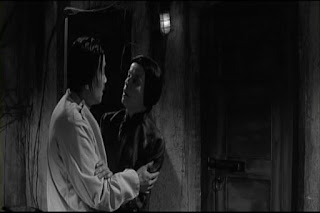
Of the Delambres' two Asian house servants, Tai and Wan (sadly, it was only until I began writing this review that I realized the significance of those two names), Tai (Burt Kwouk) is the more pleasant of the two, coming across as friendly and devoted to the family. He not only goes along with whatever they tell him to do, including helping Martin install the new equipment, without any struggle or argument but always with a smile, he also, in stark contrast to Wan, happily welcomes Pat into the family and makes no move against her. In fact, the only significant he does is near the end of the movie when he tries to stop Judith from killing Pat and he ends up killing her in the struggle. Wan (Yvette Rees, a Welsh woman who's wearing a pretty obvious makeup appliance to make her look Asian), on the other hand, is far less reliable, especially when it comes to Pat. She takes an immediate disliking to her when she shows up to the house, acting cold and hostile towards her, and the reason for it is because of an unexplained closeness she has to the mutated Judith. She goes out to the building where the mutants are kept to calm Judith down when she becomes upset upon hearing Pat playing the piano she used to play and afterward, glares at Pat when she stumbles into that section of the property while trying to hide herself from Madame Fournier and Inspector Ronet. After that, she lets Judith out and allows her to play the piano herself, only for Pat to stumble across her, prompting Wan to come up behind her and choke her out before taking Judith back to her cell. Wan later denies that anything happened, both to cover up the Delambres' secrets but also in a plan that she's come up with to drive Pat crazy by making her think she's seeing things and losing her mind (it's not clear whether bringing Judith to the piano was part of that plan or not). She amps up this plan during the third act by placing a picture of Judith before she was mutated on the nightstand by Pat's bed, removing it while she's unconscious after she knocks it to the floor, and then releases Judith to send her after Pat, provoking her rage by telling her, "She's in the bedroom... She's in
your bedroom." This plan kind of backfires on her, though, as Judith attacks Wan and throws her into the cell before heading to the house to take care of Pat. She's only released by Tai afterward and the two of them, realizing it's all falling apart, flee the house after disposing of Judith's body with the disintegrator (Tai's only moment of disloyalty, as Henri told him to remain behind to teleport Martin). While they're never seen again, Ronet puts an APB out on them right before the movie ends.

According to Inspector Charas, Martin met Judith (Mary Manson) at his university and that, before her horrible mutation, not only was she quite good-looking, as you can tell from her picture, but that she was very bright and a talented pianist. Whether she was forced to be teleported or volunteered is never made clear but, regardless, she's now completely mute, the left side of her body is hideously deformed, and the family, except for Wan and, at some points, Martin, no longer consider her to be human, locking her outside with their other human guinea pigs. Pat's appearance as Martin's new wife and the woman of the house absolutely drives Judith crazy, especially when she hears her playing the piano that she no longer can. The scene where she does try to play the piano again but can't do it well due to her deformed left hand makes her quite pitiable, especially when Pat sees her and she quickly covers the mutated side of her face in both fear and shame. However, it's apparent that Judith's mind is quite unstable now, as you can tell when she suddenly grabs and squeezes Wan's hand when she's trying to comfort her over Pat's playing, so much so that she scratches into her skin, causing her to bleed. And like I said up above, when Wan lets her out and tells her that Pat's in her bedroom, Judith's rage erupts and she attacks Wan before heading towards the house to deal with Pat. Unfortunately, the bit where she chases Pat through the house and into the laboratory is one of the film's weaker moments, as Judith is so slow thanks to her deformed left foot that it comes across like one of those old mummy movies where the victim should be able to easily evade it. They get around that by having Judith corner Pat in a hallway where both doors are locked but still, it's so clichéd to see Pat stand there, waiting for Judith to kill her, when she could easily get around her. Fortunately for her, Tai opens the door to the lab behind her, allowing her to escape, while he tries to stop Judith but when she attacks him, he's forced to kill her with a wrench.
Inspector Charas (Charles Carson) returns after having been absent from
Return of the Fly, now old, hospitalized, and apparently very sensitive to bright light as he now always wears very dark glasses. His role in the film is to do little more than to get Inspector Ronet (Jeremy Wilkins) up to speed about the Delambres and also to inform the audience about the ailments that Martin and Henri suffer from due to their grandfather's past blunders. Ronet has even less of a role than simply being a detective who gets involved with Delambres and their past due to his investigation into Pat's escape from the mental hospital. All he does is snoop around, digging up what he can on them in order to get a search warrant, and when he finally does, he shows up at the mansion at the end just in time to comfort Pat after everything that she's been through. Finally, there's Madame Fournier (Rachel Kempson), who's a little interesting in that she talks about she and everyone at the institution had been giving Pat the best treatment they could and also speaks like she is concerned for her well-being, but her monotone voice and way of reiterating the seriousness of Pat's condition in an attempt to convince the Delambres to send her back, as well as Pat's fear of her, suggest that there might be something more sinister going on that's never explained. And I apologize for the lack of images in this section but I could not, for the life of me, find any of these characters. In fact, it took me an ungodly amount of time to find that image of Tai and Wan and even it isn't ideal.
In case you haven't figured it out by now,
Curse of the Fly is definitely a contender for one of the most unusual sequels ever made, mainly because there's no fly-monster to be found here. As a result, it's inevitable for it to be compared with films like
Halloween III: Season of the Witch and
Friday the 13th Part V: A New Beginning but, in my opinion, the best comparison is with
The Curse of the Cat People, the 1944 sequel to the well-known Val Lewton film. While that film is a continuation of the story and characters of
Cat People, it goes in a completely different direction and is much more of a ghost story, rather than being another film about a person who fears they may be turning into a panther. That was done because Lewton didn't want to simply do a repeat of his earlier film and that's possibly how Robert Lippert, the uncredited producer on all three of these films, and writer Harry Spaulding felt. When you get right down to it, that kind of mix-up with a fly can only happen so many times, accidental or not, so the filmmakers probably decided that it would be best to go in a different direction, with the curse in question alluding to the horrors that have befallen the Delambre family ever since Andre's first doomed experiment. But, even as sequel, the film takes a number of liberties with its connections to its predecessors; moreover, it seems to follow the events of
The Fly, to a point, and completely ignores
Return of the Fly. In the scene where Inspector Charas tells Ronet the story of what happened to Andre, it matches up for the most part: he mentions Andre's experiments with teleportation, the disastrous experiment that the fly got caught up in (he shows Ronet a picture of a fly-man, which is actually taken from
Return of the Fly; let's not even try to get into how in the hell he got such a photo), how he thought Helene was insane when she told him the story, and how he realized the truth. However, then Charas says, "Later his son reversed the experiment and put the fly and the monster in the glass case and restored them to their original conditions." At first, I thought that maybe that was an oddly-worded reference to what happened to Philippe in the second film and how he was restored to normalcy but, when you think about it, it doesn't add up. If Andre was Martin's grandfather, then, logically, it follows that he was Henri's father, meaning that we're now in a continuity where Andre had a different son from Philippe, who was his and Helene's only child in the original, and that he apparently managed to reverse Andre's mutation. Maybe since they were unable to get Vincent Price, who was under contract to American-International Pictures and doing the Edgar Allan Poe movies with Roger Corman around this time and who acted as the one link between the two previous films, they felt they needed to rewrite the history of the series, even though I don't think it was necessary.
Plus, they still create plotholes for themselves in their revisions. They say that both Henri and Martin suffered from the cold and from bouts of rapid aging, meant to have been passed down to them from Andre due to the mixing with the fly... but, that would have to mean that Henri wasn't born until after the mutation and, what's more, if he was the one who eventually reversed it, that would have to mean he was conceived while his father was mutated. God, can you imagine Helene doing it with that fly-headed man? Even that scenario, as unsettling as it is, doesn't work because of the very short life-spans of flies and the amount of time that would have to pass for Henri to grow up and become knowledgeable enough to figure out how to make things right. Maybe that could mean that Philippe really was Henri's father and the recessive fly-genes came from him as a result of the mutation he went through but, again, that doesn't seem to be the case given what Charas says, how Philippe is never mentioned, and how Andre is referred to as Martin's "grandfather" rather than his "great-grandfather." And Albert's not having these problems is not explained at all. We're just told that he's completely normal. People complain about the science of the original film but for me, the convolutions in this story are much more maddening when you try to piece everything together.
While it's still a pretty low budget movie, I think
Curse of the Fly handles itself better than
Return of the Fly in terms of its production values. I think the laboratories look pretty good, a little more advanced and sinister-looking than the reuse of the set of Andre's lab in the previous film, and the interiors of the Delambre house, which we see a lot more of than we did Philippe's house before, and the hotel Martin and Pat stay at in Montreal look quite elegant. Normally, whenever movies back then shot outside, it ended up giving off a feeling of cheapness but the exterior shots here are actually pretty well-done. Okay, the scene where Martin and Pat have a picnic of sorts in this barren spot in the middle of a Montreal forest looks pretty cheap but, other than that, I thought the exteriors are lit very well, particularly the scenes outside the building where the mutant humans are kept, and the film looks absolutely gorgeous and atmospheric at night, with the deep blacks and the bright whites. That's another thing about the movie: its look. I think it handles the black-and-white photography a little better than
Return of the Fly did, coming across as very film noir-like at one points and creating a feel of dread and unease in sequences like when Pat hears someone playing the piano in the middle of the night and gets up to investigate. Don Sharp also manages to do some interesting things with the camerawork and editing to make the film stand out, particularly during the opening, which is shot in slow-motion, giving it a dream-like quality as you watch Pat break out of the institution and run for the gate, not to mention the shot of glass shattering and heading for the camera when she first breaks out. Other notable shots that he creates include the interior shot of Martin's car as he comes across Pat running down the road ahead, a really creepy look at one of the mutated people in his completely black cell that I'll expound upon presently, and a slowly-tilting shot from Martin's POV as he's strangled by the other mutant during their struggle.
Another thing the film has over
Return of the Fly is its tone and feel, which is nowhere near as campy. In fact, mood-wise this movie is much more along the lines of the original given how disturbing it often is, both as a result of the mutants you see and the very idea of the ongoing curse of the Delambre family, with members being affected in different ways, be it by the mutations that have been passed down to them, the horrible end results of the use of human guinea pigs, or how they simply can't rid themselves of the family's horrific legacy no matter how hard they try. What's more, the black-and-white photography not only gives it a dark, film noir look and helps create a feeling of unease and dread throughout but, when combined with the creepy science going on in the story, the fact that it was shot over in England, and the presence of Brian Donlevy, it feels a lot like those early Quatermass movies, particularly the first one (which is a disturbing story about the loss of humanity in its own right). And finally, it doesn't have any of the previous film's more pulpy elements, like the crime thriller angles and the industrial espionage, and the effects work, as we'll get into, is pulled off much more successfully. However, while the film isn't as silly as
Return of the Fly, it's not quite as entertaining, either. While it's still only 86 minutes long, it's pretty slow at times, doesn't have as quick of a pace, and the serious treatment of the subject matter makes those slower portions a little hard to sit through sometimes. Plus, the story has so many different elements to it, with Pat's story, the dilemma of the Delambres, Martin's ill-advised decision to marry Pat, the subplot involving Judith and Wan's unexplained attachment to her, Albert trying to break away from the family tradition, and Inspector Ronet's learning of the Delambres' past and attempting to get a search warrant for the property, that it sometimes buckles underneath its own weight. In short, you have to take the good with the bad when it comes to each of these two films.
The special effects makeup for the mutants was created by Harold Fletcher and he did a pretty good job in making them look hideous and disturbing, especially when given the limitations of makeup at that point in time. They're a major part of the film that make it feel much more like a Quatermass movie than anything having to do with
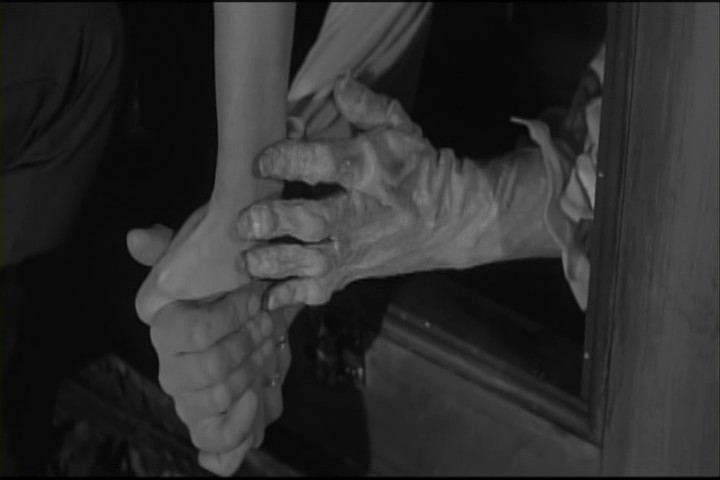
The Fly. The first mutation that we see is Martin's sudden bout of rapid aging in Montreal, where his skin is wrinkled and puffy, with a blotched texture to it. We see it again at the end of the movie when Martin has another attack and, without his serum, is eventually reduced to a skeleton after he collapses in his car. Judith's condition is gradually revealed, as we see her deformed left hand when it reaches out from within her cell and grabs ahold of Wan's wrist, twisting it painfully. The full extent of her condition is revealed later on when Pat comes across her as she's playing the piano and we see that the left side of her face is a disgusting mass of tissue, which she covers with her hand. And when Wan escorts her out of the room after she chokes Pat out, we see that her left is elongated and looks almost flipper-like, which is why she's unable to move very fast when she chases Pat later on. We first get a look at the other two mutated people, Samuels and Dill, when Pat ventures out to the cells and one of them looks at her through the window. That one, which is the big, burly man that later attacks Martin in the lab when he tries to teleport him, is pretty average-looking as far as the creatures in this film go. He just looks like a guy with a lot of clay slapped on his face, to me. The one that really freaks me out, though, is the thinner guy who you only get a look at inside his cell. His emaciated body, which you can see full-on as he's not wearing a shirt, combined with the paleness of his skin, bulbous head, and the complete darkness within his cell that he stands out from makes for quite a nightmarish image. As if that wasn't bad enough, when Samuels and Dill are teleported together, they're reintegrated as a disgusting, writhing mass of tissue that's vaguely humanoid in shape. That's what really makes me think of
The Quatermass Xperiment, as it reminds me of the monster the poor guy in that film eventually mutated into. And while we're on the subject of makeup in this film, we'd be remissed not to mention the makeup that they had to put on Yvette Rees in order to make her look Asian. While it is well-designed, when you look at it in close-up, it's very obvious that it is indeed an appliance (as if Rees' very put-on accent wasn't enough of a clue that she wasn't actually Asian).
In an interesting tradeoff, Bert Shefter, the friend of original
Fly composer Paul Sawtell who assisted him on the score for
Return of the Fly, became the sole composer for
Curse of the Fly. That said, though, he mainly reuses his friend's score for the original and only comes up with a few original pieces of music. And I'm not exaggerating when I say he reuses the entirety of Sawtell's score: you hear everything, from the main theme when the title comes up, to Andre and Helene's love theme, which is here used for the intimate scenes between Martin and Pat, and even the nightmarish piece for the fly-man's destruction of the lab when Martin begins suffering from another attack of rapid aging at the end and really starts to lose it. Shefter makes them sound a tad bit different by either slowing them down or speeding them up, depending on the piece, and he also reuses one
small part of the
Return of the Fly score, but still, there's not much music here that you haven't heard before. While it is nice to hear the themes from the original score again, something I missed in the sequel, and their presence, like the tone, is something that, surprisingly, makes the film fall more in line with the first one, it still makes you wonder why Shefter didn't just come up with something completely original. I don't want to call him lazy since, more than likely, the low budget didn't leave him much choice, but it would have been nice to hear more new stuff along with the old music. What few new themes that are here are mostly forgettable horror music and a less memorable love theme for Martin and Pat that isn't used much but he does manage to come up with a nice, poignant piano piece that's first heard during the opening credits and is reiterated a few times throughout the film. It's obviously meant to be a theme for Pat, one that harkens back to her ill-fated attempts in the past to become a great concert pianist. Pat herself plays a nice little tune on the piano in the Delambre house, albeit one that greatly upsets Judith; I don't know if it's a piece that existed before or was made specifically for the movie but it sounds nice and relaxing.

What more can you say about
Curse of the Fly? It's definitely a contender for the most unusual sequel ever and, like any movie, it has its good and bad points. On the plus side, it has a new, interesting take on the story of
The Fly, some good performances for the most part, some very well-done and unsettling mutant makeup effects, but, in contrast, the story is a tad slow and more complicated than it needs to be, it's connection with the previous films is very muddled, the music score, despite having a couple of nice, original themes, is mainly a rehash of the original's, and the different concepts and lack of a fly-monster might turn off certain viewers. Whether or not it's an improvement on
Return of the Fly depends on your tastes: if you didn't care for the second film's campiness and want more of the original's skin-crawling eeriness, you may go for this, but if you enjoyed
Return's more shlocky, B-movie feel, you'd probably find this to be plodding and boring. I myself find it to be a flawed but unique film that is a little bit underrated and should be viewed more for what it has rather than what it doesn't. But, as with everything, judge for yourself.