Saturday, May 5, 2012

Stuff I Grew Up With/Franchises: Star Wars. Star Wars (Episode IV: A New Hope) (1977)

As I said in my introduction, save for a very brief look at the cantina scene as a young kid, I never saw this original Star Wars film until I got the Special Edition trilogy on VHS for Christmas in 1997. Even though my aunt's boyfriend, who got the set for me, tried to explain the concept to me, I still didn't get why the opening crawl referred to it as Episode IV instead of Episode I. After having seen that Return of the Jedi was titled Episode VI, I was expecting this film to be made up of Episodes I-III and for The Empire Strikes Back to be Episodes IV and V in a sort of anthology, with Return of the Jedi being the one long final chapter of the saga. I was even surprised when Darth Vader showed up at the beginning because I was expecting this film to start off with how he turned to the Dark Side and then go from there. (In short, this was very, very confusing for my ten-year old mind.) In any case, my initial thoughts on this movie haven't changed all these years later: it's a good movie but it's my least favorite of the original trilogy. I do like this film a lot but, when I compare it to its successors in terms of tone and mindset it feels kind of simple. My reasons for feeling this way are more than likely due to the fact that the sequels, which delve deeper into the characters and the stories, are what I saw first, whereas this film is the one that feels the most like those Flash Gordon serials condensed down into one big movie (right down to the only possible sequel-bait being that Darth Vader is still alive at the end), which is what the entire concept was based upon. In short, it's a simple space adventure story for the most part and while that's not bad at all, mind you, I just prefer the depth of the other films.

I've heard some critics say that Episode III is the best of the four Star Wars movies that George Lucas himself actually directed but I myself strongly disagree with that. I do like Episode III but I can't deny that it has a lot of flaws; this original film, on the other hand, is much more solid in my opinion and is most definitely so when compared to Episode I and II. Granted, some of the dialogue he wrote here is kind of clunky and overly dramatic and Lucas has never been a great actors' director according to the cast, leading to aspects of the performances here and there that feel a little odd in retrospect, but what makes it work in the long run is that you have good actors who are able to overcome the hammy dialogue and less than great direction for the most part and keep you interested in the story. Also, it doesn't hurt that Lucas didn't write a bunch of sappy, overly melodramatic, attempting to be "poetic" dialogue for this film or bog the plot down with political talk as he did with the prequels or that he allowed other people to take a stab at several drafts and clean it up, something you wouldn't see very often in the future. In any case, I do know that making this movie was a miserable experience for Lucas, who had to deal with constant production and budget, problems, a British crew who wasn't too thrilled about working on what they considered to be a kids' film, and an ILM that was nothing at the time and was having a lot of trouble creating the effects needed. The exhaustion from such a stressful shoot almost caused Lucas to have a heart attack, which is why he took a more hands-off approach to the sequels. Most feel that he should have done that for the prequels but, again, we'll cross that bridge when we come to it.

Above everything else, what makes the original trilogy work is that, even though the films are very much acclaimed for their groundbreaking effects work, the effects don't overwhelm the story and likable characters, the latter of which are played by some great actors. Another thing I like is how each of the lead characters goes through a clear arc throughout the trilogy, especially Luke Skywalker. In his introduction, Mark Hamill plays Luke as an innocent, fresh-faced, naive kid who is unhappy with being stuck on a desert planet at the butt-end of the universe and dreams about going off and making something of his life. He's definitely an archetypal character in that regard but Hamill makes him so likable and identifiable that it really works. What's also interesting about Luke is that, even after he meets Obi-Wan Kenobi and he learns of the Force and his father, he's initially reluctant to take this opportunity to escape his mundane existence. It could be because deep down, he's actually scared of going off into something bigger than the small world he's known all his life but another factor is definitely because he doesn't want to leave behind his aunt and uncle, whom he does love despite the disagreements he has with them and who, he now knows, lied to him about his father. He also probably thinks that he's too insignificant to make a difference in the war against the Empire. But when he discovers that Imperial troops have destroyed his home and killed his aunt and uncle, he decides that there's nothing left on Tatooine for him now and is determined to become a Jedi and help defeat the Empire. Later in the film, he loses Obi-Wan, who has been the closest thing to a father that he's ever had, as well as his best friend Biggs during the attack on the Death Star but he quickly finds the incentive to continue the fight. (Luke experiences loss throughout the entire trilogy and, as is the case here, while he is initially downtrodden by it, he finds the will to carry on.) Another interesting thing about Luke is how the different clothes that he wears throughout the trilogy symbolize his mindset and stage of development in the individual films. Here, he wears a completely white outfit, save for the climax when he dons an X-Wing fighter uniform to attack the Death Star, meant to symbolize his young innocence and naivety, and after the Death Star battle, he's wearing a sandy brown outfit, which could symbolize that he's now a bit more mature after his first major battle against the Empire. Above everything else, Luke is a likable guy. While he longs for something bigger in his life, he doesn't obnoxiously whine about it and, what's more, his complaints are understandable. This makes you root for him, especially after his aunt and uncle are killed and he becomes determined to help defeat the Empire. You also take great pleasure in the interactions between him and Han Solo and how they eventually become friends even though their initial meeting was antagonistic. Finally, I really love his boyish enthusiasm in this film. My favorite part is when C-3PO and R2-D2 save him and the others from being crushed in the Death Star's garbage disposal unit and he exclaims loudly and happily about being saved. The only thing I wonder about Luke is why the Rebellion allowed him to be part of the attack on the Death Star. I know Obi-Wan mentions that he's become quite a good pilot but he was dead by the time they got to the Rebel base, so what convinced them that Luke would be a good asset to this mission?

Even though he's very cynical and a little prickish here, Harrison Ford manages to make Han Solo likable nonetheless. He's someone who's not at all interested in taking part in the fight against the Empire and only agrees to help Luke and Obi-Wan in their journey because they promise to pay him very well, hence his name: Han "Solo." It's all about him and his buddy Chewbacca. That could have easily made him very unlikable but Ford brings such a great, swashbuckling, tough charisma to Han that you actually do like him. Plus, you can see the developing friendship between him and Luke as they go through this adventure together. They may not like each other at first, and Han's disbelief of the Force really irritates Luke as well as his initial reluctance to help him rescue Princess Leia, but when they run into trouble on the Death Star, you can see Han starting to become more and more protective of Luke, especially when he's dragged underneath the water in the garbage disposal unit. They become so close that when he's about to leave the Rebel base with the reward, he asks Luke to come with him. Han says it's because he thinks Luke could be useful in a fight but I like to think that it's because he wants Luke around, that he's become the first friend he's ever had since Chewie. Also, Han may be wanting to save Luke from certain death since he knows that the Rebels have a slim chance at winning the battle and that the Death Star could destroy the base instantly once it's in range. Han's reluctance to once again help Luke and the Rebels and that he still seems to care only about himself is initially discouraging but Han shows that deep down, he has a loyal heart of gold when he intervenes in the attack on the Death Star and saves Luke from being blown away by Darth Vader, giving him the chance he needs to destroy the Death Star. And in the end, the Alliance realizes that he's as much to thank for the success of the mission as Luke and he's rewarded with a medal as well.

I must admit that Carrie Fisher's first performance as Princess Leia is my least favorite of the whole trilogy. While she really improved the character over the course of the films, probably due to better direction and her maturing acting chops, here, something feels off. One, there's that somewhat British accent that she puts on, which she may have felt would make her more believable as royalty but comes across as just unnatural and forced and it's a good thing she dropped it after this film (in fact, I think she may have dropped it during filming here because the accent seems to come and go throughout it). And two, I have to mention her hair-style. I know those buns are iconic but God, it's hard for me to take her seriously with those things on either side of her head, which is why I'm glad they changed her hair styles in the following films. All things considered, I do think that Fisher did a good job in her performance, making Leia come across as a determined woman who will not stop until she ends the Empire's oppression of the galaxy and her home planet in general. She's also sassy as all get-out. I love how she tells off Grand Moff Tarkin when she's brought to him aboard the Death Star, calling his bluff when he says that the Death Star will ensure the Empire's hold on the galaxy and also calls him a coward since she's surprised he had the guts to sign for her execution. When Luke comes into her cell dressed as a storm-trooper, she immediately tells him off, saying, "Aren't you a little short for a storm-trooper?" I also laugh every time when she's arguing with Han Solo after they get out of the garbage compactor, telling him that he will obey her orders and when he says that he only listens to himself, he says, "It's a wonder you're still alive." It's even funnier when she walks around Chewie, growling, "Will somebody get this big walking carpet out of my way?" and Han groans, "No reward is worth this!" Another one that makes me smirk is when Leia gets her first look at the Millennium Falcon and says to Han, "You flew in that thing? You're braver than I thought." A part of her you really have to admire is how loyal she is to the Rebel Alliance. When she's threatened with the destruction of her home planet unless she reveals the location of the Rebel base, she does seem to betray them but later, you discover that the base she led them to has been deserted for a long time. She blatantly lied, refusing to help destroy the cause she was fighting for as well as endanger her comrades. (Plus, she had good reason to lie since Tarkin ordered her home planet Alderaan to be destroyed even after she supposedly told him where the Rebel base was.) You also get the sense that she's tough and is not a damsel in distress at all. She may have needed to be rescued but she never once screams or yells, "Save me!" while they're escaping and even gets them out of a jam while they're doing so and shoots some storm-troopers herself, making it feel like she would have attempted to escape herself if she had the chance. And on top of all that, she endured the extreme torture that Darth Vader inflicted on her to get her to reveal the whereabouts of the Rebels and she never bent, even when they used something called a mind probe which would probably act as a truth serum. She's the best type of princess all-around: tough, sassy, determined, loyal, and can take care of herself.

My favorite character in the whole film is actually Obi-Wan Kenobi. I always really like this type of character: the wise, kindly, old mentor who is trying to pass his knowledge down to a younger generation. It especially helps when you have a good actor in this kind of role and Lucas and company really struck gold when they got Alec Guinness to play Obi-Wan, giving him the perfect air of kindly wisdom, spirituality, and even sly, sarcastic humor. Even though he's an old man, you know that there's much more to him than meets the eye due to his knowledge of the Force, which he introduces Luke to, as well as reveals that, despite what his uncle has told him his entire life, his own father was a Jedi Knight. As a result, even though Luke is the titular new hope for the galaxy, it is Obi-Wan who, recognizing his potential to become a Jedi, makes it known to the Rebellion. I also like how, despite being a mentor and fatherly figure to Luke, Obi-Wan does have a sense of humor and is quite a sly old devil when he wants to be. The perfect example of the latter is when he uses the power of the Force to manipulate those Imperial troops into letting them enter Mos Eisley and one quip of his that I like in particular is when Han calls him a "damn fool" and Obi-Wan responds, "Who's more foolish, the fool or the fool who follows him?" (He does have a point.) On top of everything else, the sincerity that Guinness gives his performance as well as his air of credibility really helps the movie. It makes you believe in the Force and everything that he says because he himself believes in and is so imbued with it, making it not such a surprise when he actually does become part of it after he's killed. What makes this feeling of sincerity even more amazing is that Guinness absolutely despised this film and the character in particular. He made no bones about the fact that he had a miserable time making the movie, hated the dialogue he was saying, and, supposedly, it was his idea for Obi-Wan to die so he could get out of the movie as quickly as possible (ironically, he got an Oscar nomination for this role). I've even heard that he made some young fans of Star Wars cry when he admonished them for liking it so much, which is just dickish and discouraging to hear. It is, however, nice to know that Guinness was very professional on the set of the film, helped Lucas to get everybody to take the film more seriously, and even helped Harrison Ford find an apartment when he arrived in England to film at Elstree Studios. Very commendable and is something all actors should learn from.

How could anybody not love C-3PO (Anthony Daniels) and R2-D2 (Kenny Baker)? These guys are such a great comedy duo like that they end up becoming classic in their own right and fit right in with Abbot and Costello and such. From the moment I first saw these movies as a kid, I just loved the dynamic between them: 3PO the critical, mousey, humanoid member of the duo and R2 the more child-like one that doesn't talk and yet, knows more than 3PO. 3PO is the guy who thinks he knows everything and feels that R2 is a hard-headed, confused little droid who doesn't know anything but, on the contrary, R2 has been entrusted with the plans for the Death Star and is determined to bring them to Obi-Wan Kenobi so he can take the plans to the Alliance. He's so determined that he's very secretive about it, refusing to let Luke hear the entire message when he first discovers it accidentally and actually tricks him into removing a restraining bolt so he can go hunt for Obi-Wan himself. He doesn't even let 3PO know entirely what's going on, only telling him in apparently cryptic messages given how 3PO responds to his beeps. Speaking of which, this is also the film in the saga where there is the most tension between the two robots. 3PO claims to not like R2 (even though we can tell by his actions that's not true), becomes frustrated with his secretive behavior, and is actually quite verbally and physically abusive towards him, kicking him and smacking him at several points. But, despite that, Daniels' performance is so likable overall and it's clear enough that he really does appreciate R2's company that you never grow to hate him. (Speaking of the performance, doesn't Daniels' voice sound different here than it does in the other movies? I've always felt that it had a different tone to it here, not quite as mousey and stereotypically "English servant" in its inflection.) I also like how 3PO, due to his programming, is very chatty about his functions when he's talking with Luke's uncle about buying him when they're being sold by the Jawas. He's basically being sold into slavery and yet, his programming demands that he be civil to a new would-be owner about his usefulness and you also have to like how he's determined to please Luke once he becomes their new master. Finally, I have to comment on the noises that R2 makes. Mom has always found him to be very cute, from both the way he looks to the whistles, beeps, and other childlike sounds that he makes. I myself do smile a lot when he makes some noises that sound like a kid making flatulent noises with his mouth and the whining that he makes as he rolls down that rocky path on Tatooine at sunset, where he's unknowingly being stalked by Jawas. The whistles and beeps get a bit tiring after a while but, other than that, I can't say anything bad about the little guy.
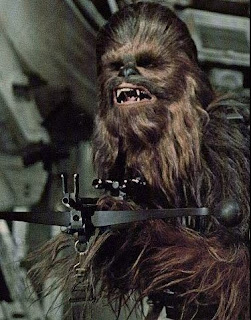
What can you say about good old Chewbacca (Peter Mayhew) that hasn't already been said? Funny thing is that when I first saw his image on the front of that Star Wars pinball machine in that Dairy Queen when I was a kid (I mentioned that in my introduction article), something about him kind of grossed me out. Maybe it was because he was so hairy and I didn't understand what he was at the time but he just rubbed me the wrong way back then.; now, of course, I love this big hairy lug like everyone else. I will say, though, that I like him more in the other films. I know it's because they just met but I don't like how hostile he is towards Luke at one point, snarling at him ferociously; I like it better in the sequels when he's like a big, teddy bear towards his friends and is only ferocious towards the bad guys. Apart from that, I do like him here as well. He's extremely loyal to Han and is like a faithful dog... just one that is seven feet tall, can work a ship, and fire weapons. He is brave for the most part but there's a weird moment where he hears an alarm after they escape from the trash compactor and runs away from it like a scared rabbit, even cowardly shaking his head when Han tells him to come back. I always found that to be kind of out of character for a big, strong creature that's normally ready to defend himself and his friends at any given moment. Another moment that I like is when Luke and Han, disguised as storm-troopers, are escorting Chewie as if he's a prisoner and one of those little droids that you often see rolling around the floor aboard Imperial ships and stations comes up to them. Chewie immediately snarls at the thing and it quickly rolls away, making a noise that sounds like it's squealing in fear, while Chewie seems very satisfied. Like that previous moment, that was odd and random but it makes me smirk. As for the sounds that he makes, while a lot of it can become grating after a while, I do like the groaning barks that he makes whenever he's discouraged or unhappy, as well as when he makes a bunch of growls in a row that sound like speech. It's pretty surreal when you see outtakes from the film and hear Peter Mayhew actually speak dialogue while in the suit, which they dubbed over with the sound effects. Mayhew's English voice saying, "That old man's mad" or something very eloquent and proper like that makes it all the more so. Is that really what he was saying? Who knew Chewie was such a sophisticated wookie? And finally, I do have a bone of contention over something that I know a lot of other people don't like: Chewie doesn't get a medal at the ceremony after the Death Star is destroyed. Why? Han may have been the captain of the Millennium Falcon but Chewie is his co-pilot and he risked his life to help win the battle as well. I always felt that was so unfair and that he got cheated. Sorry, Chewie, I guess they were afraid you'd chew up the medal or something.

Let's face it, Darth Vader was and still is one of the most bad-ass villains ever created. Some may feel that the prequels lessened his impact since you now know that he was a pretty bratty Jedi before turning to the Dark Side but I still think he's as cool as they come in these movies. Everything about him is iconic: his black armor, flowing black cape, skull-faced helmet, the flashing module on his chest, his deep breathing, and James Earl Jones' awesome voice. It's as if Lucas was doing everything he could to, if nothing else, make the villain a figure everyone would remember and he succeeded with flying colors. Speaking of James Earl Jones, I once heard him modestly say that to him, Dave Prowse is Darth Vader ,whereas he is just a special effect. I very much disagree with that sentiment. While Prowse did give Vader an imposing physical presence, Jones, to me, is the one who really created the character, with his very deep, commanding voice. It is hard to act when you can't use your facial expressions or your voice and, again, I respect what Prowse was able to do (although he did actually speak the dialogue), but it's just as hard to create a character with your voice and nothing else and therefore, I don't think Jones should be shortchanging himself so much. As for the way Vader is portrayed in this film, I know I keep repeating myself on this score but I think that he became a better character as the trilogy went on. He's still cool here but he comes across more as a brute than the chillingly calm character he would be in the following films, the next one in particular; here, he's breaking a guy's neck, throwing him against a wall, and yelling at his men to bring him prisoners in the first ten minutes of the movie. I know the reason for this is to show right off the bat that he's a guy you don't mess with and you could also argue that he's desperate to recover the plans of the Death Star but I prefer the calm intensity we got in the other movies more (but again, I saw those first, so I'm kind of biased). To me, that made you believe that all of his men were terrified of him because they knew if they displeased him, they would very likely lose their lives. In fact, none of his men seem to be that scared of him here. They follow his orders, sure, but they don't seem to cower in fear of him as much as they would in the other movies. There's even that one guy during that meeting on the Death Star who gives him shit, although he quickly learns that's not something you do. I do like that scene, though, because it shows that Vader doesn't even have to touch you to take you out and maybe that's when his men began to realize that he is a force to be reckoned with. For me, the only time you sort of see that fear in this movie is when Vader first appears and the storm-troopers stand very still as he walks through the door into the ship. They could be scared but, at the same time, they also could be simply respecting their leader. In addition, don't think Jones' voice is as intimidating here as it would become, feeling like he's playing it much more straightforward and to the point. Finally, one thing that's always driven me nuts about Vader is how his breathing is not in sync with his talking. There are so many times throughout the movies where he talks and breaths at the same time and it's always sort of irked me. I've tried to rationalize it and say that the sound you hear is of the oxygen escaping his tank but it's clearly his breathing because you hear him take a breath before he exhales. It's a nitpick but I wish they had tried harder to make it sync up in the editing. I know it sounds like I don't really like Vader in this movie but, trust me, I don't; I just have to be honest about things.

Just as menacing as Vader is Peter Cushing as Grand Moff Tarkin, the commander of the Death Star. In fact, I think he's the reason why it doesn't feel like Vader has the amount of power in this film as he would later on. Tarkin is the one who feels like the man in charge here whereas Vader is just his enforcer, with Leia even commenting that he's holding Vader's leash. Thinking about it, Tarkin is also the only character apart from the Emperor that Vader does obey, however with the Emperor it's because he is his master whereas with Tarkin, it's probably because he has to. In any case, despite Cushing's age and poor physical condition at the time, he gives Tarkin such a presence that he is an awesome villain in his own right. He's not at all intimidated by Vader and firmly orders him to release that impertinent guy whom he Force-chokes. He's very determined to stomp out the Rebel Alliance and will do whatever he can to achieve his goal. I love his wit, which is something that Cushing always played very well. That exchange of dialogue between him and Leia, where he says, "Charming to the last," after she says that she recognized his foul stench as soon as she was brought aboard the Death Star, is just awesome. As cruel as he is, you have to love how he pays no attention to Leia's insults and knows presicely how to back her down by threatening her home planet. He's also so slimy in that he says he'll destroy Alderaan unless she tells him where the Rebel base is and then decides to destroy it anyway even after she supposedly tells him. I've always felt that to be so evil. Killing a person's loved ones is one thing but destroying their very planet? What Tarkin says about it makes it feel even more cruel: Alderaan must be destroyed to make the other planets know that they mean business whereas the planet she says the base is on is too remote to be effective in that regard. (He also says, "You may fire when ready" very well, in my opinion.) Despite how unforgettable and despicable a bad guy he is, Tarkin's weakness is that he's far too overconfident in his methods. He's very sure Leia told him the truth about the location of the Rebel base and is then outraged when he discovers that she lied to him, with Vader proving he knows more than Tarkin, telling him, "I told you she would never willingly betray the Rebellion." But it's his confidence in the Death Star itself that ultimately gets him killed. He doesn't believe for a millisecond that the Rebels could possibly destroy the enormous station and therefore, refuses to leave even when a soldier tells him that there is a possible danger in what they're doing, resulting in him getting blown to smithereens along with the station. I liked him so much that I kind of wish that he had been in the other movies but now that I think about it, if he had lived, Vader would have probably never been able to really take charge and become as iconic and legendary as he is.

There are some other minor characters that I have to mention, particularly Luke's Uncle Owen (Phil Brown) and Aunt Beru (Shelagh Fraser), whom I do like. They're not in the movie for very long and Uncle Own is the only one that leaves much of an impression but I think they're very important in the long run. Aunt Beru, with what little scenes she has, comes across as warm and loving, whereas Uncle Owen is more strict and stern, constantly making excuses for why Luke needs to stick around on the farm and not go off to join a nearby military academy so he can become a pilot. Beru understands that Luke just isn't a farmer and wants adventure, especially since most of his friends have already joined the academy, whereas Owen hopes that desire will subside with time. One moment with them that has an even greater impact when you look at the whole trilogy, as well as the entire saga, in retrospect is the when Beru says that Luke has too much of his father in him and Owen says, "That's what I'm afraid." Once you learn the truth about Luke's father in the other movies, you know exactly why Owen is trying to keep him on the farm and it also makes Owen more sympathetic despite his stern nature. Speaking of which, I've always found his and Beru's deaths to be very upsetting. Just the image of Luke finding their charred skeletons got to me as a kid and it still does to this day (I'm surprised this movie was able to get by with a PG-rating because that scene is pretty horrific). I think the music that plays here also helps in its power, amplifying the feeling that Luke has lost the only parental figures he's ever known. I also want to quickly mention Luke's friend, Biggs (Garrick Hagon). He doesn't show up until right before the climactic battle with the Death Star but you hear Luke mention him long beforehand and the way they greet each other is a sign of a real friendship (there was supposed to be more development for their friendship since there was a deleted scene where Luke meets up with him in town on Tatooine). There's also a bit of a sense that Biggs is one of the main reasons why Luke is desperate to leave Tatooine: besides his want for adventure, his best buddy has left and he wants to be with him. Biggs also just comes across as a really nice guy and a good pal, like the type of guy who would be like, "What's up, man?!" As a result, I feel for Luke when Biggs gets killed during the battle, with Luke now having no piece of his former, more innocent life left.

It's amazing that this movie's budget was only $11 million because it looks like it was made for at least twice that much, especially in terms of its special effects, which this movie won a much-deserved Oscar. For effects created by a studio (ILM) that was little more than a warehouse in 1977 with only $11 million, they're unreal and deserve the praise that they still get. That famous opening shot of the Star Destroyer passing over the camera as it chases Princess Leia's ship I know wowed audiences back in the day and it's still breathtaking to know that it was done purely with models. All the ships, from the Star Destroyers and the TIE fighters to the Millennium Falcon and the X-Wings are classic for a reason: they look cool and move in a very convincing manner. The Death Star I especially thought was cool when I was a kid and the scene where it blows up Alderaan looks amazing. The final battle at the Death Star is also a great setpiece and has some of the best modelwork ever, which is to say nothing of the matting process used for this and all of the space scenes. It really does feel like you're out in deep space in those scenes, with no sign at all of any black-felt backdrops or plastic planets and asteroids. It works well in other scenes like when R2 projects that image of Princess Leia in front of Luke and 3PO and when you see how deep the tractor beam core goes down inside the Death Star. And since I'm a fan of stop-motion animation monster movies, I always smile at that little hologram chess game that R2 and Chewie play aboard the Millennium Falcon. Of course, you have to mention the introduction of the lightsaber, even though they're where I feel you can see some weaknesses in the effects. They used rotoscoping to put the glowing blades into the film but you can tell that they weren't always successful with it. For example, during Obi-Wan's fight with Darth Vader, there are instances where you can see the thin stick with a little light on the end of it that they would superimpose the blade over, a mistake I don't think they ever made again as they got more skilled at what they were doing. Also, the color of the blue lightsaber in this movie never really grabbed me. This is merely a personal preference because blue is my favorite color and I like the deep blue-colored lightsabers you would see in the later films but I never liked the light blue seen here. Plus, they can't seem to keep the color consistent because when Luke is practicing with that hovering ball aboard the Millennium Falcon, the blade of the saber is purely white. Again, I know it's a nitpick but I do notice little things like that.

Another reason why it's hard to grasp the fact that this film's budget was fairly low are the sets. Lucas made very good use of the spacious sets of Elstree Studios in London. The interior of Princess Leia's ship is pretty good but the best set I think is the inside of the Death Star. I always felt that it really did look like a functioning station, with its long corridors full of troops, an enormous hangar bay, a lot of control rooms and prisoner cells, that garbage compactor unit that looks absolutely filthy with all of the thrown away bits of machinery and the nasty-looking water (I guess it's just a personal thing but water mixed with garbage always makes me cringe), and, my favorite part of the set, the room that has the controls to the tractor beam. That just looks awesome when Obi-Wan walks across that little bridge to turn off the beam and you can see that the core goes down for miles. Like I said earlier, that's a really good matting effect there. Speaking of the interiors of the film, I have to comment on the concept of a "used" future. Everybody credits Alien with introducing the notion of a future where the ships and the interiors aren't squeaky clean and polished like in Star Trek and 2001: A Space Odyssey but if you think about it, Star Wars is really the first film to play with that idea, with the interior of the Mos Eisley cantina looking pretty dirty and Luke commenting that the Millennium Falcon is a piece junk. He's right in some ways because the thing doesn't work sometimes, it's slow, and the inside of it looks like it's a scene a lot of action. C-3PO and R2-D2 aren't exactly polished either and the aforementioned garbage chute in the Death Star is something you never see in those others science fiction stories I mentioned.. There's only one major exterior in the film, the landscape of Tunisia for the planet of Tatooine, but like the interiors, it's used very effectively. You can tell that Tatooine is a harsh place to live just looking at it. It's desolate, hot as hell (filming in Tunisia was miserable because it can get up to over 100 degrees there by midday), and when 3PO and R2 are roaming around the desert, even though they're machines, you just get the feeling that they are screwed if they don't find shelter soon. It also provides that iconic shot of Luke watching the twin suns set, which I've always enjoyed the visual of (I like sunsets in general). This is also where the western aspect of the film comes across. While the sandy dunes and the clothing worn by Luke and his aunt and uncle make it feel more like Lawrence of Arabia (another Alec Guinness movie, oddly enough), the more rocky parts of the desert are where the western idea starts to come across. Mos Eisley in particular is where it's hammered home because it feels like the outpost town you see in a lot of westerns, with the cantina being like a saloon, Han Solo and some of the residents coming across like old-fashioned gunslingers, and the standoff between him and Greedo feeling like something you'd see in a western.

You can't talk about the Star Wars universe without discussing the varied types of alien creatures and robots that you're introduced to in each of the films. The first actual characters that you meet are C-3PO and R2-D2 and after that, you see the Imperial storm-troopers, who look like robots (or "droids," as they're called) due to their armor, and Darth Vader, who is basically is a cyborg since he's a human being with a number of electronic parts attached to him. I like the different droids that you see when 3PO and R2 are captured by the Jawas, such as one with an insect-like head, a different model R2-unit, one that looks like a refrigerator with a pair of stubby legs (he's called a Gonk droid, which makes sense given how all he says is, "Gonk! Gonk!"), and this other one that's off to the side and looks like it has insect-like wings on either side of it (that one creeped me out when I was a kid). Speaking of the Jawas, I've always laughed at those guys. They just look so funny to me with their hoods, glowing eyes, how they scurry around like rats, and especially those gibberish noises they make, particularly when there are two chattering to each other. And that, "Unteenee!" yell they make never fails to cause me to smirk either. As for the Tusken Raiders, I don't know if those things are wild humans or what (probably not from the sounds they make) but that scene when one comes out of nowhere and tries to kill Luke while howling like the freak he is really horrified me when I was a kid. Not much to say about the Bantha creatures they ride on, although I think it's cool that they're really elephants that the crew dressed up. While we're on the subject of the Tusken Raiders, or the sand-people as Luke calls them, one part that always confused me is when Luke is watching two Banthas with his binoculars and at first, he says he doesn't see any sand-people but then goes, "I can see one of them now." Where? Of the many times I've watched this movie, I've never seen any sand-people in that shot. Maybe it's just me but has anybody else seen them? When I was a little kid, I thought that the dewbacks that the storm-troopers ride were cool because they look kind of dinosaurs but now, after realizing how bad the computer-generated ones for the Special Edition look, I'm not as enamored with them anymore. Speaking of creatures that exist only in the special edition, there are also these little rats that scurry out of the way of Luke's speeder when he enters Mos Eisley with the others and there's also this gigantic, giraffe-like thing that's startled by a speeder bike, causing the Jawa that's riding it to fall off and end up hanging by the reigns. I know the purpose of these creatures was to give more life to Mos Eisley but they're really not needed (especially that little hovering droid that annoyed this human-like one so much that it smacked it).

The inside of the cantina is the film's, and perhaps the entire saga's, most famous scene for displaying all sorts of alien creatures. It's interesting to note that, before they became well known for their makeup effects work, Rick Baker and Rob Bottin worked on some of the creatures in this scene, which explains why they're quite striking in their appearance (some of them really freaked me out as a kid, I must say). You have that typical-looking alien that looks right into the camera at the start, those creatures that are playing music (I always thought those guys looked cool), that white, furry thing with a bunch of eyes and a little proboscis tongue that it strokes, this thing with a hammerhead, a mouse-girl (as Harrison Ford called it) ordering a drink, these two creatures that are having a conversation, a reptile-thing that has a honking laugh, this ugly thing with pink flaps of flesh under his chin that picks a fight with Luke and gets his arm sliced off by Obi-Wan, and, of course, Greedo, who's only in this movie for a few minutes and yet, little did they know back in 1977 that he'd be forever linked to one of the special editions' biggest controversies (I'll talk about that presently). Even the humans in the bar look weird, like that bartender with a big nose and that ugly as sin guy with a crushed nose who picks on Luke right after his alien friend does. Due to behind the scenes footage, I know that there was a big praying mantis in that scene too but you never see it in the actual film, probably because it looked rather stupid, and I've also seen a shot of a werewolf-like creature that you don't see in the special editions, which is too bad because it looked interesting to me. I also have to comment on this creature that acts as a spy for the Empire and follows Luke and Obi-Wan to the Millennium Falcon. He wears goggles and has a long snout but what gets me is that he talks with a sound that you would hear when you scratch a disc like a disc jockey. Definitely different, I'll give them that.

There's also some weird stuff aboard the Death Star. There are those little droids that roll around the hallways that I talked about before. I still don't get what purpose those things serve. The one droid that would be my worst nightmare is that floating one with a syringe that Darth Vader uses to make Princess Leia tell him where the Rebel base is. As I said earlier, I guess it's a mind probe thing and that syringe is filled with something like a truth serum but whatever the case, I must say that if that were me, I would have shriveled the minute I saw that thing since I hated needles as a kid and even today, although I can take it, I'm not a big fan of them. Princess Leia is a stronger person than I am because I would have cracked the minute Vader came at me with that thing. Finally, I have to mention that bizarre, squid-like creature that attacks the gang when they're stuck in the garbage chute. As I said in the introduction, by the time I first saw this movie, I had already played Star Wars: Shadows of the Empire and as a result, I knew that this creature was called a dianoga since there's a level in that game where you have to deal with them. You don't see the entire creature here save for a red eye on a hideous stalk and a tentacle that looks like that of an octopus that grabs Luke, but that helps to make it an all the more suspenseful scene and the idea behind its function is creepy when you think about it. You know the Imperial controllers no doubt let the creature loose on them because they knew they were in the garbage chute and the thought that they keep this thing around just in case something living gets down into the chute, intentionally or otherwise, is rather unnerving. They might also keep it starved so when they let it loose, it attacks them voraciously. In addition, it seems at first like the water in that chute isn't even knee-deep but the dianoga pulls Luke down and Han is unable to find him as he shifts his hand through the water, with Luke only managing to get free when it lets him go. Judging from the loud clanging you hear, the dianoga must have an opening where it can enter in and out of the room and again, if you think about it, the reason Han couldn't find Luke is probably because it was trying to drag him back into the chamber where it's kept so it could eat him. There's another creepy thought for you.

While the later Star Wars movies, particularly the prequels, would become well-known for their large and intricate action sequences, the original is a bit light on it. There's the opening with the Star Destroyer attacking Princess Leia's ship and its boarding by Darth Vader and his troops but that ends rather quickly; a brief scuffle between Luke and a Tusken Raider as well as the scuffles in the Mos Eisley cantina but again, they're very brief; the escape of the Millennium Falcon from Tatooine where they're being pursued by Imperial fighters but ultimately, they manage to jump to lightspeed before the attack gets very severe; and Obi-Wan and Darth Vader's little lightsaber fight in a hallway in the Death Star but it's also not much to write home about. There are really only three major action setpieces in the film. First, there's by Luke, Han, Chewie, and Leia's struggle to escape the Death Star, which is where the movie becomes the most like a Flash Gordon-type of serial filled cliffhangers. They continuously run into one tight spot after another and have to fight their way out, be it by escaping down the garbage chute when they're cornered in one hallway or splitting up into pairs in order to escape another ambush, which is my favorite part of this section of the movie. I always laugh when Han and Chewie chase after some storm-troopers with Han yelling like a maniac, only for it to change into a cry of terror when he runs into a room filled with troopers (this is an instance where I think the special edition made it better, with the room now being filled to the brim with troopers instead of just a few as in the original). I also laugh at the moment right after that when they're being pursued by the troopers, with one saying, "Close the blast doors!", but whe Han and Chewie manage to get through the door before it closes, locking the troopers out, that same trooper is now yelling, "Open the blast doors! Open the blast doors!" Another good moment is when Luke and Leia are also being pursued and have to find a way to get across a chasm since Luke, in his haste, blasted the controls to extend the bridge to keep the guards. This is where Leia gets to prove how tough she is as she covers Luke, firing at attacking storm-troopers on the other side of the chasm, while he gets the wire ready in order to swing over it (said swing is definitely something that's right out of an adventure serial). The second big action scene is when they manage to get aboard the Millennium Falcon and escape the Death Star but are pursued by a small squadron of TIE fighters. This was another scene that was featured in a commercial I saw when I was a kid and it's a pretty good one, albeit limited to constant cutting back between the outside of the Falcon and the interiors as Luke and Han gun down the fighters. This is where the classic exchange between Luke and Han occurs: "I got him!" "Great kid, but don't get cocky!" I wonder if many catch that Han had yelled excitedly because he destroyed a fighter right before Luke did and he was now being kind of a hypocrite?

The biggest setpiece is the climactic attack on the Death Star and it's the best scene in the movie by far. It's such a great, exciting setpiece, with impressive model work, great interplay between the various pilots, and the iconic line, "Use the Force, Luke!" It also works in a dramatic sense because you can feel how desperate the situation is getting as the battle progresses, with more and more X-Wings being shot down and  the first attempt to send a proton torpedo into the core of the Death Star fails miserably. The impact of the pilots' deaths really hit me when I was a kid, especially since I had seen similar scenes in other films and TV shows and had played a lot of video games such as Star Fox 64 where the gameplay is similar to what you'd see in this scene but I had never before given much serious thought to all of the aircrafts being shot down because in every previous instance, they were either piloted by robots or you simply didn't get any indication of a living character dying in the crash. The many shots of the X-Wing pilots screaming right before their ships are destroyed were something I hadn't seen before and while it didn't traumatize me, mind you, it did give me pause, especially when even poor R2 is fried in the battle, which must have made people back in '77 gasp loudly. This scene also shows that, unlike most evil villains in these types of movies, Darth Vader isn't content with sitting around and letting his men do all the work; he actually gets into his own TIE Fighter and takes part in the battle, gunning down quite a few X-Wings in his own right, which is something I like in a villain. Finally, as I said before, the end of the battle and the ending of the film itself leaves no indication that there would be any follow-ups. Other than Vader not being killed, everything is wrapped up nicely: the Death Star is destroyed, the Empire has been dealt a major blow and possibly even crushed, and the Rebel Alliance has been saved. If there had been no more movies, I don't think anyone would have been surprised. Of course, that wasn't the case.

Along with the actors and characters, the story, and the effects, it's also hard to imagine Star Wars without John Williams' iconic music. Oddly, that is almost how it happened. Lucas at first intended to go the route that Stanley Kubrick had with 2001: A Space Odyssey and use classical music for the score when Steven Spielberg encouraged him to use Williams since Spielberg had worked with several times before on flicks like Jaws and Close Encounters of the Third Kind. Like the film itself, it's hard talking about this score because everybody knows it: the iconic opening theme (whose first note sounds a bit different here than in the other films); Luke's theme (my favorite version of this piece as well as my favorite part of the entire score occurs when he's looking at the two setting suns of Tatooine after having an argument with his uncle and I also mentioned the powerful somber version of it when Luke discovers his aunt and uncle's slaughtered bodies), Leia's romantic-sounding theme with its leitmotifs, the music for the action scenes, and so on. I also like how Williams knows when to hold back, such as during the Death Star battle where there's not much music for the most part, the sound effects and dialogue driving the drama. Only when the leader of the squadron is killed does the music, which now has an urgent sound to it, make an appearance. The only musical bit that I miss in hindsight since it wasn't introduced until the next film is the awesome Imperial March: here, the Imperials just have a theme that goes, "Dun, dun dun dun!" that doesn't have nearly the same impact. Just as important to the movie as the music are the sound effects and a lot of them are also classic, like Vader's breathing, the sound of the blasters, the humming and crackling of the lightsabers, the roar of the TIE Fighters (which I know I've heard in other films and TV shows), Chewbacca's roaring and growling, R2's beeps, boops, and whistles, and so on. I also recognized sounds I've heard in other stuff when I first watched the movie in 1997, like this weird gurgling noise in the garbage chute and the screams of the dewbacks, the latter of which was also part of the cry Obi-Wan makes when he scares away the Tusken Raiders when they're attacking Luke. Speaking of that scream, it seems like Lucas is never satisfied with that sound because he changes it every time he puts the movie out. First it was that sound I had heard in Hanna-Barbera action cartoons, then in the 2004 DVD release it was just this weird, electronic-sounding screech, and the 2011 Blu-Ray release had the worst of all: a noise that sounds like Obi-Wan is crapping and barfing at the same time. I don't know why Lucas can't settle on a sound for that moment and just makes it more and more stupid each time.

Now let's talk about the changes made to the film in the special editions. Most of them are pretty inconsequential and do improve the film in my mind, such as the added ring of fire when the Death Star explodes, the shots of the X-Wings actually flying out of the Rebel base instead of blurry shapes flying quickly into space, the added, detailed shot of them approaching the Death Star, the digital shot of the Millennium Falcon flying out of Mos Eisley, the fixing of odd effects such as those that were originally present on Luke's Tatooine speeder, and the scene aboard the Death Star involving Han, Chewie, and storm-troopers that I mentioned earlier. There are others, however, that I do agree are completely unnecessary, such as the shots of storm-troopers riding on dewbacks on Tatooine, which added nothing and like I said before, the CGI dewbacks aren't that impressive at all. The same goes for that stupid scream that Obi-Wan makes in the Blu-Ray edition and the expansion of Mos Eisley and the new, digital creatures that I mentioned earlier (speaking of which, does that moment between those two droids not feel like something you'd see in Episode I?) I respect Lucas' desire to have Mos Eisley feel more open with more inhabitants running around but that added stuff wasn't necessary and just looks silly. Of course, that's nothing compared to the two most controversial changes to the film that occur in this section. First, there's the altered confrontation between Han and Greedo. Lucas grew to feel that Han just out and out blasting Greedo in the original version made him look like a cold-blooded killer, so he altered the scene by having Greedo shoot first and Han reacts by quickly dodging the shot and then killing him. When I first saw this as a kid, I thought it looked cool because Han seemed to have super-fast reflexes but, when I was able to slow the action down and really look at it on DVD later, I realized how awkward and stupid the effect looks. On top of everything else, Lucas' feelings weren't accurate to me. For one, the original, unaltered scene makes Han look more like a bad-ass rather than a cold-blooded killer. Let's not forget that he's a smuggler and, like I said earlier, is dressed like a wild west gunslinger, so he shouldn't be someone you should mess with. For another, it's not like Han killed him for no good reason. Greedo was the one holding Han at gunpoint and was talking like he was about ready to kill him himself so, in either case, Han was defending himself. And finally, I find it odd for Lucas to rationalize that change the way he did and then put a lot of decapitations into the prequels, especially Episode III. What, it's okay for Yoda to behead two clone troopers at once but Han can't blast some guy who's holding him at gunpoint, even though Yoda was defending himself like Han? Really weird priorities, Mr. Lucas.

The other major change is the scene outside the Millennium Falcon with Han and the CGI Jabba the Hutt. As Gary Kurtz mentioned in The People vs. George Lucas, there's a good narrative why this scene was deleted from the original release in addition to the issues with the limited technology of the time: it's repetitive. We already learned from Greedo that Jabba is angry with Han and, what's more, at points the dialogue between Han and Jabba is practically the same as the exchanges between him and Greedo earlier. It also doesn't help that in the 1997 edition, the CGI Jabba looked really bad. He didn't look close to how he was in Return of the Jedi and, in fact, he looked rather... gay, with his hands constantly on his sides and the weird way his face was designed. Lucas must have realized how bad he looked because he did improve his design for the 2004 DVD release. What he didn't change, though, is how Jabba comes across as a total wimp, screaming like a bitch when Han steps on his tail, something you'd never expect the real Jabba to do, and how he appears smaller here than he would in his real first appearance. Ultimately, I would say that, the beneficial editions aside, the original Star Wars is the entry in the original trilogy that has suffered the most from the special editions (although, I personally don't think any of these changes are the absolute worst, which we'll get to later on down the road).

At the end of the day, the original Star Wars does deserve its classic status in my opinion. It introduced us to that galaxy far, far away and gave us a legendary story, unquestionably beloved characters played by good actors, unforgettable scenes and settings, and iconic music and sound effects. But, all that said, it's still my least favorite of the original trilogy due to the fact that I first saw The Empire Strikes Back and Return of the Jedi, which are more dramatic and emotionally deeper, whereas this feels like a simple, space adventure story like the Flash Gordon serials it's based on. Nothing wrong with that but I still prefer the other entries in the original trilogy more. So, I guess you could say I like where the series went more than where it actually originated from. But, again, I don't hate this original film at all: it's a very fun two hours and I can totally understand why it became such a phenomenon back in '77.

Tuesday, May 1, 2012

Star Wars: An Introduction

Just looking at that title, you're probably wondering why I'm even bothering with an introduction to this because, let's face it, Star Wars doesn't, or rather shouldn't, need one: it's the very definition of a modern day myth. Everybody has either seen or at least heard of the movies and know of the characters, the story, etc. It's penetrated the popular culture in ways that few movies could ever hope to; in fact, I would go as far as to say that it has created its own culture, much like other franchises such as Star Trek, Lord of the Rings, Harry Potter, and such, since aside from the movies, there are tons of books, comics, video games and so on to introduce newcomers to the saga as well as expand on it endlessly. In short, the Force really does bind us. So why am I giving it an introduction? I'm not. I'm giving my introduction to it. Some franchises are just such a phenomenon that they go far beyond their original source and so, I feel I must give my introduction to said phenomenon in general. Here, I'm going to talk about how I first became a fan of Star Wars, what I think of the phenomenon and the fans, how I feel about George Lucas, and so on. Let's begin.

Star Wars was one of those things that I was vaguely aware of when I was a very young kid but I didn't know exactly what it was. I can't remember which I saw first but my first introduction to it was either this pinball machine at this Dairy Queen near my aunt's house or some commercials I saw that may have been advertizing the original trilogy's release on VHS or something. I also remember an advertizement for a puzzle game that featured clips from the original film and I caught a brief, and I mean brief, look at the original film on TV one day. It was during the cantina scene of all things and so, right off the bat my young eyes got a look at some of the weird creatures to be found in this franchise, some of the strangest things that I had ever seen up to that point. So when I was a kid, I was definitely aware of it. I didn't know what Jedi were or what the Force was or anything like that but I vaguely knew about the characters, like Luke Skywalker and such. I definitely knew about Darth Vader (whom I called "Dark" Vader for the longest time) because those commercials I saw had clips of him with his iconic heavy breathing and James Earl Jones' booming voice. There were also these Energizer commercials where Vader confronts the Energizer Bunny but the batteries in his lightsaber run out before he can kill him and he yells in anger. (Speaking of Vader, before I saw The Empire Strikes Back, Mom had already told me that Vader was Luke's father. Yeah, Mom didn't know anything about spoiler alerts back in the day.) I also got the idea that Star Wars was actually a TV show instead of a film series, and before you say that my young mind got it mixed up with Star Trek, I want to make it clear that I did also know about that. I just figured that Star Wars was a show as well and it wasn't until the special editions were released in 1997 that I began to understand that they were movies. Speaking of which, that year was also when I really became a fan, starting with my playing the Nintendo 64 game, Star Wars: Shadows of the Empire. The game was quite difficult but I enjoyed playing it nevertheless. I actually thought it was based on one of the movies but I found out that the first stage, the ice battle on Hoth, was the only part that was so. In any case, due to that game and some comics based on it that Nintendo Power started publishing in their magazines, I was already sort of a fan of Star Wars and if fate hadn't intervened, I would have just left it at that without ever having seen the movies. However, that was not the case.

It was on one Sunday when I was ten years old that I actually watched the Star Wars movies, or two of them anyway, for the first time. They were playing on USA and I'm pretty sure that this was after the special editions had finished their theatrical run by this point, although these were the original versions that I saw. The first one I watched a significant portion of was The Empire Strikes Back. Mom was through flipping the channels and came upon it about halfway in, at the scene where Han Solo seduces Princess Leia when the Millennium Falcon is broken down inside that asteroid. She and I, as well as a visiting cousin of mine, watched the rest of it (well, my cousin and I kept playing in-between and missed some of it but we eventually stopped what we were doing and watched the rest of the flick). Funny thing is that my cousin wasn't a Star Wars fan in the least but when he actually watched some of it, he changed his tune (although he now tries to say that he's never liked it but I just roll my eyes because I know that he's full of crap on that). Return of the Jedi was on next, making it the first one I saw all the way through. My cousin eventually went home and even though the movie's running time was going on past 10:00pm and I had school the next day, my mom allowed me to stay up and watch the whole thing. It was an experience that I would never forget and after it, there was no going back. I was now a Star Wars fan. I never got absolutely obsessed with it as a lot of people do but I did become quite a lover of it. That Christmas, I got the special edition trilogy in a VHS boxset, my own personal copy of the Shadows of the Empire game (I had rented it before then), a lot of toys (most notably a big AT-AT model that is still sitting in the same room me as I write this, as well as all of the other stuff that I got), and I also eventually read a few of the books in the expanded universe.

As has been the case with a lot of things, after a while, my love for Star Wars cooled down a bit. It was not because of the prequels or because of George Lucas' constant tinkering with the original trilogy or even because I went through a film snob phase: it was just because I entered high school and college later on and so, a lot of things took a backseat because I had much more important stuff to concern myself with. I still liked the movies quite a bit, having bought the DVD boxset when it came out, continued playing a lot of the video games, and went to see Episode III: Revenge of the Sith at the theater, but I never, and I still haven't, gone back to being as huge of a fan of it as I was when I was a kid. I still like the saga quite a bit and I'm not ashamed that I was once an uber-fan of it (though, again, not as much as a lot of people) but it's a more laid-back appreciation of it now than being a big fanboy.

Speaking of that appreciation, Star Wars is one of those things that, when you're a kid, you simply find to be cool but when you get older and more mature, you admire what it really stands for. As I said, it really is a modern day myth, one that incorporates so much of folklore, popular culture, classic writings, scripture, and so forth. At its basis, it is a tribute to the Flash Gordon serials, just as the Indiana Jones movies are for the classic adventure serials of the same era, with the opening crawling text and the basic plot but there's a lot more to it than that. It's an epic hero's journey, taking elements from classic like The Odyssey and The Iliad; the setting of Tatooine for most of the original film is very much like a western, with Mos Eisley being similar to those remote outposts you see in those movies, and the scene where Luke discovers that his aunt and uncle have been slaughtered has similarities to a moment from The Searchers; there are a lot of references to Gothic horror, particularly Hammer Studios since alumni like Peter Cushing, Christopher Lee, and Dave Prowse had significant roles in various parts of the saga; and there's even parallels to actual history and real-world politics, with the Galactic Empire coming across as very fascist and brutal, not unlike how certain countries have been throughout history. If you want more insight into this aspect of Star Wars, watch the documentary Star Wars: The Legacy Revealed (which is truly excellent, I might add) or the first part of James Rolfe's overview of the saga because they do it far, far better than I could ever hope to. Basically what I'm trying to get across is that Star Wars is an incredible amalgamation of old ideas, concepts, and themes put into the setting of a science fiction fairy tale. As James Rolfe himself said, it truly is everything!

Now let's talk about the man behind the Force, George Lucas. He's truly an interesting figure in that I don't think I have ever seen anyone build up so loyal and loving a fanbase and then turn it completely against him in the way that he has. Let's start with his constant tinkering with the original trilogy and how he refuses to release the unaltered versions of it on DVD or Blu-Ray in any good form. I'm a bit biased on this issue because the version of the trilogy that I grew up with was the 1997 Special Edition. I only saw half of the unaltered version The Empire Strikes Back and Return of the Jedi I only saw twice in its original form so they didn't leave much of an impression (I've never even seen the unaltered version of the original film). Obviously, when I was ten, I was still a little too young to understand that what I was watching was not what a generation before me had seen but now, of course, I do get it. From everything I'ved read and seen, the bottom line is that Lucas never felt that the original trilogy was completed the way he wished it could have been, so he decided to go back and add stuff that he was unable to do because of money and time constraints and limited technology. Therefore, in his eyes, the special editions are the original trilogy and the unaltered versions are more like failed first attempts that he's trying to correct. I do think that since they're his films, he has every right to alter them however he sees fit but, that said, I do think that he's being a major prick by not allowing the fans who grew up with the unaltered original trilogy to continue to enjoy it. Directors make new edits of their films all the time now, like Ridley Scott with the many versions of Blade Runner and Steven Spielberg with the 2002 Special Edition of E.T., but they at least have the insight to know that there are many fans of the original versions and so, they give you the option to watch whichever version you choose; Lucas, on the other hand, is basically smacking the fans' hands away from the unaltered original trilogy and saying, "These special editions are the only you're going to be able to watch these movies so you better get used to it!", which is very narcissistic and stupid of him to do. An even bigger middle finger to the fans was that he did, in fact, release the unaltered original trilogy on DVD but they were ports from a laser disc that weren't remastered, weren't anamorphic, and were relegated to just being a bonus feature. That is just unacceptable. And even though I feel that it is his right to alter the original trilogy however he sees fit, I can't help but wonder why he does so every time he brings it out on a new format. What exactly is he trying to compensate for? I know he's probably still not satisfied with those films but I doubt that it's fixing anything by going back to them again and again. While I myself am updating these older reviews that I've done, I'm not going to keep going back to them and messing with them, especially since there are some that I thought weren't that good but I got good feedback on nevertheless. You just don't know what people are going to gravitate to and you should just let them judge for themselves instead of trying to force what you think they should like onto them.

I also can't deny that Lucas has gone from being a filmmaker to a businessman over the years. Once upon a time, he genuinely wanted to make movies but, after Star Wars, he never directed anything ever again save for the prequels. Even more so, he's become fully committed to ringing every last dollar out of Star Wars that he can. He said that after Episode III: Revenge of the Sith, he was going to devote himself solely to more artsy films, with Mark Hamill commenting in an interview that Lucas now has the ability to make exactly the movie he wants to make. So... where are those artsy, independent movies that he can make exactly how he wishes? They never came to pass. Instead, he's still trying to milk Star Wars for all it's worth, from the countless toys and merchandizing tie-ins, to the CGI Clone Wars movie and TV show (the latter of which I've heard is good but I've never seen it), to the scrapped re-releasing of the entire saga in 3-D, selling it to Disney while still trying to butt in, and so on. I like that Lucas himself even admitted that he has become the head of a corporation, something that he was vehemently opposed to becoming when he was younger, but, you know, George, if you would actually make those other movies you wanted to, you might be looked at less as a corporate parasite and more as a filmmaker again. Either that or just don't make movies anymore at all if you're burnt out and don't want to even produce stuff anymore. Talking about how you hate having become a corporate entity and then continuing to suck on the Star Wars tit makes you look like a massive hypocrite (as does his once trying to stop Ted Turner from colorizing black and white movies and then turning around and altering his own films, perhaps going as far as to forever alter the original negative, and not letting anyone else have the choice of watching the unaltered versions, but that's a discussion for another day).

While we're still on the subject of Lucas himself, let's get into the next aspect of this issue: the prequels. When I was a kid and first saw the original trilogy, I had no idea why they were actually titled Episode IV, V, and VI, which really confused me. It wasn't until my aunt's boyfriend told me that Lucas was working on prequels (as well as when I finally understood that Shadows of the Empire had no place in the actual continuity of the films) that I understood. By that point, I had subscribed to a Star Wars fan magazine whose featured articles at that time were, needless to say, all about the upcoming prequels and in the months leading up to the release of Episode I, the magazine featured articles on such aspects of the film like Darth Maul, an interview with Jake Lloyd, and others. When I saw Episode I in the theater that June when my parents and I took our annual trip to Destin, Florida (which was a terrible trip, I might add, due to my getting sun-poisoning, throwing up twice that week as a result, and then coming down with strep throat the day after we got back home), I enjoyed it, as did everyone else in that theater. I didn't see Episode II in the theater but by the time Episode III came around, I had become aware of the general, negative consensus on the prequels due to a lot of my classmates at high school. Again, I had only seen Episode I by that point (when Episode III came out, I had graduated from high school) but I knew how much people despised everything about those movies, from the over-abundant CGI to the lame acting, the convoluted stories, Jar Jar Binks, and so on. While I don't hate the prequels as most people do, and I'll go into further detail when I actually review them, I do understand why they alienated people from Lucas even further. They really showed off his weakness as both a writer and director in terms of dealing with actors and his reluctance to get creative with the effects in favor of just using CGI for everything. While I prefer practical effects, I think CGI can be used well and he would have pretty much had to have resorted to it to create the worlds that he had in mind, but using it for virtually everything that moves save for the actual actors is a sign of laziness to me (I'm amazed it took him so long to make stuff that is completely CGI like The Clone Wars since he appears to have wanted that all along). As for Jar Jar Binks, while I don't out and out despise him as everyone else does, I do think he's useless and pointless, and I think you can see Lucas giving the haters of that character the finger by sticking him in the other prequels, albeit briefly and not speaking for Episode III, instead of eliminating him and even having you hear his voice in the 2004 edition of Return of the Jedi.

That I think exemplifies Lucas' major issue: he's not willing to let anybody criticize what he does or creates. The more you give him shit for something he does that you don't like, the more he'll rebel against you. But, again, you shouldn't get into a public business like filmmaking if you can't take criticism because you're going to run into it. And It also doesn't help that he's surrounded by people who kiss his ass and don't question anything that he does because he needs to hear those criticisms from people who work with him (don't know if it would work, though, because he won't listen to his best friend, Steven Spielberg, about the unaltered original trilogy, and I once read that he fired a person for disagreeing with him on the Young Indiana Jones Chronicles). To sum all this up, I think George Lucas is someone who once was a filmmaker but, through the years, became a businessman who can really be a selfish dick that refuses to take any criticism whatsoever and is determined to milk every cent he can out of his greatest creation. If you want more insight into this subject, I'd recommend the documentary The People vs. George Lucas, which is not only a great exploration of the issue but is also a great study of nerd-culture in general.

Finally, let's talk about the fans of Star Wars, who are some of the most loyal followers I have ever seen. From those who can quote the movies line for line to those who create short fan films (you can devote an entire book to the study of Star Wars fan films), those who have little groups who get together in order to dress up as Jedi and play Star Wars roleplaying games, similar to followers of Dungeons and Dragons, to those who fill every room in their house with toys and memorabilia, and so on, I'm not kidding when I say that Star Wars has become a culture all its own and I want to I want to say at the outset that I'm not here to judge. I'm not the kind of person who calls people freaks just because they're very deeply into something, mainly because I obsess over certain things myself. I don't dress up like the characters or decorate my entire house with the stuff or anything but when I do get into something, I can get very fanatical. Therefore, I don't judge Trekkies or Dungeons and Dragons groups or any of the gigantic factions of nerdom because I would be a huge hypocrite if I did. Granted, I don't understand some of it, such as the idea of camping outside the theater for days when a new movie is coming out (does it really matter if you're literally the first one to see the movie?) or writing your own fan fiction when something didn't meet your expectations in a movie, but, again, I'm not going to judge. If you're into something that hardcore, I say power to you. The only bone of contention I do have with it are those fans who accuse George Lucas of destroying their childhood, in particular those guys who sang George Lucas Raped My Childhood in that aforementioned documentary. He did nothing to your childhood. If you had fun with Star Wars when you were a kid, nothing that he's done in the years since can take that away from you. It's like when people bitch about remakes and say that they destroyed the originals. The remakes may indeed suck but the originals are still there! Watch them! It's the same principle here. Lucas may have messed with Star Wars a lot and turned it into something than what it used to be but he didn't do anything to your actual childhood. And as we've talked about, he doesn't care what you say, so you might as well quit bitching. Didn't mean to go off on a tangent there but there are some aspects that are simply beyond your control that you've just got to learn to deal with.

Okay, That's enough of an introduction; next, I will actually review the movies. I just wanted to talk a little bit about how I became aware of the Star Wars phenomenon, what it meant to me when I was a kid and what it means to me now, and my thoughts on the controversies surrounding it and so forth. Hope you've found this introduction enlightening and I also hope I've brought back memories of how you first became acquainted with Star Wars.

Tuesday, April 24, 2012

Disney: The Hunchback of Notre Dame (1996)

There are some movies that you see as a child that you don't appreciate at that time, either because the real greatness and depth of them goes right over your young head or because they're so mature and complex, your young, hyperactive mind isn't interested in them. In my case, one of those movies is Disney's The Hunchback of Notre Dame. I was nine years old when the movie was released in the summer of 1996 and my mom and I went to see it at the theater when we were on vacation in Destin, Florida (which was a summer tradition when I was young). I remember liking it alright but it wasn't one of my personal favorite Disney films at the time. I didn't rent it at all when I was a kid and the only other time I saw it during my childhood was when it was shown on ABC one Sunday night. As with most Disney movies, I didn't see or think about it again until I got back into Disney when I was in high school. I saw bits of it here and there but when I really got interested in it was when I was in college. That's when I realized that, for a Disney movie, this is a pretty dark and mature film. As I read up on it more and saw it all the way through a couple of more times, I became very enthusiastic about it and it started to become of more favorite Disney flicks. Now, I can safely say that, in my humble opinion, it's one of the best films produced during Disney's animation renaissance period.

Taking in Paris in the 1400's, the film begins with Clopin, a gypsy puppeteer, telling a group of children the story of the hunchback, saying that it is the tale of a man and a monster. A group of gypsies try to sneak into Paris but are trapped by the cold and cruel Judge Claude Frollo, who has devoted his life to stomping the gypsies out of existence because, to him, they practice witchcraft. A gypsy woman tries to flee with a bundle that Frollo takes to be stolen goods but when he chases her and grabs the bundle from her, accidentally killing her when he causes her to fall backwards and break her neck, it discovers it to be a deformed baby. Believing it to be a demon, he attempts to drop the baby down a well but is stopped by the archdeacon, who tells him that, to atone for his sin of shedding innocent blood, he must raise the child as his own. Frollo reluctantly agrees and twenty years later, the boy has grown up to the titular hunchback, Quasimodo, who stays within the walls of Notre Dame and works as the bell-ringer. Being isolated within the cathedral has made Quasimodo long for just one day out in society and, against Frollo's wishes, he sneaks out to take part in the annual Festival of Fools. There, he meets the beautiful and kind gypsy Esmeralda, whom Frollo develops a lusting attraction to. After Quasimodo is a made cruel spectacle of when he is found out and Esmeralda helps him, he returns to the cathedral while Frollo, with the help of his new captain of the guard Phoebus, who secretly does not approve of Frollo's cruel methods, trap Esmeralda in there as well. When Esmeralda befriends Quasimodo, he begins to doubt all that Frollo has told him over the years about himself, gypsies, and the world in general, while Frollo becomes determined to have for Esmeralda for himself or kill her if she refuses.

The movie was directed by Gary Trousdale and Kirk Wise, the same directing team who did Disney's Beauty and the Beast and would go on to direct Atlantis: The Lost Empire. Both of them had had extensive involvement in animation; both of them had been storymen on The Lion King and Oliver & Company (which Wise also worked as part of the animation department on), as well as storyboard artists on The Rescuers Down Under, and the 1990 Mickey Mouse short The Prince and the Pauper. Trousdale was also a storyboard artist on The Little Mermaid and Wise had worked in the animation department on The Great Mouse Detective and The Brave Little Toaster. Trousdale hasn't directed anything spectacular since Atlantis: The Lost Empire, directing mainly short spin-offs from films like Madagascar and Shrek. Wise hasn't directed anything since that film and in recent years, has only produced the Disneynature documentary Oceans and acted as a dialogue director for the English dub of Hayao Miyazaki's Spirited Away. I think it's a shame because I feel that they proved with this film and Beauty and the Beast that they are a proficient animation directing team.

It was really gutsy for Disney to adapt The Hunchback of Notre Dame into an animated film. Even though I've never read it, I am aware that Victor Hugo's original novel is a very dark story, dealing with deformity, religious taboos and hypocrisy, lust, determinism, social revolution and strife, and class issues. Some may feel that Disney, in an attempt to keep the story as family-friendly as they possibly could, wimped out on certain things but I think they did a pretty good job of keeping a lot of the mature aspects of the story in there. In fact, it's crazy that this film got a G-rating because, especially in the stuff dealing with Frollo, it is a very dark and adult movie. To me, this movie really should have been rated PG at least due its content. I know Disney said that they wanted another G-rating because they wanted to market it as much to kids as well as adults but I think they could have still pulled that off with a PG-rating (and yet, Atlantis: The Lost Empire, directed by the same team, does get a PG so go figure). While I do jeer at Disney for putting those gargoyle characters in the film (I'll get to them presently), on the whole, I applaud the studio for tackling some dark material and making the film as mature as they could while not going overboard with it and losing their family audience.

Tom Hulce gives a very sympathetic voice performance as Quasimodo. Despite being raised by someone as cruel as Frollo, Quasimodo is a gentle, kind person. His situation makes him a very pitiable character. Ever since he was a baby, he's been dominated by this evil man who forces him to stay within the dark walls of Notre Dame where his only friends are the gargoyles. Frollo tells him that he is a monster and that the world is a cruel place, especially to people who are as deformed as he is. Frollo has also told him that gypsies are evil, using his long-dead mother as an example by telling him that she abandoned him as a baby because of how he looks. You can tell that Quasimodo is deeply fearful of Frollo, slouching and talking very meekly whenever he's around. Despite what Frollo has told him, Quasimodo can't help but long for just one day out in the real world. Unfortunately, Frollo's warnings about the world's cruelty are momentarily proven to be true to Quasimodo when he is treated horribly at the Festival of Fools after his hideous visage is revealed to the crowd. (Some may find the crowd celebrating him one minute and then turning on him the next to be really sporadic but I see it as an example of mob mentality that happened when one of Frollo's soldiers humiliated him first by throwing a tomato at him.) One bit of good does come out of the situation though. Quasimodo makes friends with the gypsy Esmeralda and when they later meet up again at Notre Dame, she tells him that he is not a monster and that he has a good soul. That, coupled with Esmeralda's kindness in general, begins to make Quasimodo doubt what Frollo has told him. He becomes determined to help her escape from Notre Dame and he also develops a crush on her but he's initially shattered when he learns that Esmeralda loves Phoebus, which makes him think that Frollo was right about her. This makes him reluctant to warn Esmeralda that Frollo supposedly knows where the gypsy hideout, the Court of Miracles, is, saying that she already has her knight in shining armor and it's not him. But Quasimodo can't stop thinking about how kind she was to him and so, he decides to help Phoebus warn her. He becomes very despondent when he ends up unintentionally leading Frollo to the Court of Miracles and Frollo refuses him when he begs his master to spare Esmeralda's life. He's at first so depressed about the situation that he doesn't even try to stop Frollo from burning Esmeralda at the stake but he eventually gets the will to fight back against his former master (although I wish he had found the will himself instead of getting it on the part of those gargoyles but we'll talk about that later).

Quasimodo is also very strong despite his small size and hunched over posture, able to lift Phoebus up by one hand and able to easily overpower Frollo once he gets the gumption to do so. That latter part is a great moment when he confronts Frollo after he believes that Esmeralda is dead and he says, "All my life you've told me how the world is a dark, cruel place but now I see that all that's dark and cruel about it is people like you!" I do like how he's at first not too fond of Phoebus, even more so when he discovers that he's become romantically linked with Esmeralda but the two of them eventually become comrades and by the end, he has accepted Esmeralda and Phoebus' romance, placing one's hand in that of the other. It shows that Quasimodo has matured and learned that just because Esmeralda doesn't have romantic feelings for him doesn't mean that she's an evil, manipulative person. The final section of the movie where Quasimodo steps out of the cathedral and a little girl comes up to him and hugs him is a very touching moment. It's the very antithesis of what happened the first time he did so. He's treated not as a monster but as a hero and, more importantly, as a human being, finally being accepted into Paris' society.

I also liked Demi Moore's performance as Esmeralda. Those who criticize Disney princesses should admire Esmeralda because she's not like that. Although she is very beautiful and is a kind person, feeling bad for unintentionally causing Quasimodo to be treated horribly by the townspeople when she reveals his face to them, she's a street-smart, feisty woman, able to run circles around Frollo's guards. She's very independent-minded and not at all swooned by men. Even though they become romantically involved later in the film, the relationship between her and Phoebus is downright antagonistic at first, with the two of them having a bit of a skirmish in the church. I like when Phoebus says, "You fight as well as a man" and she responds, "Funny, I was about to say the same thing about you." Phoebus says, "That's hitting just a little bit below the belt, isn't it?" She says, "No, this is" and actually goes for a literal example of said hit. Now, some may accuse her of being something of a slut because of the provocative dancing she does but at one point, she says that she only does because she has to in order to receive money. Above everything else, she hates the way that Frollo treats her people just because of their different viewpoint and is determined to seek justice for them. That's also part of the reason why she becomes so close to Quasimodo. She hates that he was treated so terribly because of how he looks and is even more disgusted that Frollo orders her arrested and traps her inside Notre Dame simply because she helped him. From then on, she is ever loyal to Quasimodo, showing him that what Frollo is doing is wrong and encouraging him to stop his evil master, bringing justice to the city of Paris.

The best part of the movie by far is the villain, Judge Claude Frollo. This guy is one of the greatest villains that Disney has ever created. Tony Jay, God rest his soul, was an awesome voice actor and this was, without question, his best character. His deep, commanding voice gives Frollo such an overwhelming presence of menace and power and you can tell that Jay was giving the role his all, basing his performance on Sir Cedric Hardwicke's turn as the character in the 1939 adaptation of the story. The fact that they made Frollo a judge in this film instead of a priest as he was in the original novel may make some think that Disney wimped out on that score but he's still very religious here so I think it works. Also, whereas Frollo was characterized as an antihero in the novel, he's represented here as the very embodiment of religious hypocrisy. He's a cruel, ruthless man who rules Paris with an iron fist and because of his position, is above whatever laws the city has. He's also shown to be quite sadistic, giving a guard of his directions about how to whip a prisoner in order to make him feel the pain of every lash and letting Quasimodo suffer at the hands of the crowd at the Festival of Fools in order to teach him a lesson. He has a seething hatred of gypsies, seeing them as unclean, witches who live outside the established order of the city. He does so many horrible things to rid the world of gypsies that it's unreal: he kills a gypsy mother who tries to flee with her baby, thinking that the bundle she's carrying is stolen goods; when he discovers the deformed baby Quasimodo, he tries to drop him down a well because he sees him as a demon who must be sent back to hell; if any of his guards disobeys him, he has them executed (he tries to do so to Phoebus and you can imagine that he did the same to the captain he had before Phoebus); locks up several families of gypsies when they won't tell him the whereabouts of Esmeralda and even orders Phoebus to burn down one small house when he believes that the occupants have been harboring gypsies. Frollo does all these horrible things and yet, he makes the excuse that he does it all under God's will. Even though the archdeacon strongly disapproves of Frollo's methods, Frollo doesn't see any evil in what he does because he feels that he's doing it all to purge the world of sin.

Despite how cold and sadistic that he is, there is an underlying hint of tragedy to Frollo. When Clopin sings during the prologue that shows how Frollo came to be Quasimodo's guardian, he says that Frollo saw corruption everywhere except within himself. He has such a narrow view and an overwhelming feeling of self-righteousness that he can't see the evil in what he's doing and that he is the one who is corrupted. It's a lesson to be careful in your beliefs because if you let it, it will drive you crazy and turn you into someone that you don't want to be. It's only when the archdeacon warns him that he will be damned for doing something so horrible as to kill an innocent woman on the steps of Notre Dame that Frollo has a moment of realization about his actions. You can see the terror in his eyes as at he looks at the statues on the cathedral, who do look like they're judging him. That's when he is told that he must raise Quasimodo in order to attone for his sin and he reluctantly agrees, hoping that one day the child could prove useful to him. Another aspect of Frollo's character that Disney didn't sidestep around is his lust for Esmeralda. The scene where he sniffs her hair while holding her hands behind her back is extremely mature for a Disney film and so is the exchange between the two of them afterward: "What are you doing?" "I was just imagining a rope around that beautiful neck." "I know what you were imagining!" Frollo then accuses her of twisting the truth around in order to taint it and a person's mind. Even keeping it as subtle as that, Disney was still taking a huge risk by making that part of the film. That leads to the most controversial and amazing part of the film, the Hellfire song, which I will go into detail about when I talk about the songs themselves. Frollo's lust for Esmeralda drives him crazy and he decides that she will either be his or burn at the stake. He gives her that choice right before he burns her, to which she responds by spitting in his face. Frollo tells the crowd that was a sign that Esmeralda refused to recant and proceeds to attempt to burn her but she is saved by Quasimodo. Frollo has really lost his mind by this point and he has his men break down the door of Notre Dame, throws the archdeacon down the stairs when he attempts to stop him, and tries to kill both Esmeralda and Quasimodo. To the end, he thinks he's doing God's good work. Just as he's about to stab Esmeralda, he yells, "And he shall smite the wicked and plunge them into the fiery pit!" He's ultimately killed when the gargoyle he's standing on top of breaks off and he falls to his death in the molten lead that is now surrounding Notre Dame. The lead and fire is clearly meant to symbolize that he has fallen into the fires of hell for what he's done. My only complaint is that I wish that Quasimodo was the one who dealt the fatal blow and that Frollo didn't die just because the gargoyle came loose. Also, I'm not exactly sure why the gargoyle snarled at Frollo right before he fell. Did that really happen or was it in Frollo's mind? Maybe it was meant to be a sign of divine punishment for his actions, which was foretold in the prologue when the statues of Notre Dame seemed to be judging him. As you can probably tell, Frollo is one of my favorite Disney villains and for good reason. He's unapologetic in his evil, complex, and the ballsiest character that the studio has ever created. In short, he's awesome.

A big problem that Disney has always had with their animated features is that the romantic interests of the lead females, the princes, if you will, tend to be the blandest, most uninteresting characters in the film. Disney did something interesting with that here by making the character that would be the typical handsome leading man in other features a supporting character and actually giving him a personality. I like what they did with the character of Phoebus, voiced by Kevin Kline. They make him a wise-cracking and yet, very honorable soldier. He only becomes the captain of Frollo's men because he's ordered to and from the start, he does not approve of Frollo's cruel, inhumane methods. When Quasimodo is being tortured at the Festival of Fools, he asks Frollo's permission to stop what's going on (although he didn't reprimand the member of his guard who started the riot) but Frollo tells him not to stop it just yet because Quasimodo needs to be taught a lesson. Knowing full well that Esmeralda did nothing wrong and Frollo's reason for wanting her arrested has no good basis, Phoebus "traps" Esmeralda inside of Notre Dame because it's the only way that Frollo can't get her (he tries to but the archdeacon stops him). When Frollo orders Phoebus to burn down the house of an innocent family because Frollo suspects them of having harbored gypsies, Phoebus decides he's had enough of this, saying, "I wasn't trained to murder the innocent." Frollo tries to have him executed for his insubordination but with the help of Esmeralda, Phoebus manages to escape, although he's gravely injured in the process. If I do have a problem with Phoebus, it's that, while I appreciate Disney giving him a personality, I didn't find his romance with Esmeralda to be that interesting. Granted, they didn't fall in love from the moment they first met (they did see each other here and there before that scene) and Esmeralda isn't that sure if she trusts him after he forces her to stay inside of Notre Dame, but after she saves him from Frollo, that's when they fall in love. Now, there is a build-up to it when she is suturing his wound and you could argue that she loves him now because she knows how honorable he is but still, being this is only their second dialogue scene together, it felt a little contrived. But that's a minor nitpick. I like Phoebus for the rest of the movie as he tries to warn the gypsies that Frollo seems to know where their hideout is, leads the people of Paris to revolt against Frollo after Quasimodo saves Esmeralda, and ultimately saves Quasimodo from certain death at the end of the film. Plus, he's a funny guy with dry humor, constantly telling his horse, Achilles, to sit on the guards' heads, and Esmeralda is forced to pour wine on his wound, he says that particular wine isn't of a good year. Some may find Phoebus to be as bland as most of Disney's handsome leading men but I like him much more than the majority of them.

As for Clopin (voiced by Paul Kandel), the mischievous gypsy puppeteer, I kind of like him but I don't really have an opinion on him. I like his introduction of the film and the story of Quasimodo as well as his singing of the Bells of Notre Dame but as for the rest of his antics throughout the film... I just don't know. I wasn't that amused by his silly use of hand-puppets, particularly in the opening of the movie when he first talks about Quasimodo, or by his other songs. I don't hate his other songs or scenes, I just wasn't that into them. Don't know what else I can say about that.

Oh, boy, now we have to discuss the gargoyles: Victor (voiced by Charles Kimbrough), Hugo (ha, ha, it's not funny) (voiced by Jason Alexander), and Laverne (voiced by the late Mary Wickes). It's ironic that in the making of documentary that was made at the time of the film's release, Alexander said that the gargoyles would become three of Disney's most beloved characters. I know he was paid to say that and probably wasn't serious but I just smirk at that because the characters are universally hated by almost everyone, including hardcore fans of the movie. While I won't say I despise the gargoyles, I do agree with the criticisms people put forward about them: they're distracting and don't need to be in the movie. Some may feel that they needed to give Quasimodo some characters to interact with other than Frollo before he meets Esmeralda but I felt that being completely isolated would have given him more incentive to go out into the real world and therefore, making him meeting Esmeralda more meaningful. And if they wanted to give Quasimodo some supportive friends, they should have done them better. I think we know why the gargoyles were created the way they were: because every Disney movie has to have some goofy sidekicks or comic relief characters that will appeal to kids. But when you're working with such dark source material, that is going to be jarring when compared to everything else. I think Jason Alexander is a funny guy but the schtick they give him as Hugo (the obnoxious, loud wise-cracking, sight gags, and his infatuation with Esmeralda's goat, despite the fact the goat is male which must mean that Hugo is gay!) is so intrusive to the proceedings. It really hurts the dramatic climax of the movie where Quasimodo is trying to stave off Frollo's attack on Notre Dame for Hugo to chew up a bunch of rocks, fly around while imitating a bomber, and spit the rocks at the guards like a machine gun. For that matter, it's also demeaning to it for Victor to delicately drop a brick on a guy's head and apologize for it, or for Laverne sending a bunch of pigeons out to help with the battle while acting like the Wicked Witch by saying, "Fly, fly my pretties!" and then cackling like her on top of it. Speaking of the other gargoyles, while I don't think Victor is as jarring as Hugo, he's such a stereotype (the refined, sophisticated, yet meek in the face of conflict type of character) that it is distracting when something serious is going on. The one gargoyle I felt was kind of nice was Laverne because she really cared about Quasimodo and tried to do what's best for him but her shtick of being a slightly grouchy old lady who has to put up with pigeons constantly nesting on her wasn't needed. Phoebus' dry wit and Clopin's antics were enough comic relief. The film didn't need this stuff, particularly in the midst of dramatic moments. Moreover, that musical number that they do stops the film cold and doesn't add anything at all to it (again, I'll go into greater detail on that later).

I agree with what Doug Walker said about the gargoyles: it would have been great if they had made it unclear whether they were real or just in Quasimodo's mind. For a lot of the movie, it does feel that they could be just figments of his imagination and perhaps different sides to his personality because no one else sees them. That would have been an awesome concept because it would have shown the effect that Quasimodo's isolation had had on his mind. But, they drop the ball because Hugo making a kissing face at Esmeralda's goat (again, what the hell, Disney?) and the goat responding to it and the gargoyles taking part in the climactic final battle does indicate that they are real. That also poses the question about how they are real and where did their souls come from. That also ties in with the aforementioned gargoyle that comes to life and snarls at Frollo right before he falls to his death. If that was meant to be a sign of real spirits in the cathedral and not something that was simply in Frollo's unhinged, overly religious psyche, then why are the three main gargoyles such goofy characters? Did they just decide to get to know Quasimodo while the others wanted no part of him? I know I'm looking into this too deeply but it does bug me. Also, some could say that the gargoyles were important because they're the ones who gave Quasimodo the confidence to break his shackles and save Esmeralda from Frollo. Like I said earlier, I would find it to be much more inspiring if Quasimodo is at first depressed about the situation and finds the will to do so himself. If they had been all in his mind, that would have worked but they weren't, so there it is. To sum up my thoughts on the gargoyles, while I don't out and out hate them, I do agree that they're distracting, unneeded, shoehorned in, and hurt the film's far more serious aspirations.

One last character I have to mention is the archdeacon (voiced by David Ogden Stiers). While he's not in the film much, when you think about it, he's the basis for why Frollo is eventually overthrown because he stops him from dropping the infant Quasimodo down the well. If he hadn't intervened, Quasimodo wouldn't have existed and Frollo would have ruled Paris with an iron fist much longer than he did. On top of that, he is the exact opposite of Frollo and you could see them as two sides of the same coin. Whereas Frollo represents religious hypocrisy with his cruelty despite his insistence that he's doing it in the name of God, the archdeacon is the true embodiment of the church. He is kind and accepting of those who are different, including Esmeralda, whom he comforts when Frollo traps her inside of Notre Dame. He strongly disapproves of Frollo's methods and knows that what he is doing is wrong but the church is the only place where he has authority over him. He can't do anything to stop Frollo out in the rest of the city. Because of that, he tells Esmeralda that she can't stop Frollo by herself and encourages her to put her trust in God. Frollo despises the restraints the archdeacon places upon him in the church and by the climax of the movie, he has become so determined to kill Quasimodo and Esmeralda that he defies the archdeacon's authority and shoves him down a flight of stairs, saying that he will not interfere with the business between him and Quasimodo this time. That's the last time you see the archdeacon. You know he wasn't killed because you can see him starting to get up. I kind of wish he was in the movie after that, congratulating everyone for ending Frollo's tyranny. Moreover, I wish there were scenes between him and Quasimodo period, with him telling Quasimodo that Frollo isn't right about everything (although, Frollo could have probably overruled him on that score because he is Quasimodo's legal guardian). Again, I'm just nitpicking but I really liked the archdeacon and the dichotomy between him and Frollo.

In my humble opinion, this is the most beautiful looking film that Disney made in the 90's. Everything just pops. The colors are magnificent, particularly during the climax where there is a red glow engulfing everything. You would think that it would be due to the molten steel that Quasimodo pours around Notre Dame but it's there even before that happens so I guess you could say that it's coming from the fire that's being prepared to burn Esmeralda at the stake or from the fact Frollo had gone mad and had torched a good portion of Paris in order to find Esmeralda. Or, as Disney tends to do, it could just be colored that way to represent the emotions of the scene. Whatever it is meant to be, it looks gorgeous. The scene with Quasimodo and Esmeralda on the roof of Notre Dame with the orange from the setting sun and the purple color of the growing darkness is also a knockout. Everything is used to give a mood to the scenes. Besides the colors, there are the lighting effects. The overcast look with rain pouring down as Quasimodo retreats back into the church after being humiliated at the Festival of Fools works perfectly in bringing out the somber feeling of the scene. A great moment of shadow-work is when Frollo is about to stab Quasimodo near the end of the movie and you see his shadow as he raises the knife. That looks just unreal. The movie is very well designed as well. The buildings, both large and small, look authentic to the time period and so do the clothes the people wear. Notre Dame itself is a knockout. It looks exactly like the real Notre Dame, albeit remodeled to look 15th century, and the inside of it especially looks like a real church, with its stain-glass windows, the candles, the beautiful, golden bells (all of which Quasimodo has named), the wood-carvings, and so on. Quasimodo's actual living quarters in the cathedral look good and the roof, with all the gargoyles, columns, rails with water running through them, also looks great. In short, you can't say that Disney doesn't do their homework. On top of that, the scope of the film is just huge and has some amazing set-pieces. The very opening of the movie is a breathtaking spectacle that starts in the clouds as the camera pans toward Notre Dame, comes down through the clouds, and moves throughout the village. My favorite set-piece though is when Quasimodo breaks free of his chains, grabs a rope, swings around the side of Notre Dame, over the enormous crowd (which in itself looks amazing), saves Esmeralda, carries her up to the cathedral, and yells, "Sanctuary!", with the crowd cheering every time he does so. That is freaking awesome! The closing scene of Quasimodo being treated as a hero and carried away by the crowd as the camera pulls back past Notre Dame and back up into the sky where it started is such an effectively uplifting way to end the movie. In short, if you don't find The Hunchback of Notre Dame to be at least a visual feast, I don't know what to say to you.

Disney is a family company, of course, and they are well known for putting a lot of slapstick silly humor in their films that would appeal to little kids. That's fine most of the time but like I said earlier, when you're doing a story as dark as The Hunchback of Notre Dame, you need to be careful about how much silliness and humor you put in there because you could hurt some of your loftier aspirations. As much as I love this film, I do think that Disney did succumb to that in some ways. I've already talked about the gargoyles and how they're the most distracting, unnecessary obnoxious aspects of the movie but there are others. In my opinion, Phoebus' dry wit and Clopin's antics would have been enough humor. Phoebus ordering Achilles to sit on the heads of some of the guards may seem a little childish and immature but I felt it wouldn't have mattered if that was the extent of how slapsticky and immature the film's humor got. But on top of that, you've got this running joke that centers around an old man who's being held prisoner for some reason, is released through some silly circumstance, says, "I'm free! I'm free!" and ends up stumbling into something else that traps him and he says, "Dang it!" I guess that was funny but was there any point to it? No. And that happens again during climactic battle at Notre Dame where the guy falls down a manhole and there's even a sign that reads Mon Sewer. That's too much. In fact, the climactic battle has a lot of antics that undermine its seriousness. I've already mentioned how the gargoyles bog it down but there's other stuff like the Goofy scream being heard at one point when some guards are knocked off a ladder and a closeup of guard's teeth getting knocked out in a humorous way. Granted, there was some slapstick when Esmeralda ran from Frollo's men at the Festival of Fools but there was so much silly stuff at that festival to begin with that Esmeralda's antics fit with it. Plus, I feel that it showed how much of a sarcastic, fun, streetwise woman she can be. I even think the banter between her and Phoebus when they have a little duel inside the church was appropriate at that moment, mainly because Kevin Kline's acting could pull it off well. But a very serious climax where a lot is at stake is not the place for silly stuff such as what I've mentioned. There is a moment at the very end with Laverne interrupting the joyousness of it by having to yell at the pigeons to get off of her one last time but by that point, I'm so uplifted that it doesn't bug me (however, Hugo yelling, "Good night, everybody!" after the credits does irritate me slightly because it's the very last thing you see). Bottom line, I know Disney likes to put in humor to keep the kiddies entertained as much as the adults but here, they should have been much more careful and subdued with it.

In his Disneycember video on this film, Doug Walker brought up something rather interesting: this movie's depiction of gypsies is rather confusing. Frollo sees the gypsies as evil people who live outside of the established order and has vowed to wipe them out completely. Also, the people of Paris don't seem to trust them either because there's a moment when you first see Esmeralda where a woman tells her kid to stay away from the gypsies. And yet despite this, there is the Festival of Fools, which seems to celebrate them. At first, I didn't think anything about it and just thought it was an annual celebration that the city of Paris itself puts on but after I heard what Doug said, I realized that he may be right. Even if it's not entirely a gypsy festival, Clopin and Esmeralda are very prominent during it (in fact, Clopin acts like showman of the entire thing) and Frollo himself even attends it! Moreover, Esmeralda tells Quasimodo that not all of the gypsies are untrustworthy thieves and yet, when you see the Court of Miracles, they seem to have a lot of stolen stuff down there. I always thought the wagons, parchments, clothes, and everything else you see down there were stuff that belonged to the gypsies but maybe it was stolen. Now that I think about it, I do agree that that is a very unclear part of the screenplay and could well be a big plothole. It doesn't completely destroy the movie but it is puzzling.

As with most Disney films made around that time, the score is composed by Alan Menken and man, does it make an already spectacular film ever more amazing! The film's scope and visuals are enormous to begin with but the music just makes everything feel all the more grand. The scale of that opening shot I described earlier is elevated even more so by the incredible main theme, whose melody actually forms the skeleton for several of the film's songs. The score is also often accompanied by a choir singing in Latin which, I can't explain why, but it helps the actual music in making everything feel big and epic. The drama of the flashback where we see Frollo pursue Quasimodo's mother is elevated tenfold by both the music and that choir, as is the moment when Frollo is about to drop the baby Quasimodo down the well. Another such moment is when Quasimodo saves Esmeralda from being burned at the stake. The chanting choir helps make that scene as unforgettable as it is. It does the same for the final battle with Frollo where he's trying to kill Quasimodo and Esmeralda as they jump across the ledges on the side of Notre Dame. It's hard to describe how this music works but you'd understand perfectly if you heard it, trust me. Besides the dramatic stuff, Menken's score works well with the sad moments, like after the main title when Quasimodo watches the baby bird he's been caring for fly away and he wishes he could be free like him or when he walks through the crowd back to Notre Dame after being disgraced; the soft moments such as the scenes between Quasimodo and Esmeralda; and the silly moments. To sum up, like most of Menken's Disney scores, the music goes with the visuals perfectly.

There are a lot of unforgettable songs in this movie. The opening song, The Bells of Notre Dame, which is sung mainly by Paul Kandel as Clopin but there are bits that are sung by David Ogden Stiers and Tony Jay as their respective characters. It bookends the movie, as it helps to tell the story of Quasimodo at the beginning and it is sung briefly again at the end as Quasimodo is hailed as a hero. It really is an amazing and beautiful song, which, as do most of the songs in the movie, does exactly what a song in a musical should do: tell a part of the story through song and thereby, advance it instead of bringing it to a halt. It also has a message for the kids, which is, in referring to Quasimodo and Frollo, "Who is the monster and who is the man?" The meaning behind it is obvious from the moment you hear it: don't judge someone due to their outward. Quasimodo may seem like the more monstrous one of the two but from their actions, it's clear that he is the man due to his kindness whereas Frollo is undeniably the monster. When I was a little kid, even I figured that out the minute I heard it. It may be obvious but it still thought the message was conveyed well during the song.

There are two songs sung by both Quasimodo and Frollo which feature each of them singing differently about the same thing. The first is Out There, which begins with Frollo warning Quasimodo that the world is a cruel, dark place and that if he goes out in public, he will be reviled because of the way he looks. A little duet that the two of them have is really heartbreaking due to what's being said: Frollo sings, "You are deformed" which Quasimodo repeats "I am deformed" and Frollo says, "And you are ugly", to which Quasimodo says, "And I am ugly." Frollo tells him, "And these are crimes for which the world has little pity." As this first part of the song ends, Frollo makes his point clear to Quasimodo: stay within the bell-tower. He even sings, "Stay in here," which is a contrast to the very title of the song and what the rest of it ends up being about. Quasimodo, out of song, apologizes to Frollo for thinking of going to the Festival of Fools, to which Frollo says, "You are forgiven. But remember, Quasimodo, this is your sanctuary." Once Frollo leaves, both the song and the scene itself become much brighter, as Quasimodo sings about his dream to leave the cathedral and live as part of society. Tom Hulce has a pretty good singing voice in my opinion and the way he sings the song is so joyous, sincere, and full of hope that it's beautiful. It really makes you hope that he does get his wish and therefore, makes the heartbreak he endures at the Festival of Fools all the more tragic.

The first comedic song, Topsy Turvy, sung by Clopin, is a very wild, bouncy song that takes place during the Festival of Fools. It's meant to be nothing more than out and out silly as Clopin describes what goes on during the festival, where everyone is encouraged to let loose and act crazy. Not much else to say about this one. It's not the best song in the movie by far but it serves its purpose. Since I talked about that, I might as well go ahead and mention the other comedic songs as well. The worst song in the entire movie in my opinion is A Guy Like You, sung by the gargoyles. It's their attempt to reassure Quasimodo that Esmeralda loves him as much as he does her and it's essentially this movie's version of the song A Friend Like Me from Aladdin, because, like that song, there are a lot of moments and references to stuff that wouldn't exist for centuries in relation to the film's setting. It's also the song that comes after Frollo's Hellfire (which I'll save for last) so it's also meant to give the audience a sense of relaxation after such an intense and dark song as that. I get that. But this song is way too over the top and comedic. It also stops the movie dead in its tracks. I'm aware that some people may have a problem with the Genie making so many references during A Friend Like Me (or during that entire film and franchise, in general) but I bought the pseudo-explanation that he's able to do that because he's an all-powerful being who can travel from one time period to another. In a movie like The Hunchback of Notre Dame whose story is very dependent on the time period that it takes place in, that just doesn't work and it undermines the film. Bottom line, this song did not need to be in here (although it was interesting to find out that Jason Alexander has a nice singing voice). The final comedic song is The Court of Miracles, sung by Clopin and the gypsies after they capture Quasimodo and Phoebus and, thinking they are acting as Frollo's spies, set them up to hanged. This one is based on black humor, with lyrics like, "It's a miracle if you get out alive" and the like. The main action of the song is Clopin setting up a mock trial for the boys, changing costumes rapidly, including putting on Frollo's judge suit, and preparing to hang them. I think it's a nice attempt at black humor in a Disney song but it's not one of my preferred songs from the film.

God Help the Outcasts is a song sung by Esmeralda (Heidi Mollenhauer instead of Demi Moore) when she is trapped inside of Notre Dame by Frollo. It has a beautiful sound to it, as Esmeralda sings about how she wishes God would help her people as well as anybody who's shunned because of their social status, which I think says something about Esmeralda's character. There's also a chorus that backs it up with random people in the church singing about what they hope for from God. Not one of my favorites but a nice song nonetheless. It actually replaced a song called Someday that supposed to be sung during this scene. A pop version of that song performed by All-4-One plays over the ending credits. Some may think that I would object to a modern pop song playing in a movie like this but since it's not actually in the movie and its lyrics do fit with it, I don't mind. For some reason, modern pop songs never bug me as long as they are played over the ending credits of a film.

Finally, we have the two songs by Quasimodo and Frollo where they each sing about how they feel towards Esmeralda. Quasimodo's song Heaven's Light happens after he has helped Esmeralda escape from Notre Dame. It's a quiet, gentle song with him wondering if she cares about him the same way that he does her. It's a sweet song that starts out sad because he says that he's always felt that no one as hideous as he is would ever be loved but then it becomes lovely and hopeful when he starts singing about Esmeralda and how she was the first person to not be repulsed by his appearance. It draws to a close with Quasimodo ringing the church's bell and it soon leads into the song Hellfire. The first, sad part of the song is reprised in Quasimodo's mind when he sees that Esmeralda has fallen for Phoebus and he is absolutely devastated by it. His hope in the latter part of the song juxtaposed with his seeing the two of them kiss and remembering the sad beginning of the song makes it all the more heartbreaking.

In his Nostalgia Critic video of The Top 11 Villain Songs, Doug Walker put Frollo's song Hellfire as number 1 and I'm not inclined to disagree with him. It was really ballsy for Disney to leave in Frollo's lust for Esmeralda and even more so for them to make it the focus of a song. The end result is unquestionably the best scene in the film and one of the darkest songs the studio has ever produced, if not the darkest. The very lyrics are so sexual in nature that it's amazing. Frollo says that he is "so much purer than the common vulgar, weak, licentious crowd" and goes on to sing that he sees her dancing and that "her smoldering eyes still scorch my soul. I feel her, I see her, the sun caught in her raven hair is blazing in me out of all control." Where it becomes very adult is when he says, "this fire in my skin", takes out the scarf he got from her at the Festival of Fools, and rubs his face against it while singing, "This burning desire is turning me to sin." Since the stuff went over my head when I was a kid, when I watched this movie again years later, I was like, "Oh, my God!" I couldn't believe the blatant sexuality on display here. My mom doesn't get or rather, is in denial about, the notion of any sexuality in a Disney film (yeah, like Ariel wasn't sexy at all) and when I let her hear the lyrics of the song, I said, "What do you think he's talking about?!" This is when the song becomes visual and they match what Frollo is feeling perfectly. He sees a curvaceous, dancing image of Esmeralda as he sings and after that last lyric I described, this vision of these red, hooded figures suddenly pop up around him. I have no clue what these figures are or what they represent but they chant the Latin words, Mea culpa, which means my fault. Their purpose is probably meant to symbolize Frollo's internal struggle with his lust, how, deep down, he senses that it is coming from him and him alone but he, feeling that he couldn't have such vulgar thoughts on his own because of his "purity", is blaming it on Esmeralda, saying that she cast some black magic on him. He even hints that she could be of satanic origin, singing, "He made the Devil so much stronger than a man!" Those figures then become flames, envelop Frollo, and then swerve back into the fireplace, as if dragging him into Hell (which could be a foreshadow to his eventual fate which does look like he fell into Hell).

Frollo sings for the Virgin Mary to protect him from Esmeralda's spell, saying that she must either be destroyed or be his prisoner, when he can do with her what he pleases. The image of Esmeralda during the song perfectly symbolizes both sides of his decision. When he says, "Let her taste the fires of Hell", the image of her in the fire changes from a provocative dance to her screaming in pain as she is burned alive (implied, mind you) and when he sings, "Or else let her be mine and mine alone", a smokey image of her comes out of the fireplace and Frollo attempts to passionately embrace her. The song is then interrupted by a guard entering the room to inform Frollo that Esmeralda has escaped from the cathedral. It might just be my dirty mind but I know I've heard some other people suggest this as well: when the song is interrupted and Frollo swings around at the sound of the door opening, he looks like somebody who's been caught masturbating. I'm just saying. After telling the guard to leave, Frollo becomes determined to find Esmeralda, even if he has to burn down Paris in order to do it. He continues singing by saying, "Now gypsy, it's your turn. Choose me or your pier, be mine or you will burn!" This finale of the song is the most incredible part of it to me. Frollo throws Esmeralda's scarf into the fire and we see the flames consume it with a sound like a muffled explosion. He then backs against the wall, singing, "God have mercy on her. God have mercy on me," as shadows of figures holding crucifixes stream across the wall and the music and Latin chanting builds and builds, with him finally declaring, "But she will be mine or she... will... burn!" After that powerfully charged final moment, Frollo passes out on the floor, with his body forming the shape of a crucifix. I can't encourage anyone who thinks that Disney is all kids' stuff to check this movie and this song, in particular, out more. This song is an absolute work of visual and auditory art, from the visuals, the mature subject matter, Tony Jay's excellent singing, and because of it, I'm doubly ashamed of what Disney has become nowadays because I know that they're better than that.

If there was any Disney movie that didn't need a sequel (though some would argue that about all of them), it was The Hunchback of Notre Dame. Everything is wrapped up nicely at the end: Quasimodo is accepted into Paris' society, Esmeralda and Phoebus are together, and Frollo's tyranny is ended with his death. You didn't need to say anything else about these characters and this story. But, as Disney had a habit of doing around that time, they just couldn't leave it alone and so the direct to DVD sequel, The Hunchback of Notre Dame II, was released in 2002. I have never seen this movie and I don't ever intend to so I might as well briefly mention it here. Looking at clips of it, the animation is dreadful. I know I shouldn't expect good animation from a direct to video film but when compared to the amazing animation on display in the original, this is a HUGE step down. The story sounds so contrived: Quasimodo finally gets something of a girlfriend. Just couldn't keep it as perfectly resolved as it was, could you, Disney? Also, the villain just sounds lame. No villain was going to be able to live up to the awesomeness that was Frollo and this guy, who looks at himself in the mirror and says, "I could kiss myself" certainly doesn't. Amazingly, save for Tony Jay and Mary Wickes (the original voice of Laverne who died during the production of the first movie), all of the original voice actors return, including Tom Hulce, Demi Moore, and Kevin Kline. That just blows my mind, man. Why would they do this bottom-of-the-barrel movie?! Bottom line, this movie does not exist in my opinion. The first movie is one of Disney's finest 90's films, a sequel wasn't needed or wanted, and I will NEVER watch that movie.

The Hunchback of Notre Dame may not have been what audiences wanted from Disney (even though it was the fifth highest grossing movie of 1996) and it may not have been the best movie to do in order to bounce back from the disappointing box-office of Pocahontas but in my opinion, the risk that Disney took paid off artistically. Despite its flaws (the unnecessary gargoyle characters, the inappropriate humor, the confusing depiction of the gypsies), I find it to be one of the studio's finest. It's a well-constructed, surprisingly mature movie with complex characters, dark subject matter, one of Disney's greatest villains, unforgettable songs and music, and incredible animation and production design. Even though I still feel that it deserved a PG-rating, I don't think it went too far with the mature themes it deals with and it did them well enough that a family can watch the movie. If you haven't seen this movie or even if you're not that big of a Disney fan, I would still recommend it if you like good animation or good movies period. It truly is a mature work of cinematic art to me.