This is another one of those movies that originally came to know through the Crestwood House books that I would find at my school library. Those books came in two types: they either told the story of one particular film or they did so as well as provide background information on the movies. This was the former. It told the entire story of the film from beginning to end and, naturally, as a little kid it enthralled me. (If you remember back in my review for It Came from Outer Space, as a little kid I thought that was a sub-title for The Deadly Mantis, since on the listing of the books on the back, that title came right after the it. As a little kid, I didn't put two and two together even when the book just said The Deadly Mantis and there was no mention of the mantis even being from outer space at all.) Years later, I saw an episode of Mystery Science Theater 3000 on the film and finally, when I was around thirteen, I saw the actual film. I enjoyed it then and I still enjoy it now. It may not be among the best giant monster films of the 50's but I think it's above average for this type of flick.
An outpost of the Distant Early Warning System (the DEW Line), a system of radar stations ranging from Canada to the North Pole, is found destroyed with odd skid-mark like tracks in the snow outside and no sign of the men who were operating it. Afterward, a mysterious flying object appears on the radar screens but disappears before a squadron of fighter jets can find it and not long after that, a cargo plane disappears and is later found crashed on the ground. This time, in addition to the same strange skid marks, an odd pointed object that appears to have been broken off of something is found aboard the wreck. The object is sent to Washington, where it is eventually examined by top paleontologist Dr. Nedrick Jackson, who theorizes that it must be from an enormous insect. Tests eventually prove that it is from an insect: a huge praying mantis to be exact. It's not long before the monster makes its presence known to the world, killing more people and eventually threatening the United States, with the military doing its best to stop it.
This movie's director is an interesting one: Nathan Juran. Juran was a Romanian-born Jew who immigrated to America with his family when he was just five years old and got his start in the film business as an art director, winning an Oscar in 1941 with How Green Was My Valley and was nominated again for The Razor's Edge in 1946. His first film as director was The Black Castle, a 1952 Gothic mystery featuring Boris Karloff and Lon Chaney Jr. He directed quite a few films and television episodes from the 50's to the early 70's, including beloved sci-fi classics like 20 Million Miles to Earth, B-movie favorites like The Brain from Planet Arous and Attack of the 50 Foot Woman, fantasy films like The 7th Voyage of Sinbad and Jack the Giant Killer, and episodes of shows like Voyage to the Bottom of the Sea and Lost in Space. Visually, he was fairly skilled in most of his work but when it came to directing actors, he seemed to suffer. The performances in this and many of his other films aren't bad but they could have been better.
Craig Stevens plays Col. Joe Parkman, the hero of the film. He's a fairly charismatic lead, even if he comes across as a little too laid back for a colonel. I don't know if the military was different back in the 50's or what but this guy just doesn't strike me as the high-ranking officer that he's supposed to be. Still, he is courageous and does take the mantis on himself twice in the film, in a fighter jet and in the finale in the Manhattan tunnel. William Hopper plays Ned Jackson, the paleontologist who identifies the creature that's causing the crashes and disappearances near the DEW Line as a giant praying mantis and stays on hand to help the military deal with the monster. Hopper plays the role pretty straightforward: he identifies the hook found at the wreckage of the cargo plane as a spur from the mantis's forelimbs, he concludes that this creature could be one of the deadliest living things ever, and gives the military advice about the mantis when necessary. He's not one of those scientists in these types of movies who wants to keep the monster alive. He knows that the mantis is a threat to mankind and does everything he can to help the military destroy it. Not much to this character but he is likable. Alix Talton plays Marge Blaine, a reporter for the Museum of Natural History's monthly magazine who works with Ned. She comes across as the type of go-getter woman who knows a scoop when she smells one and hopes to get a fairly big story when it appears that Ned is being consulted by the Pentagon on something secretive. After that, she really doesn't do much other than become the obligatory love interest for Parkman. At one point, she does come up with a plan that could help find the mantis but, as with most of the characters in this film, she's just kind of... bland.
Donald Randolph plays General Ford, who doesn't do much for a general. Randolph isn't bad in the role but the only thing of importance that he does in the entire film is give all the military guns along eastern seaboard freedom to fire at any object not identified as friendly when the mantis is flying in the skies above them. One character that I do kind of like is Paul Smith as a corporal at Red Eagle One who's basically tripping over himself when Ned arrives with Marge. When he first tells Parkman that Ned has arrive with Marge, he says, "He's with a woman. A female woman. I thought they'd stopped making 'em." I liked not only him but how starved for women the rest of Parkman's men were and how they reacted when they saw Marge. After she introduces herself, someone off-camera wolf-whistles, causing Parkman to say, in a rather embarrassed tone, "Uh, that'll be all, men." And then there's the scene were Corporal tries to ask Marge to dance but he stumbles over his words and Marge accepts, probably in pity for him. It's not much of the movie but that aspect does make me smile.
Let's talk about the mantis itself. I've never been able to figure out exactly how they brought it to life. It's not stop-motion and, other than one brief moment, it's not a real mantis on a miniature set. It looks to me like it's a model of a mantis that's operated around miniature buildings and landscapes. However it was realized, I think the mantis looks pretty good. Granted, it doesn't move very fast and at times its movements do feel a bit clunky but I think it works for the most part. What really helps bring the mantis to life are the sound effects that accompany it. Its main sound is a loud roar that you've heard in many monster movies. While it's unlikely that no insect, no matter how big, would be able to make such a sound, that roar does make the mantis threatening. It also hisses a couple of times (it sounds like it's saying "piss off" when it makes this sound) and growls. I'm pretty sure I heard the growl of the Creature from the Black Lagoon at one point during the finale in the Manhattan Tunnel. And, like most of these giant monsters, when it's mortally wounded at the end, it makes a mournful wail that tries to make you feel sorry for it (although you can't really feel sorry for a giant bug that's killed a lot of innocent people). Besides its roar, the mantis' other signature noise is the loud droning its wings make whenever it's flying. It's actually two sounds: a high-pitched buzzing (that was reused the following year for the giant dragonfly in Monster on the Campus) laid on top of the really loud droning. It's quite an unpleasant and intimidating noise when you listen to it.
The first time you see the mantis is when it attacks an Eskimo village but you really get to see it strut its stuff when it attacks Red Eagle One, the command center of the DEW Line. It's an exciting sequence, as the mantis slowly creeps up on the base and smashes through the roof of the base, leading to a brief battle between the soldiers and the monster. I like the part where Ned, Joe, and Marge are discussing the mantis' origin, with no idea that it's right outside the base at that very moment, hovering over the building. I often wondered exactly what the mantis is doing as it lingers around the base before finally attacking. It's probably inspecting the base, wondering what it is. At one point, the mantis manages to fool the air force into thinking they've killed it but it slips underneath the radar with the aid of fog and begins prowling around Washington D.C., attacking a train and then a bus. I've always liked the shot where you can see the mantis standing in the fog, obviously waiting for something to come by and when a bus does so, it springs to attack. I think the final battle in the Manhattan Tunnel is well filmed. The tunnel is filled with smoke in order to keep Parkman and his men covered when they go inside to attack it and it gives the scene an eerie, film-noir quality. You can hear the mantis roaring at the back of the tunnel but you can't see it except for closeups when it's shown trashing a bunch of piled up cars. Finally, the mantis appears out of the smoke and attacks upon seeing the men. When I was a little kid, I always felt the mantis looked especially creepy in this last scene. It was something about the way its head looked or something amid the smoke and darkness.
When I read that Crestwood House book as a kid, the reason that I still thought the mantis was from outer space was because the book never explicitly stated its origin except in some guessing by the characters. However, the movie itself shows you the mantis' origin from the get-go. A volcanic eruption in the Arctic Circle triggers a violent seismic reaction at the North Pole that reveals the glacier where the mantis is frozen. The ice melts, solving the mystery of where the mantis came from. Later in the film, Ned states that the mantis is of an ancient species from the prehistoric ages where insects were much bigger than they are today. One thing he says that I find funny is when he says that in the mantis' ancient world, the smallest insects were the size of humans and, failing to find those insects now for its food, it's simply doing the best it can, referring to the missing people that were undoubtedly devoured by the monster. I thought that was a nice, subtle bit of black humor.
This movie has one of the most unusual beginnings for this type of flick. The first thing you see after the Universal-International logo is a map of the world, with a narrator saying, "For every action, there is an equal and opposite reaction." (Sources say that this narrator is veteran voice actor Paul Frees but it doesn't sound like him to me.) After the opening credits, the narrator returns, telling of the importance of radar in defending the United States against enemy attacks. He then proceeds to show us the various radar fences that stretched across Canada up into the North Pole, ending with the DEW Line. The narrator then shows and tells us how the DEW Line was built with stock footage from various other sources. A first time viewer would probably thinking, "Am I watching a monster movie or one of those old documentaries from the 50's?" This segment ends with the arrival of Col. Parkman to Red Eagle One and the movie actually begins. I guess it was necessary to talk about the radar fences since they play an important part in the story and the average Joe who has no knowledge of them would need to know about them but it's still an odd opening for a monster movie. I can't think of a way that the filmmakers could have incorporated this into the narrative but it's just bizarre. The narrator comes back briefly when we shift to the offices of CONAD in Colorado Springs to introduce General Ford in order to tell us about the significance of CONAD as well as its emergency hotlines. After that, the narrator doesn't return again. There's plenty of other stock footage throughout the film as well, chief among them the footage of the Eskimos fleeing from the mantis, ground observers searching for the mantis when it drops below the radar net during a jet pursuit, and footage of people at radar stations tracking the mantis (which you would see in other monster movies like Gorgo).
What really makes the movie exciting for me is the music by Irving Getz and William Lava. The main theme that plays over both the opening and ending credits is really awesome in its sound and the action cues I think really work in getting the adrenaline pumping. One part of the music that would be used quite a bit in a film from the same year called The Monolith Monsters is the piece that plays when the mantis climbs up the Washington Monument and also during the finale in the tunnel. I've always liked that music in particular because of its exciting and urgent sound. The score also has some nice atmospheric cues like when Parkman and his partner investigate the wrecked weather shack and airplane wreckage. What tends to happen with me when it comes to movie music is that sometimes the score is so good that it makes the movie itself seem much better than it really is and this may be one of those cases. Still, this movie has an awesome score nonetheless.
Okay, so The Deadly Mantis is no classic. True, the characters are a little shallow, there could be more action scenes, and the effects aren't the best for this time period but I still really enjoy this 50's monster flick. I think the effects used to bring the mantis to life are interesting and, while, as I said, a little iffy, help give it just enough personality to make it threatening, there are some great sequences in it, and the music really helps make the movie seem better than it is. For those who like 50's monster movies, I would recommend seeing it at least once. It's only 79 minutes so even if you don't care for it, you won't have wasted that much of your time.
Tuesday, September 6, 2011

Thursday, September 1, 2011
Dino Flicks: The Beast from 20,000 Fathoms (1953)

Beyond the Arctic Circle, Operation Experiment, a top-secret H-bom test, is conducted under the supervision of the U.S. military. During the explosion, two of the base's radar-men spot a large object on the screen but, by the time they tell Col. Jack Evans of it, it's gone. After the test, Prof. Tom Nesbitt and fellow scientist George Ritchie go out to the site to investigate the results via observation posts. Forced to strike out on foot after finding their path blocked by ice, both men encounter an enormous, prehistoric monster out on the glaciers. Ritchie is killed in an avalanche and Nesbitt is badly injured, so much so that he has to be flown back to the United States. While recovering in New York, Nesbitt discovers that no one believes his story about the monster, as the only other witness is dead and all signs of the creature have been covered over by a blizzard. The doctors and Col. Evans chalk it up as a traumatic hallucination but Nesbitt is not convinced, nor should he be: the monster is very much real. A carnivorous reptile called the Rhedosaurus, it was released from being frozen inside a glacier by the nuclear test and is now on a rampage across the North Atlantic, sinking ships and destroying lighthouses. Hearing of the reports, Nesbitt tries to convince paleontologist Prof. Thurgood Elson of the creature's existence but the scientist, although sympathetic, is skeptical of it. After he's released from the hospital, Nesbitt is approached by Elson's assistant, Lee Hunter, who shows him some sketches of all the know prehistoric animals to see if he can pick out the one he saw. Sure enough, he does, and he's eventually able to get a survivor from one of the ship sinkings to corroborate it. With Elson now thoroughly convinced, they're now intent on making the authorities believe that the monster exists as well, and the sooner the better, because the beast is heading straight for its ancestral home: the waters of the Hudson River Valley, near New York City.


The supporting cast is full of a number of recognizable actors, especially for a genre fan like me. Kenneth Tobey from The Thing from Another World plays Col. Jack Evans, the commanding officer of the nuclear test that freed the beast. Like everyone else, he, at first, doesn't believe Nesbitt, in spite of their friendship, but he is willing to listen when Elson agrees with him and has a high ranking friend in the Coast Guard to see if there have been any unusual happenings around the North Atlantic. This leads to the discovery of the destruction of a lighthouse on the coast of Maine, which in turn proves that the beast does exist, and once the magnitude of destruction he can inflict becomes clear, Evans is determined to do everything possible to destroy him. Evans isn't in the film much but, like everyone else, he is very likable, which is aided a lot by Kenneth Tobey's natural charisma. In addition to him, you have an appearance by Ross Elliott, who appeared in several of Jack Arnold's science fiction pictures, like Tarantula and Monster on the Campus, as George Ritchie, Nesbitt's friend who first sees the beast and dies before Nesbitt can save him, as well as King Donovan, who would later go on to play Jack Belicec in the original Invasion of the Body Snatchers, who appears in one scene as Dr. Ingersoll, a psychiatrist who tries to convince Nesbitt, and succeeds in convincing everyone else, that the beast was merely a hallucination caused by the blizzard. This character isn't noteworthy for anything other that that but seeing this actor who would later have a substantial role in a sci-fi classic pop up here was interesting and so, I felt the need to bring it up.


While it was distributed by Warner Bros. and became a big hit for them, The Beast from 20,000 Fathoms was produced as a fairly small, independent movie, with a budget of just around $200,000. Therefore, it's not surprising that none of the interior sets, which were designed by Eugene Lourie himself, are all that elaborate, with the one exception being the interiors of Dr. Elson's museum, which is fairly big, with some dinosaur skeletons in there (the major skeleton you see there was used before in a previous film). It's also pretty obvious that the exteriors of the snow-covered landscape during the first act are nothing more than a small interior set, with fake snow, matte paintings, and backdrops used to make it more believable, but it works fine for what it has to do. In addition, this film, like a lot of these types of movies that were made on a low budget, uses some stock footage during the opening for the H-bomb explosion and some of the lead-up to it, as well as the aftermath of the Beast's attack on Manhattan and, most obviously, in the scene with the diving bell, where Elson sees a fight between an octopus and a shark. Ignoring the fact that there are no octopi or sharks to be found in the Hudson River, it's clear from the crappy picture quality that this is merely documentary footage that's been inserted into the film (you can even see the footage get reversed and played back to pad the scene out more), and when the Rhedosaurus descends on the two animals, it looks more like he's looming towards a projection screen.
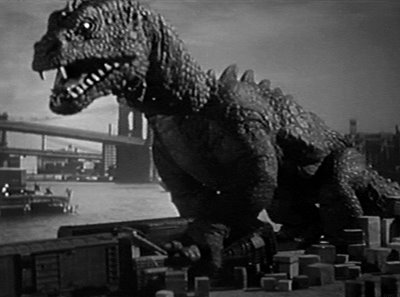


Speaking of which, let's stop beating around the bush and get to the real star and main selling point of the film: the Beast himself, the Rhedosaurus. First of all, his design is just cool and fairly iconic: he looks like a Tyrannosaurus Rex that's down all fours, with big powerful front legs as well as back legs, a dragging tail, crocodile-like scales, and a row of spikes along the center of his back. I've always been particularly intrigued by his head, which is alligator-shaped, with a mouth full of teeth, including a couple of long fangs out front, and a forked tongue. There are drawings of what the Beast was originally going to look like, which was a creature with a much longer neck and smaller head, akin to a Brachiosaurus and similar to what the monster in The Giant Behemoth would look like, and it looks like it would have also stood on its hind legs. Ray Harryhausen was the one who came up with the final design, as he wasn't satisfied with the original one, and I'm glad he made that decision, because this is much more memorable. And the way the Beast is brought to life through Harryhausen's stop motion is absolute classic and is definitely some of the best stop-motion ever seen in a 50's monster flick. This monster really does feel alive, breathing, and attacking! He may not have much of a personality, other than being just a typical marauding monster, but he looks so cool and feels so alive thanks to the animation that it doesn't matter. When the Beast rampages through Manhattan, it does feel like he's really there: they used a matting process to put the animation footage in with actual background footage of the city, with extras running around, and the result is very well done. I also like his vocalizations, which are these very low, deep, menacing growls and roars, as well as pained yells when he's injured and right before he dies, which manages to make me have some sympathy for him, in spite of all the death and destruction that he's caused.


There are many classic scenes involving the Beast. First, you have the beginning where Prof. Nesbitt and George Ritchie first encounter him out on the ice. The first real look at him following a short glimpse is breathtaking, as he stands on a glacier in front of Ritchie and lets out a loud, booming growl, after which he appears above Nesbitt when he's trying to help Ritchie and causes an avalanche that nearly kills both of them. Following that, you get a scene where the Beast sinks a ship. He looks really menacing when the captain and mate look at him through the porthole, which is obscured somewhat by the water running down the glass, and the shot of him actually destroying the ship by pushing it down into the water repeatedly and biting at it is particularly effective. One of my favorite scenes in the movie is when the Beast destroys a lighthouse, hearkening back to the Ray Bradbury story, The Foghorn, that the film was inspired by. All shots of the Beast in this scene are done completely in dark silhouette, giving it a very eerie and ominous feel. I particularly like the shot of him coming out of the ocean, onto the land, and growling at the lighthouse, no doubt because of the foghorn, before attacking it. From all the movies I've seen, stop-motion monsters typically don't get to cause a lot of destruction on the level of Godzilla and other suit-actor creature because of the chore of having to animate the crumbling structures but the Rhedosaurus, as well as many of Harryhausen's creations, gets to destroy quite a bit and the lighthouse really looks good when it crumbles. There's some nice underwater water footage of the Beast when he enters the undersea caverns of the Hudson River Valley where the fossils of his ancestors were discovered. Granted, it's obvious he's not really underwater, as they merely put a shimmering effect on the picture to make it look that way, and I thought the environment might have been a miniature set but instead, it looks like just another backdrop, with a few foreground elements here and there. The animation is still good, though, with the only major flub in the sequence being the stock footage and the way the Beast interacts with it. Originally, the movie was sepia-toned rather than full-on black-and-white, with this underwater sequence having a kind of green look to it, but I don't think that print exists anymore, which is a shame, because it sounds interesting.


The most famous scene with the Beast, as well as in the entire movie, is when he comes ashore at the New York docks and goes on a rampage throughout Manhattan. It's a pretty good monster rampage scene, with the Beast smashing cars, crashing through building walls and crushing people beneath the rubble, grabbing one vehicle (with a person in it) in his mouth and shaking it around before dropping it, battling some rifle-wielding policemen, and, in one particularly horrific moment for the early 50's, grabs one policeman who shoots at him with his mouth and swallows him whole! The effect doesn't hold up that well, as the stop-motion Beast doesn't look like he's actually touching the real actor, but still, I'm surprised the censors at the time let it by. The only thing that kind of deters from the excitement of the scene is that the running extras don't movie all that fast and don't seem genuinely scared, with all the screams being dubbed in. There's even one moment where, if you look closely, you can see some people and cars going by casually, in spite of the fact that a big monster just rounded a corner! This tended to be a common problem in crowd running scenes in monster movies, where the extras either wouldn't run frantically enough or, worse, they didn't take it seriously and you could see them laughing (as in the famous theater scene in The Blob). To be honest, the crowds in The Giant Behemoth and Gorgo came across a lot better. After the rampage, you get a moment where the Beast is cornered in the city street, with the military firing on him, and like most giant monsters, the initial bombardment only angers him instead of hurting him. However, he is definitely hurt when a bazooka shot hits him right in the neck while he's snapping at the electrified fence surrounding the soldiers' blockade, causing him to let out a pained howl. He gets away after destroying the fence but the military discovers that he's wounded via a trail of blood going up the street. However, that turns out to not be a good thing, as the soldiers who follow the blood trail suddenly fall deathly ill, as have many of the civilians caught up in the rampage, and it's revealed that the Beast is carrying a deadly disease. Nesbitt then comes up with the notion that the only way to destroy the Beast without infecting the city is to shoot a radioactive isotope that will destroy the germs into the wound along with him.


The finale at the Coney Island amusement park (which was actually shot at the Long Beach Amusement Park) makes for a really good spectacle. While the Beast bites and chews on parts of the roller-coaster (definitely the most elaborate miniature built for the film; Ray Harryhausen is said to have come up with the ending) that's he standing in the center of, Nesbitt and Corp. Stone use the cars of the coaster's car to get to the top of the structure in order to get a clear shot with the isotope. The Beast becomes frantic and pained after being hit with the isotope (the wide shot of them standing atop the coaster to the right and the Beast off to the left after he's been shot is a really good bit of optical work) and flails around, shaking the coaster and causing the cars to slip away from Nesbitt and Stone, leading to their crashing and starting a fire that engulfs the whole structure. While the men carefully walk down the tracks and climb down the side of the coaster to safety (it would have been a little better if it felt like they were in more danger during this bit), the Beast continues to scream in pain as the isotope destroys him from the inside and snaps at the flames, at one point sending a bunch of fiery debris flying into the air with his tail. He eventually walks through the coaster after a section of it collapses to the outside of the park and finally gives out with one last scream. Like I said before, as with a lot of monsters, in spite of what he's done, you can't help but feel sorry for the Beast as he walks around in a circle in the sand, quickly losing his strength, and screams in pain before finally dying. He wasn't an evil creature; he just was what he was and didn't belong in this modern world.
Another big component of the film's success is the awesome music score by David Buttolph. When the film was first sold to Warner Bros., it already came with a score by Russian composer Michel Michelet but the higher-ups at the studio decided it wasn't strong enough and so they hired Buttolph to compose all new music. The result was, in my opinion, some of the best music ever composed for this type of flick. The music over the opening credits, the Beast's main theme, the music during the rampage through Manhattan, and the music you hear playing in a concert hall at one point are all very well-orchestrated, with the Beast's main theme being particularly memorable, with its low, depressing sound created from descending strings that give off a very unsettling vibe. It's particularly creepy in the trailer, where the narrator is talking about supposed frozen monsters in the polar ice caps. My favorite piece of music, though, is the one that plays during the finale in the amusement park to the very end of the film. The last part of it in particular, after the Beast expires, has an awesome and powerfully final feel to it that I just love.

Sunday, August 28, 2011
B to Z Movies/Franchises: Jaws. Jaws: The Revenge (1987)
First thing I have to say is that I don't understand how this movie got made. I know Jaws 3 did pretty well, despite its enormous flaws, but did the series still have enough clout by this point for the studio to greenlight another sequel? It's truly mind-boggling. Anyway, this film is often regarded as the true nadir of the series and is considered one of the worst movies ever made. I can understand why people feel that way. This film really is bad but, call me crazy, I enjoy it a lot more than the previous movie in the series. If I have choice on watching either of the films after Jaws 2, I'll always go with this one. It's hard for me to explain but I'll try my best. Before I begin, I must say that this one is special to me because it was the first DVD I ever watched. When I got my first player for my sixteenth birthday, this was one of the four DVDs I got with it and it was the first one I watched so go figure.
This movie basically ignores the events of its predecessor, creating a new continuity for its returning main characters. It begins with Sean Brody living on Amity with his mother Ellen, whose husband Martin has died some time before from a heart attack. A few nights before Christmas, Sean, who is the deputy sheriff on the island, is sent out to remove a piece of driftwood from a buoy. While doing so, he's attacked and killed by a large great white shark. Ellen is now convinced that the shark killed Sean on purpose and is now stalking her family for what happened to the sharks in the previous films. To try to take her mind off things, she travels with her other son, Mike, and his wife and daughter to the Bahamas to spend Christmas there. While there, Ellen meets up with a carefree airplane pilot named Hoagie, who helps take her mind off the tragedy. However at the same time, Mike and his friend Jake, who work as marine biologists, encounter the great white shark, who has apparently followed Ellen to the Bahamas to kill her and her family. While trying to study the shark, Mike begins to think his mother's fears may have come true.
Okay, I must say that I do agree with those who complain that giving the shark a motive is ridiculous because it is. The sharks in the previous films were just being the big predators of the sea that they were, nothing personal. Giving the shark a motive goes into supernatural territory which cheapens the impact of the first film. Ironically, the seeds of this movie were sewn in a brief exchange in Jaws 2, where Brody is thinking that the shark in that film could be prowling around Amity for what happened to the original one and the biologist tells him, "Sharks don't take things personally, Mr. Brody." Granted, Brody's thinking in that film was no doubt motivated by fear but here, it's clear from the get-go that this shark does have a method to its madness. So, yes, I do agree with that complaint.
The director this time is Joseph Sargent, who worked with Lorraine Gary before on a TV, which is no doubt how he got her to do this film. That's one thing this movie had going for it, that its director had actual directing experience, unlike Joe Alves in Jaws 3. Unfortunately, that doesn't help the film overcome its shortcomings. Sargent is pretty good at directing the character moments in this film but when it comes to the suspense and action scenes involving the shark and underwater photography, he has no idea what he's doing.
I think some of the acting is good in this film whereas others aren't so much. Lorraine Gary reprises her role as Ellen Brody, making her the veteran of this series. The take on Ellen in this film is interesting, with her being as paranoid about sharks as her husband became in the second film. Sometimes it does work, like when she's worried about Mike having a job that has him in the ocean a lot and as she starts to lighten up when she strikes up a romance with Hoagie. However, there are other times where it comes across as melodramatic. Her rant in the kitchen after Sean's death when she is telling Mike to quit his job comes across as silly. During Sean's funeral, she's remembering the moment in the original when Sean imitated his father at the dinner table and she smiles, making some people at the funeral wonder why she's doing so. At another point, she tries to pick her granddaughter up but has to give her back to her daughter-in-law because she's too weak and starts crying for some reason. I'm guessing it has something to do with when Sean was a little kid but it just comes across as random. Also, as anyone who's seen the film knows, she has flashbacks to scenes from the first film and to stuff earlier in this one. One has to wonder how she remembers stuff that she didn't witness in the first place. Granted, she was there for the aforementioned scene in the original and the scene in this film where her granddaughter is attacked by the shark while on a banana boat but how does she remember her son getting killed when she didn't actually see it and how her husband killed the original shark? You could rationalize that Martin probably told her about what happened during the final battle in the original but the stuff with Sean? No, that's a goof.
Lance Guest plays Mike Brody and I thought he did a pretty decent job. He may not win any Academy Awards but I thought he came across as likable, particularly in the scenes with his mother, his family, and Jake. They could have done more with the notion that his mother's fears about the shark to creep in on him when he encounters it but it doesn't go anywhere. Still, I thought Guest was passable. And no discussion about Jaws: The Revenge would be complete without talking about Mario Van Peebles' infamous role as Jake, Mike's Jamaican buddy. I'll just come out and say it: I love Jake. Yes, I know Van Peebles is playing him as a typical stereotype but I always found him to be funny and likable. The scenes where he and Mike are ribbing each other does come across as two good friends to me. But I do agree that the bit at the end with him showing up after he was clearly eaten by the shark is bull. Did the shark swallow him whole and he came up after it was killed or what? If it just spat him out, where was he during the rest of the final battle? No excuse. Even Mike when he helps him says what we're all thinking: "The hell are you doing alive?"
Michael Caine plays Hoagie, the charismatic pilot. You really have to wonder what Caine is doing in this film. True, it was a sequel to the classic Jaws but I think if he'd seen the others, he would have known that this probably wasn't going to be a film he would be proud of. Caine claims to this day that he's never seen the film and the main reason he did it was for the money so he could build a house. He also was unable to personally collect an Oscar he received for another movie because he was filming this but he seems to look back on it with a tongue-in-cheek attitude. As for his performance, I liked the way Caine played Hoagie. As with Van Peebles as Jake, Hoagie is a likable, charming, easy-going guy with a good sense of humor, even when he's about to get eaten by the shark: "Oh, shit!" I do like that he survived, although how he swam from his destroyed plane to the ship and barely even got wet is something I don't understand at all.
Karen Young plays Mike's wife, Carla, who's an artist that creates sculptures for the island tourism trade. Not much to say about her. She's sexy and is a caring enough wife and daughter-in-law to Ellen, as well as gives Mike hell when she realizes that he knew about the shark all along and didn't tell them. Judith Barsi plays Mike and Carla's young daughter, Thea. Not much to say about her other than she's cute and really didn't annoy me. One dumb thing she does is what she says to someone as soon as she and her parents visit Ellen after Sean's death: "Uncle Sean is dead, you know. Will he come back?" Carla says, "We'll talk about that later, Thea." I think you should have talked to her about that earlier! (On a sad side-note, I found out that Barsi was murdered, along with her mother, by her insane father a year after this movie was made, which is really tragic.) Finally, Mitchell Anderson plays the brief role of Sean Brody. The one thing I have to say about him is that I do think his death is disturbing. The way the shark first bites his left arm off before killing is bad enough but the way he's screaming and that there are kids singing The First Noel nearby is quite disturbing to me. I actually saw this scene when I was a kid on TV and it really messed me up.
This film does suffer from some melodramatic and corny moments. There's a scene that recreates the dinner table from the original with Sean imitating Martin, only this time done with Mike and Thea. It is kind of touching but may succeed only in making viewers wish they were watching the original Jaws. Another weird part is the first scene between Mike and Jake. Jake gets really angry at him for taking off to Amity and leaving him with the workload, causing Mike to yell at him. Jake then very calmly says, "I'm sorry about your brother, man." That was a sporadic change of emotion! The most laughable melodramatic moment is when Jake "supposedly" gets killed by the shark. The entire moment is in slow-motion with no sound except the music and when the shark disappears beneath the water, Mike yells, "JAAAAAAAAAAKE!", which even echoes. I know it's supposed to be tragic but it comes off as just plain silly and overplayed. Plus, the guy's not dead so it was pointless.
The shark looks the worst in this film. It's so fake and lifeless that it's not even funny. As much as I bashed the shark in Jaws 3, I bought that one more than this (and that should tell you something). It looks like one of those shark toys I used to play with in the bathtub when I was a kid. When Jake first encounters the shark while operating the mini-sub, it literally seems as if the damn thing just floated instead of swam towards him and bumped him. Even when the shark is chewing on the side of the boat or coming up to attack people it looks fake. There are scenes where it's so far out of the water that it has to be balancing its tail on something right below the surface! A scene where the shark chases Mike while he's scuba-diving is particularly silly looking because Mike takes cover inside a shipwreck on the ocean floor and the shark still manages to squeeze inside of it. The sight of that big-ass shark swimming down corridors in that wreck (barely doing so, by the way) just makes me smirk. Oh, and the shark roars as well. During the finale, Mike and Jake put an electric device in its mouth that Mike uses to shock it to death. When he does so, the shark actually sticks its head out of the water and makes a T-Rex style roar. I'm pretty sure I've heard that roar in other movies, including the original Jaws after the shark is destroyed.
The most baffling part is the shark's death. As Mike continues to electrocute the shark, Ellen steers the boat right into it. When the bowsprit jabs into the shark, it blows up for some reason. To this day, I'm sure many wonder what the hell that was about. Some try to rationalize that the shark exploded because the bowsprit hit the device Jake put down its throat but I'm pretty sure that thing wasn't a bomb. From what I can gather, the ending was originally shot to depict the shark getting gutted by the boat and tearing it apart with its contortions, with Mike, Ellen, and Hoagie having to jump off the boat to avoid getting killed. Test audiences apparently didn't like this ending for some reason and it was reedited to produce the confusing ending that exists now. Interestingly, I think I've seen that original ending on some TV airings of the movie but the explosion is the one on the DVD. Also, right before the boat rams the shark, we get a sepia-toned shot of Roy Scheider saying, "Smile, you son of a bitch!" from the original (in Ellen's mind) and the shot of the decapitated shark sinking to the bottom afterward is from the original as well.
My favorite thing about Jaws: The Revenge is the music. Michael Small did the music here and it's pretty good. My favorite part of the score is the main title, which is a fairly tense piece of music with bits of John Williams' score for the original thrown in for good measure. It makes the opening title sequence (which is presumably from the shark's point of view as it prowls around Amity harbor) quite thrilling. I also like the new twist on the infamous shark theme that Small creates for this movie and the rest of the score is pretty good as well. This may be why I actually like the film despite its faults because the music makes it feel better than it really is. The only complaint I have with the music is that, as with the other two sequels, they use the shark theme too much and it gives away the shark's presence, ruining what suspense could have been created from it.
Since I've spent the majority of this review picking on the flaws of Jaws: The Revenge, you're probably wondering why I said I like it. Like I said, it's hard to explain. It could be because I saw it when I was young and I thought it was great then. Or could it be that I get enjoyment out of its flaws, being a lover of bad movies, and the fact that, despite those flaws, it feels like Sargent's heart was in the right place for the most part. I really don't know. All I do know is that I can watch this a whole lot more than Jaws 3, even though this is technically a worse film. But, a lot of other people didn't feel that way. This movie bombed, putting the final nail in the coffin for the franchise. Even though I do get enjoyment out of this, I am glad it was the last one because any further sequels would have probably been even more unspeakably bad than this film every dreamed of being.
Saturday, August 27, 2011
Movies That Suck/Franchises: Jaws. Jaws 3 (1983)
When I came across this on the Sci-Fi Channel one day, I didn't even know at first that this was a Jaws movie. I just assumed it was some random horror movie about a shark terrorizing a water park. I think I'd seen the first two films as well as Jaws: The Revenge before I saw this one and since this is the only one that has no scenes on Amity or any cast members from the original, it didn't look like a Jaws movie to me. If I hadn't heard the legendary shark theme play, I would have never known. I didn't even know that it was originally in 3-D until I did a little research on it after seeing it. My opinion of it the first time I saw it has remained unchanged to today: while the movie is not out and out horrible, it remains my least favorite film of the franchise.
A new SeaWorld park is preparing to open in Florida, its main attraction being a series of underwater tunnels that snake throughout a man-made lagoon. However, a mechanic disappears while fixing a gate into the ocean that came off the rails for some reason. Mike Brody, the now adult son of Chief Martin Brody from the first two films, is the chief engineer at the park and the senior marine biologist, Katherine Morgan, is his girlfriend. While searching for mechanic in the lagoon, the two are attacked by a ten-foot great white shark. While the park's owner, Calvin Bouchard, and a visiting big game hunter, Phillip FitzRoyce, at first intend to kill the animal, Kay suggests that if they manage to catch it and keep it alive, they'd be famous for being the only facility in the world with a captive great white shark. They eventually manage to capture the shark but it dies after being put on display. When the mangled body of the missing mechanic turns up, everyone discovers from the state of the corpse that the shark they caught was a baby and the real killer, its 35-foot long mother, is inside the park. Before long, the enormous creature goes on a rampage throughout the park, injuring many people and causing a malfunction that traps a bunch of tourists inside the underwater tunnels. Now Brody and the others must save the trapped people as well as kill the shark.
Jaws 3 was originally meant to be a comedy spoof called Jaws 3, People 0, with the script written by John Hughes and Todd Carroll, who had just written Animal House, and Joe Dante was going to be the director. However, Universal didn't like the idea of a spoof and, along with new producer Alan Landsburg replacing the original ones, Richard Zanuck and David Brown, set out to make another serious film. Famed sci-fi writer Richard Matheson wrote the script and while he still gets credit, Carl Gottlieb, who revised the scripts for the first two films, also gets screenplay credit along with a guy named Guerdon Trueblood for the story. The director ended up being Joe Alves, the production designer on the first two films. This is the only film he's ever directed and when you see it, it's not hard to understand why. Matheson himself hates the finished film and even blasted Alves, saying he's a good art director but can't direct to save his life. I can't help but agree with Mr. Matheson.
Remember back in my Jaws 2 review when I said that even though I like that film, there's no tension whatsoever. That principle holds true for this one as well, only it's ten times worse. Not only is this movie not scary in the slightest but I've always found it to be kind of dull. You'd think a movie about a gigantic shark terrorizing SeaWorld would make for a hokey but entertaining monster movie. Sadly, no. Except for a fair sequence where the mother shark, just recently discovered, wreaks havoc on the park and injures a lot of people, none of the action sequences are interesting. When the actors are underwater interacting with the shark, it's even more boring for reasons I'll get into bottom line. So, that's the first fact that I must begin this review with: this movie is a dud.
The acting, while not the best, is decent for the most part. Dennis Quaid plays Mike Brody and he does a fairly good job at making him likable. He's a typical, blue-collar guy who's dedicated to his work as chief engineer of SeaWorld as well as keeping the tourists safe when the shark is discovered, putting himself in real danger to help the ones trapped in the undersea kingdom portion of the park. Bess Armstrong is also fairly likable as Katherine "Kay" Morgan, senior marine biologist and Mike's girlfriend. The interplay between the two of them as a couple is believable and there's even a dilemma where Mike is about to be transferred to Venezuela and Kay is not sure what to do about their relationship. Too bad it's solved so quickly and matter-of-factly that its being there in the first place was pointless to say the least. Still, I do like Kay for how dedicated she is to her job and Mike because even though he feels a bit neglected by her because of her duties, is never a jerk about it.
Simon MacCorkindale plays hunter Phillip FitzRoyce, who comes across as full of hot air and yet is kind of charming as well. Even though is gun-ho about killing the baby shark at first, he is good enough to go along with the plan of capturing and actually helps to save people when the mother shark goes on a rampage instead of just sitting around, doing nothing. His death is also the only thing part of this movie that makes me cringe in a good way. The way he gets trapped inside the shark's mouth and is eventually crushed to death (presumably by the pressure since he was far away from the teeth) is pretty nightmarish to me, made even more so by his muffled screams. I didn't care for his assistant Jack (P.H. Moriarty). The guy just came across an ass-kisser to his boss and acted like a douche to everyone else. Also, his accent is so thick that I can't understand more than half of what he's saying. When FitzRoyce doesn't surface after they finish trapping the shark inside a filtration pipe and climbs down a shaft into it and yells for him, I didn't understand anything he said. I also think he just flat-out disappeared from the film after that (if he got killed, I honestly don't remember).
Louis Gossett Jr. plays Calvin Bouchard, the manager of the park. While he's not quite as dickish as Mayor Vaughn, he's still a douchebag who only cares about making money. After Kay and FitzRoyce tranquilize the baby shark and nearly get killed in the process, all he cares about is whether the film of the event is okay. He orders the baby shark to be put in an exhibition tank without Kay's permission, resulting in its death. Also, after the mother shark is trapped inside the filtration pipe, he orders his engineers to shut the pumps down just so he won't lose any money in the process, which results in the shark being able to escape. Granted, he does seem concerned about the people trapped in the underwater tunnels and is good enough to help one of his technicians escape when the shark smashes into the control room but he does nothing to help his nephew and leaves him to be eaten. Bastard. Rounding out the cast is John Putch as the younger brother Sean Brody, who seems likable enough and the chemistry between him and Quaid is solid enough that you believe they're brothers. Like his father, he's now terrified of water because of the shark attacks in the first two films but that never goes anywhere. Finally, Lea Thompson plays Sean's water-skier girlfriend, Kelly, who's pretty spunky and fun but after she gets injured by the shark, both she and Sean disappear for the rest of the movie.
The shark effects in this film are poor. The baby shark doesn't look real and the mother shark DEFINITELY doesn't look real. There's real shark footage mixed with the model of the baby but there's no such technique used for the mother, making her believability suffer ever more. The biggest problem with the mother is that she lumbers around so slowly and has no life except when she opens her mouth and growls. As I've said before, the mechanical shark in the original did look fake a couple of times but was photographed so well that you believed it for the most part. Here, the camera holds on the shark too long and the lack of movement doesn't make her come across as anything more than what she really is: a big plastic sculpture. Also, sharks need to keep moving in order to keep oxygen flowing into their gills. This shark moves so slow that she would suffocate in less than seconds! But I haven't gotten to the worst shot of the shark in the entire film. After Mike and Kay finish repairing the underwater tunnels, they see the shark swimming towards them through the window in the control room. It looks as if someone took a still photograph of the shark and moved it slowly towards the camera because there's no fine movements, no tail movements, no breathing, nothing! The effect of the shark smashing through the window is even worse. That is just inexcusable for a movie that had a fairly good sized budget at the time of $18 million.
The 3-D effects are the worst aspect of the movie for me, even though I can't see them. Granted, I don't have the 3-D version of Friday the 13th Part 3 either but in that film, the 3-D is so simple, with objects mainly just coming close to the camera, that it doesn't bother me. Here, there are so many bad optical and matte effects with the underwater 3-D stuff that it's just nauseating. When Mike and Kay are investigating the lagoon in a little mini-sub, there are painfully obvious moments where the edge of the sub becomes transparent. The dismembered fish-head and arm that float towards the screen also look hokey and the shark's death is ruined by her jawbones flying towards the screen and just floating there after she's destroyed. I also think the film itself just looks bad. I don't know if it's the 3-D cameras they used or what but the film, especially the underwater scenes, just looks murky and ugly. (Funny thing about the 3-D opening titles. in the VHS releases of the film, the titles were replaced with generic, flat red titles and the 3-D ones didn't appear again until the DVD release.)
Another subplot in the film has to do with the two dolphins, Cindy and Sandy, who instantly sense the shark's presence at the beginning of the film. They pop up time and time again throughout the film, I guess trying to warn people about the shark. Honestly, they come across as just annoying. There's an instance where the shark seems to eat one of them (which should have happened), leading to the ending scene where Mike and Kay call for them after the shark's destroyed. It looks like Cindy made it but Sandy didn't... until she jumps out of the water, with Kay cheering. The last shot is a corny still of both actors framed in-between the jumping dolphins, with Kay yelling "All right!" Yeah, some people got killed but as long as the dolphins are okay, everything's just dandy! I so don't care about those damn dolphins.
The music for the movie is bad because it's so repetitive. John Williams had no involvement with this film and the music was instead scored by Alan Parker. The shark theme is, of course, part of the music but most of it is really generic music that seems to loop again and again. The theme that plays over the ending credits, as well as throughout the movie, drives me especially bonkers because it's so unoriginal and, as I said, loops. So bad.
Jaws 3 is the epitome of boring to me. Despite some fair acting, the movie is dragged down by an unconvincing shark, piss-poor 3-D and optical effects, unimaginative direction, and repetitive generic music. While I've seen much worse movies, this is what I call the Great White Turd, as Steven Spielberg described the troublesome mechanical shark in the original movie. This is a movie I only watch if I'm really (and I mean REALLY) desperate for something to watch and even then it's far from my first choice.
Friday, August 26, 2011
Franchises: Jaws. Jaws 2 (1978)
Jaws was one of those rare movies where, despite all the problems during production, everything fell into place and a classic was born. In fact, Universal regarded it so highly that even before the film became the biggest movie of all time at that time, they demanded a sequel. Three years later, Jaws 2 was released in the summer of 1978. This was the first of three sequels to Steven Spielberg's blockbuster that many fans and critics consider vastly inferior to the original. While the third and fourth films in the series are definitely not up to snuff, I've always had a soft spot for Jaws 2, having actually seen a good majority of it before I saw the original. While there was no way for this film to live up to the legacy of the original and it does indeed have its shortcomings, I still think it's a worthy sequel and a nice companion piece to Spielberg's classic.
It's been four years since the events of Jaws and life on Amity has gone on. Martin Brody is still the chief of police and still lives on the island with his wife Ellen and his sons Mike and Sean, who are now sixteen and eleven-ish respectively. However, a rash of mysterious incidents such as the disappearance of two divers, a mysterious water-skiing accident, and the mangled carcass of a killer whale lead Brody to believe that another large great white shark is stalking the waters around the island but, as before, Mayor Vaughn and the local government officials refuse to believe him. Brody's paranoia about sharks after the events of the first film lead him to do something rash enough to get him fired from his job. As if that wasn't bad enough, his two sons head out on a sailing trip with their friends and become targets for the shark.
Steven Spielberg wanted no part of a sequel to Jaws because he felt he'd already made the definitive shark movie and that doing sequels was a "cheap carny trick." However, seeing as how Spielberg would go on to direct all the Indiana Jones movies as well as one of the sequels to Jurassic Park, I personally think he didn't want to do it because he didn't intend to go through the torture he went through on the first film again. John Hancock was originally hired as director but due to his inexperience in making big budget movies like this and Universal's disliking of the dark tone he was going to bring to it, he was eventually fired. The guy who eventually took over was a French director named Jeannot Szwarc, who honestly didn't have many credentials at that time but got the job because he was friends with production designer Joe Alves. In an interview with Szwarc on the DVD, he said he felt the script focused too much on the action and some of the characters were not well developed and asked writer Carl Gottlieb to fix that (which I don't think he did but we'll get to that presently). Szwarc may not have been as talented as Spielberg when it came to characters but the action scenes in this movie are very well filmed in my opinion. I also feel that he did a good job in keeping the movie in tone with the original: while it's a serious horror/thriller, it also has a feel of fun and adventure to it rather than being all dark and dreary, as Hancock probably would have made it.
The main aspect of the film that keeps it in line with the original is that many of the actors return in their roles. Chief among them is Roy Scheider as Chief Martin Brody. Scheider did not want to do the movie, feeling that there was nothing new to do with it, but Universal used a contractual obligation he'd failed to live up to, as well as a big paycheck, to get him to do it. Scheider then reluctantly returned and decided to do the best he could. Despite his misgivings and constant fights on the set with Szwarc, I think Scheider turned in another good performance. Brody is exactly as he was in the first film and more: he's still a likable, charming chief of police, tough when he needs to be but fair. There's also an added layer to his character in this film that wasn't there in the original. After what he went through in the first film, you can see the concern and terror in his eyes when evidence that there's another shark prowling the waters around Amity begins to mount. He kind of becomes as paranoid and as obsessed with killing the shark as Quint was in the original. It comes to a head when he mistakes the shadow that a school of fish create for a shark and, without thinking, orders everyone out of the water and even shoots at the shadow. This leads to him being fired from his job and he feels like an idiot for what he did. But the next day, when a commotion comes up in the town, his need to check it out despite the fact that he's been fired leads him to discover that his sons are in danger and, being the dutiful and courageous guy he is, he takes it upon himself to save them and once again destroy the marauding shark.
Lorraine Gary returns as Brody's wife Ellen. While she doesn't have much to do, as in the original, she remains ever loyal to her husband, going as far as to defend what he did at the beach. In this film, Brody has a kind of rival when it comes to his wife in the form of Len Peterson (Joseph Mascolo), a businessman who's built a new resort on Amity and happens to be Ellen's boss. While it never becomes a big thing, Peterson seems to have a thing for Ellen and may resent that Brody is married to her. Again, this is never explicitly stated, (although there are some deleted scenes that would have made it a bit more upfront) but it is a kind of undercurrent to the way Peterson resents Brody's shark paranoia, going as far as to keep Ellen away from him after the panic on the beach he starts. This, coupled with the mere fact that his actions could ruin Amity's tourist trade, could have definitely encouraged Peterson to get Brody fired. Speaking of this, one thing I like about Ellen in this film is her last scene, after it's confirmed that there is another shark lurking near Amity. Peterson tries to make Ellen understand his position but she berates him for firing her husband, stating, "I don't give a damn what about your position. All I know is that a boy is dead and my son and husband are still out there!" I just loved seeing Ellen stick it to that bastard!
Murray Hamilton reprises his role as selfish Mayor Vaughn, who, to me, comes across not only as an even bigger jerk but as a complete idiot in this film. The fact that this guy once again refuses to believe Brody when he says that there's a large shark in the waters around the island makes him look like the most selfish idiot to enter politics (and that's saying something). He even says to Brody, "Don't press it this time." You mean like he pressed it last time... and was right? And what about all those people before that were killed... because of you? You're going to let that happen again? It's such a shame that the people of Amity apparently never find out what an asshole their mayor is because of they did, not only would he be fired but he'd probably be deported! (Again, there was a deleted scene that showed Vaughn in a better light. After the scene where Brody shows the town council the picture of the shark and they decide to have a private meeting about what to do about him, there was going to be a scene where the council votes about where they should fire Brody or not. Everyone except Vaughn votes for firing Brody, making it look like Vaughn really does believe Brody and is being pressured by the council and Peterson to go along with them. If it had been kept in, I do think this scene would have helped make Vaughn a little more sympathetic instead of a selfish jerk who learned nothing from the events of the original film.)
Jeffrey Kramer also reprises his role as Deputy Hendricks, who has a bigger role here than before. He remains ever faithful and loyal to the chief, even when he could easily think that he's lost his mind. I like the scene where Brody comes home after he's been fired and he tries to promote Hendricks as the new chief. Hendricks, ever the loyal deputy, tells Brody that he doesn't want his job and says he's the greatest. Really makes Hendricks a likable character. I also like how he at first tries to stop Brody and Ellen from taking the police boat out on the water but eventually decides to help them, stating, "What the hell, they can't fire both of us. Someone's gotta be in charge." In his last scene, I like the less than positive look he gives Peterson after Ellen scolds him for firing Brody. He's the kind of deputy you'd want to have if you were in charge.
Where the film falls flat for me characterwise is the teenagers who become prey for the shark in the film's last half. Remember when I said that Szwarc asked Carl Gottlieb to help flesh out the teenagers? Well, they failed big time because when it comes to most of these kids, I don't remember who's who. It's never a good sign when I remember the majority of the names of the kids from slasher movies but I remember hardly any from the sequel to one of the best films of all time. The main one is Mike Brody (Mark Gruner), the oldest son of Martin and Ellen. There's some character there, like the arguments that he and his father have about him getting a job for the summer and his father ordering him to stay out of the water. Still, it doesn't really amount to much in the long run. Also, how in the world can he be sixteen when he seemed to be only like nine or ten in the original, which takes place four years before? The younger brother, Sean (Marc Gilpin), has even less to his character, mainly just being the little brother who wants to tag along and is a pest to Mike. There is one nice moment with him where he helps his father pick up the gun-shells after he causes the panic on the beach and Brody is clearly touched by it. Other than that, one good thing I can say about him is that I didn't find annoying, although the part where he blackmails Mike into taking him with him on his sailing trip is a bit douchey.
Now, I will try to name the other teenagers but I know I won't get all of them. I definitely know and liked Tina Wilcox (Ann Dusenberry), who seemed like a fun, spunky girl and I felt bad for her when she sees her boyfriend get eaten by the shark and is hysterically frightened when Brody, Ellen, and Hendricks find her. Not much to say about her boyfriend Eddie (Gary Dubin) other than he and Tina seem to have a nice relationship and his death scene is memorable. Amongst the other teens who end up stranded by the shark, the one I remember the most is Andy (Gary Springer), Mike's big, curly-haired friend. I can't help but like him since he seems like the type of person you'd want to hang out with it. The only scene with him I don't like is when they're trying to save Sean after a girl named Marge (Martha Swatek) has been eaten right in front of him but Sean is too scared to tie the line around the boat he's stuck on. Andy gets tough on him to get his attention and threatens him. Okay, I know they're trying to help him but the poor kid is scared to death and you're threatening him? Andy does make it clear when they finally get him across that he really does care about him but I just found it to be a little extreme. I definitely remember Donna Wilkes as Jackie, a cousin of a friend of Mike's named Brooke (Gigi Vorgan) (I think), mainly because once they're stranded by the shark, she becomes very hysterical and screams a lot. That leads me to Larry (David Elliott), Vaughn's son, who comes across a major dick, blowing up at other teenagers once they're stuck, especially Jackie when she becomes hysterical. Like father, like son, huh? I definitely know Keith Gordon as Doug, but that's only because I remember him from Christine. He has one funny moment where he over-inflates a part of his boat and it pops right after he's been acting all melodramatic, making him look like a dork. G. Thomas Dunlop is memorable as Timmy mainly because he's so mopey and sure he's not going to get a girl, although he does end up with one. And I remember Cynthia Glover as Lucy because at one point when things look their bleakest, she says a prayer. I know there were some other teenagers but I can't for the life of me remember their names. I'm surprised I remembered as many of them as I did (I had to look at a credits list for half of them anyway).
One complaint that's always thrown towards Jeannot Szwarc's direction of the film was his decision to show the shark clearly from the first attack to the end, instead of going the Hitchcock route and not showing it for most of the film like Spielberg did. His reason for doing so was because he felt the legendary chumming scene from the original could never be duplicated so they might as well just show the shark. Me, personally, I've always felt that when you're making a sequel like this, you should know what the fans want to see and what they wanted to see, in this case, was the shark. The route that Spielberg took in keeping it hidden for the most part was cool but by the time you get to a sequel, the audience knows what's going to happen and they know what they're paying money for: to see the monster do its thing. So I think you should just give them what they want and I agree with Szwarc's decision. Now that said, I do think he could have filmed the shark a lot more skillfully. When Spielberg finally showed the shark in the original, he almost never held on it so long that you could tell it was fake. Granted, there are a couple of times in the original where the shark does look a little iffy but for the most part, I think it still holds up. However, in Jaws 2, there are plenty of shots where the shark is clearly fake. One is where the shark first kills a water-skier and then attacks the woman who was driving the boat. You can clearly tell that the shark is made of rubber because they hold on it for too long. The shot where it looks the most artificial is a scene where Mike is floating in the water unconscious and his friends just barely manage to pull him onto the raft before the shark swallows him whole. As the shark passes by the boat with its big mouth open, you can see the mechanisms down its throat. It's brief but it's noticeable.
I did like that they gave this shark a distinct look with him getting burned very early on, disappearing for most of the film and then when he reappears, he's got a big ugly scar on the left side of his head. However, I don't feel that they ever got it to look real. I know that they were basically painting a scar on the side of a big mechanical shark but honestly, that's what it looks like. It doesn't look natural and it just looks painted on. Having said that, I honestly can't think of a way they could have fixed it because that's tricky: making something look real on something that's already artificial. While it was cool, it just never looked all that real to me. And plus, like they did in the original, they use real shark footage intermixed with the mechanical one and every once in a while, it doesn't match because there's no burn. Speaking of which, there's a moment where the shark almost gets a guy who's para-sailing and when it cuts back to an above water shot, the shark's fin or tail is briefly seen and he just looks small. I've always felt he looked small at that moment. My final thought about the shark is that I love the way he's destroyed at the end. Some people may think it's a little farfetched but the spectacle of the shark biting that cable, getting the crap shocked out of him, getting set on fire and sinking down into the water is a sight I saw as a kid and thought was amazing then and I still do now. Like the climactic destruction of the shark in the first film, I like the buildup to it where the shark is racing towards Brody and I like the line he says: "Open wide!" Nothing can top, "Smile, you son of a bitch!" but I liked that as well. And I you still think that the death of the shark here was farfetched, watch the death of the shark at the end of Jaws: The Revenge for comparison (I'll get to that later!)
The death of the shark brings up a gripe about the film that I agree with: Jaws 2 is way too derivative of scenes from the original. While I like the similar buildup to the death of the shark here, I agree with those who say that this film copies too many scenes from the original. Since it's a sequel, it's nice that they kept the same general spirit and tone of the original but doesn't mean they had to out and out plagiarize stuff from it. Some of it includes more scenes with Brody having to deal with the inane troubles of the townspeople (first it was karate students chopping picket fences; here it's noisy police scanners and teasing women), a dead body convinces Brody that there's a shark in the waters (it's a dead whale this time instead of the remains of a victim but still), and then there's the reused plot device of the mayor refusing to believe Brody, which, again, makes Vaughn look even more selfish and stupid than he was before. There are also some scenes that are just blatant rip-offs of some of the original rather than just being similar. One is a beach montage that looks awfully similar to those in the original to me. Even though I like this movie, the first time I actually saw it I was thinking, "Really?" But the one that really gets me is the ripoff of the infamous head scene with Richard Dreyfuss from the original, this time involving Brody investigating a big piece of driftwood and being startled when the remains of a shark victim come right up in his face. That was so blatant and it didn't work at all, unlike the scene in the original. That one really does disgust me whenever I watch the movie. Bottom line, while it doesn't completely ruin the movie for me, it is kind of disappointing that recycled so much from the original when writing the script for this one.
I don't think Jaws 2 has the level of suspense that the original had. That's a given, naturally, but when you watch the two films back to back, it's clear that Szwarc doesn't have the talent in creating and maintaining suspense that Spielberg has. Even though Szwarc decided to show the shark completely, I think you can still show the monster and make the suspense work. I think this movie's biggest problem is that they use theme too much which instantly gives away the shark's presence. While the original is famous for that music, if you watch it again, you'll notice that the music always did a slow build whenever the shark was stalking someone from nearby and never hit you full force with the "da-dum, da-dum" until the shark either appeared or full on attacked someone. Here, you hear that theme full on whenever it's even hinted that the shark is nearby so no tension builds. There are also some moments where it's quiet music wise and then suddenly the shark pops up but I don't know if it's just because I've seen so many horror films or what but I don't think they work here. They only one that got me was when the shark comes out of the water to attack the helicopter and even that didn't get me as much as a scene in the original where Hooper and Quint are pulling in a rope and the shark suddenly pops up.
With what I've said about the music, you probably think I hate it but I don't. I think they could have used the iconic theme better but most of the music that John Williams wrote for this film is really good. The opening music is absolutely beautiful, especially when it swells as the title comes up in front of a school of fish. I also really like the music that plays during the moments where Brody is looking out at the ocean when he suspects that there's another shark out there. I also like the music that plays when Brody has caused the panic on the beach and Sean is helping him pick up the bullet shells. The music that plays over the ending credits is a nice one and a good compliment to the similar music in the original. All in all, it may not be as memorable as the score from the original (how could it?) but I do like this film's music score.
Jaws 2 is definitely not a perfect film. A good majority of the characters are forgettable, the shark is not as skillfully filmed as before, and there are too many scenes that copy from the original. Still, it's a fun two hours. The returning cast members are still on form, the film feels very in line with the original, and the new music score by Williams is very well done. Even Roy Scheider said once that, despite how much he didn't want to do it and the arguments he had with Szwarc, he thought it was a pretty good sequel and that's how I feel. Was it necessary for it to have been made? No, but since money talks and a sequel was going to be made no matter what, it's lucky that we got one that doesn't tarnish the reputation of the classic original. Unfortunately, that luck wouldn't hold out for long.
Subscribe to:
Posts (Atom)