So, I'm sitting in chapel, waiting for the service to be over, when a guy comes bursting through the door, revving a chainsaw. No, this is not the set-up for a bad joke; this actually happened to me. The high school that I went to was fairly religious and every Monday, Wednesday, and Friday, you would begin your day by going to the chapel for half an hour and listen to a bit of a sermon, as well as announce anything special or important that was going on. One day (and I cannot at all remember what grade I was in at this time), when it came time for announcements, I suddenly hear a chainsaw revving and I, along with my other classmates, look over the edge of the balcony we were sitting in to see somebody run into the aisle while wielding one. Of course, it wasn't a real chainsaw (at least I don't think it was) but, nonetheless, it got everyone's attention and with that, the guy, whom I think may have been one of the teachers, if I remember correctly, announced that that Saturday night, they were going to be showing
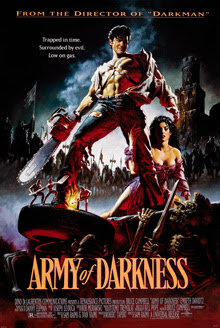
Army of Darkness, either
in one of the dorms or in a projection room down at the building where classes were held. I think it was October and they were showing it as a way to get into the Halloween spirit. Regardless, that was my first clue as to what this movie featured. I'm pretty sure that I knew of the title
Army of Darkness before then but I can't remember when I connected it to Sam Raimi and, moreover, when I realized that it was the third
Evil Dead film. I did see some clips of it over the years, notably on a special documentary series called
Creature Features that was narrated by Keith David and on one of the other editions of Bravo's
Scariest Movie Moments, and I also became aware of some of its lines, like, "Hail to the king, baby," and "Good, bad, I'm the guy with the gun," without knowing what they were from for the longest time, but, like the other
Evil Dead movies, I didn't really become interested in it I still saw the episode of Cinemassacre's Monster Madness that featured clips of all three movies. Significantly, this is the first one I actually saw a little bit of. To this day, one of the Encore channels sometimes plays it and I saw a big bit of the movie's beginning one night, possibly after I had seen that web video. Again, I can't really remember because it was so long but I think I watched it up until Ash sets off on the journey to get the Book of the Dead, when I stopped, for whatever reason. Like
Evil Dead II, I wouldn't see the entire movie until I bought them both on DVD in the summer of 2009.
There are a number of movies that I feel you have to see at exactly the right time in order to become a part of their cult followings and, unfortunately, the
Evil Dead series is one where I missed my opportunity. If I had seen any of these movies when I was in my early to mid-teens, I'm sure I would have eaten them up like everyone else but, by the time I got to them when I was 21 and 22, I had seen so many other movies and had become so jaded that they didn't leave a big impact. The original
Evil Dead I found to be overrated and had nothing to recommend it except for the gore and the creative camerawork and editing, which only go so far;
Evil Dead II, while being much more entertaining to me and, in my opinion, the best of the bunch, burned me out with its relentless, manic energy; and
Army of Darkness, while still being entertaining and having the most impressive scope of the series, also didn't endear itself to me to where it became a movie I wanted to watch again and again and again. Like the other films, I can appreciate it for Sam Raimi's ingenuity, Bruce Campbell's performance, the energy, and the mixture of horror and slapstick humor, but, again, the film doesn't have me up off the couch, jumping and cheering, or dancing wildly. I can understand why it's become a cult classic for so many people but, by the time I got around to it, its impact was lost on me.
Like
Evil Dead II, the lead-in to this movie from the previous one contradicts what you saw before. It does have a more concrete attachment to the previous film, to the point where it feels like the first
Evil Dead doesn't count at all given Ash's story of going to the cabin with only Lisa, but it still doesn't mesh with the previous film's ending. Here, instead of being hailed as a hero like he was at the end of
Evil Dead II after he killed a Deadite upon being dropped into Medieval times, Ash is taken prisoner as soon as he arrives, is almost executed, and is only hailed as a hero once he kills a Deadite while trying to escape said execution. So, what was the reason for reworking things this time? It obviously wasn't rights issues since some footage from
Evil Dead II is used during the prologue (if that stuff is also a recreation like some of the other material, then it's uncanny). Apparently, it was due to Universal not wanting to make that big of a connection to the two previous films so it could stand on its own and also because it seems like they weren't allowed to use the actual
Evil Dead title, which included calling it
The Medieval Dead as Raimi originally wanted.
I also read on IMDB that the original script had Ash first being hailed as a hero (although him shooting down the flying Deadite was ignored there) and then suspected of being one of Duke Henry's men by Lord Arthur, who was also skeptical of the idea that Ash could be the prophesized hero since, according to the prophecy, he wouldn't be bleeding. But, for whatever reason, that was changed when shooting began. So, I don't have a straight answer to this question, but it makes wonder if Raimi did it just because he had done it on the last one. That's another issue I have with this series: it's so difficult to transition from one film to the next, something that should be very, very simple. (I'm kind of surprised Raimi didn't do the same thing with his
Spider-Man movies.) Normally, I can overlook little things like that but with these movies, even though the situation here isn't as maddening as the one in the previous film, it really gets to me.
By the time he got around to
Army of Darkness, Sam Raimi had done his first film for a major studio,
Darkman, which wasn't exactly a blockbuster but was still a pretty good financial success. As a result, he was able to muster a fairly big budget of $11 million from Dino De Laurentiis and Universal, who partnered up to produce the film. There had been plans for a third
Evil Dead movie even before
Darkman and the script was developed throughout that film's production, with Raimi and his brother, Ivan, whom he co-wrote it with, deciding to move it even further away from the first movie's horror vibe and instead do a full-on comedy mixed with a fantasy/adventure, with only the most minute horror elements thrown in. More than ever, Raimi got to show off his love for slapstick comedy as well as other films, notably the fantasy adventures
Jason and the Argonauts and
The Seventh Voyage of Sinbad, particularly in regards to the stop-motion work of Ray Harryhausen, and with the big budget, he was able continue his experimentation with camerawork, editing, and visual effects. Unfortunately for Raimi, Universal took the film over after production was over, forced him to reshoot the ending, then further edited it without his involvement, pushing back its general release date, and it didn't do much at the box-office (like the other films, its cult status came to be when it was released on video). In fact, while Raimi would continue to make movies for both big studios and independent ones throughout the 90's, working with big-name actors like Gene Hackman, Sharon Stone, and Kevin Costner, he wouldn't have another hit on his hands until he hit the jackpot with
Spider-Man.

When people think of the character of Ash, this portrayal is what usually comes to mind, to the point where they think that he's like this in all three of the movies. Of course, if you watch the movies in order, you know that it's a gradual progression of the character, as he started out as a normal guy in the first film, which carried over into the second film and was shaped into a more badass, experienced characterization by the end, and now, after everything that he's gone through, he's a snarky, cynical, and thoroughly pissed off person who wants no part of being a prophesized hero and is only interested in getting home. Some have said that Ash is rather unlikable here but, while there's no denying that he is surlier here than he's ever been, to me it's understandable that he'd be this way at this point, especially after what these people put him through right after he gets dropped into the past, and, what's more, there's just something about Bruce Campbell's performance that makes it nigh impossible to hate him. Plus, he's not all bad. After he escapes his intended execution, he makes them let Duke Henry and his men go free and later on, while he's initially still selfish enough to be demanded to be sent back home after he's doomed everyone to having to face the Army of the Dead due to his incompetence, he decides to help them in the battle and gives them an advantage with his knowledge of 20th century weaponry and by training them. Of course, you could say that he seems to have done that simply because the Deadites kidnapped Sheila, the woman he had the hots for, but, in the end, he does lead everyone to victory.


He may have been a major part of the previous ones but this film, more than any other, is all about Campbell. The other characters are just ancillary; Ash is who this entire movie rests on and, like I said, there's no denying that Campbell plays this kind of character really well. He's wonderfully sarcastic and cynical, delivers his lines, of which there are far too many memorable ones to count (I'm personally partial to, "Well, hello, Mr. Fancy Pants," and the boomstick speech), really well, has some nice moments of true badassery (notably when he kills the Deadite in the pit and the She-Bitch by shooting her over his shoulder and during the S-Mart ending), and still proves how adept he is at physical comedy. He may have had some great, Three Stooges-like moments in the previous movie but I think some of the stuff he does here, like his battle with those little evil reflections of himself, his messing up the magic words he was supposed to speak in order to safely retrieve the Book of the Dead, and when the skeletons' hands slap him around when he falls amongst, rivals it. As if that wasn't enough, Campbell is also pulling double-duty by also playing Bad Ash, this evil clone that sprouts from his own body. He's pretty damn funny when he first emerges and is singing, "Goody Little Two-Shoes!", and the same goes for some of his schtick when he's undead later, like when he's having trouble saying something because his rotted face is trying to fall apart (plus, he looks more goofy than scary in that makeup). The downside of his performance in this film, though, is that afterward, Campbell played little else. If you watch any of the countless films he's appeared in since
Army of Darkness, nine times out of ten he's simply playing the same snarky character, with few variations (for instance, his brief performance at the beginning of
Congo is basically Ash with a little less cynical sarcasm). I may not be that big a fan of the guy, so it ultimately means little to me, but it's kind of a shame to see how he did use to try to act and now, save for
Bubba-Ho-Tep, he's been doing the same thing since 1992.

Like I said, nobody else in this movie really matters. Even Sheila (Embeth Davidtz), Ash's love interest, is little more than window dressing. They try to give her some character by having her initially antagonize and even attack Ash since she thinks he's part of Duke Henry's army, who killed her brother, and then have her be very remorseful when she finds out the truth and eventually become romantically involved with him, but there's nothing to her at all. Ash only gets with her because she's the only woman around, frankly, and his, "Gimme some sugar, baby," comes sporadically right after he's angrily admonished her over nothing really. For that matter, when he comes back after having retrieved the book and still intends to leave after having doomed everyone, she, in an attempt to make him stay and help them, asks him about some sweet stuff he said to her when they slept together off-screen and he chalks it up to nothing more pillow talk, meaning that she was nothing more to him than a way to get his rocks off. Like I said, it's only after she's kidnapped by the Deadites that Ash suddenly gives a crap about her and everyone else and, to be honest, like Linda before, Sheila is only memorable when she herself becomes a Deadite (and even then, I don't remember much about her except her line, "I may be bad, but I feel good," and when she tried to skewer Ash). I do like, though, how they don't get overly shmaltzy over this whole thing, with Ash not suddenly becoming a pushover and overly concerned with trying to get her back. The exchange, "You found me beautiful once," "Honey, you got
real ugly," is the best way they could have played it and it doesn't disctract from the importance of the battle, the outcome of which leads to Sheila being freed from her possession. Ultimately, it still didn't matter to me whether or not she was freed or even if she lived or died, though. And here's a weird fact: she went on to appear in
The Amazing Spider-Man, the reboot made after the Raimi films which all featured cameos by Campbell.
Lord Arthur (Marcus Gilbert) is also just kind of there. He's initially dismissive of the idea that Ash could be a prophesized hero and tries to have him executed along with Duke Henry and his men and is still unwilling to believe it even after Ash manages to thwart the execution. It's only after Ash blows away his sword that he backs off but even then, he's still not fond of him and, when they learn how he's screwed them all over, he's only too willing to mention how Wise Man and everyone else was a fool to believe that he was a hero. But, even though he's initially skeptical that they stand a chance, Arthur does decide to help Ash fight the Army of the Dead. Speaking of Wise Man (Ian Abercrombie), I do kind of like him, mainly because I always like these type of old, knowledgable characters, mainly they're smart enough to believe in stuff that others don't and this character is no exception, even though at one point he feels was stupid to believe that Ash was the prophesized hero. I like the all-knowing sound to his voice and how much he knows about the Book of the Dead and what it can do, including give them a way to send Ash back to the present. Plus, I like his nice, Gandalf-esque beard. It was probably fake but it still looks good. Another character who I kind of like is Duke Henry (Richard Grove), who becomes an ally to Ash after he frees him from captivity. I just like the way he gives Ash a respectful smile after he's set free and pats him on the shoulder, as well as that he didn't forget the gesture and came to his and everyone else's aid in order to fight the Army of the Dead. And you have to love how, after the battle has been won, he and Arthur act like they're still enemies and are about to duel to the death... and hug each other instead. Oddly enough, Bridget Fonda appears briefly in the prologue as Linda from the previous films. Equally surprising, which I never would have guessed due to the heavy makeup, is that Patricia Tallman, the star of Tom Savini's remake of
Night of the Living Dead, plays the woman who gets possessed and becomes the "She-Bitch." And finally, Bruce Campbell isn't the only one playing multiple roles; Ted Raimi has at least three different parts. His most obvious appearance is at the end as the disbelieving store clerk whom Ash is telling the story to but he also appears elsewhere as a couple of different characters (for instance, he's the guy who, when Ash is looking for volunteers to help him in the upcoming battle, says, "You can count on my steel"), unrecognizable due to the way he's made up, how brief the roles are, and because his voice sounds like it's either been dubbed or altered.
The idea of setting an
Evil Dead movie in the Middle Ages had originally been thought up of for the second movie but it had to be abandoned due to budget constraints. However, I think it was a smart move on the filmmakers' part to, when it came time to make the third movie, resurrect that idea since, as Bruce Campbell noted, it would have become very stale if they had done yet another movie at that cabin. In addition, the setting allowed them to do some stuff that they hadn't gotten to yet and it was a nice way to open up and explore the mythology of the Book of the Dead and the Deadites, especially since the previous movies hinted at a bigger idea behind what you actually saw. And finally, it gave them the opportunity to make this film truly stand-out from the others, an opportunity that Raimi most certainly embellished by making it feel more like a very comedic entry in the fantasy genre than part of a horror series, to the point where most people probably aren't even aware that it's a part of a series when they first come across it (like me when I first heard about both it and the other two films.
It's truly amazing how this series evolved as went on: we went from a low-budget, gory horror film with an exploitation look to a sequel that was more of a wild horror comedy and finally, to a full-on fantasy/adventure with an emphasis on slapstick and goofy humor, with only the vaguest hint of its horror roots. In fact, I hesitate to give it even that because, except for the look of a couple of the Deadites and a couple of instances of splatter near the beginning, this film is all about making you laugh rather than scaring you. In addition to Bruce Campbell's thoroughly tongue-in-cheek performance and constant snarky one-liners, you have all the other goofy, cartoony stuff that happens to him. When watching the original
Evil Dead, you'd probably never guess that you would eventually come to a sequel that has a scene where Ash takes shelter in an old windmill and has to deal with some evil little reflections of himself who poke him in the butt with a fork, causing him to jump up and smash his head on a wooden beam, trip him with a broom and cause him to hit a pipe and get his face stuck on the surface of a hot stove, which he has to pry himself off of with a small shovel, and cause him to step on a nail, leading to him slipping and knocking himself out. It sounds like I just described a Looney Tunes or Tom and Jerry cartoon but, nope, that's actually one of the film's many memorable scenes. As funny as that is, you also have Ash singing London Bridge when trying to stomp one of the little ones, only for the others to finish it for him when he steps on the nail, them tying him up after he knocks himself out, which is straight out of
Gulliver's Travels, prying his mouth open and allowing one to jump down his throat, and him retaliating by pouring scalding hot water down after it. This leads into the birth of Bad Ash, whose head grows out of his right shoulder (that image of him running around with two heads, which is funny in and of itslef, was something I first saw on the opening of that original CineMassacre's Monster Madness) and whose antics Ash responds to with a Moe Howard eye-poke, with Bad Ash responding by the classic Stooges response, "I'm blind! I'm blind!", before slapping him in the face. When Bad Ash finally breaks loose, he does that, "Goody Little Two-Shoes," song and does a jig while punching and slapping Ash (you even hear a clown noise at one point), until he gets the barrel of Ash's gun shoved up his nose and he's blown into a tree from the shot. Even Bad Ash getting dismembered afterward, the lead-up of which is meant to remind you of Ash's aborted dismemberment of Linda in the original film, is played for laughs, right down to Bad Ash still making snarky remarks as he's buried.
And if you thought the film couldn't get any more cartoonish after that, you'd be dead wrong. After that fiasco, Ash arrives at the spot where the Book of the Dead lies... only to find that there's three waiting for him. Deciding to try them all, he opens one that contains a portal with an air current strong enough to stretch your skin as you get sucked down into it and Ash, after getting sucked in completely, pulls himself out only to realize that his face has been hilariously stretched. It takes him several tries, with his face gradually regaining its natural shape every time he shakes his head (those other "stages" broke me up more than the first one because I hadn't seen any clips of them before I saw the movie), but he manages to recover from that, only for one of the other books to bite his fingers, forcing him to struggle with it like he did Linda's severed head in the previous film. The only difference here is that he manages to throw it away but the book flies back at him and bites his face and the back of his head before he finally gets it back on its spot, where it settles down. Following that is a scene that trumps the previous sequence with Bad Ash in terms of references to the Three Stooges. When Ash bungles the magic words he had to say in order to safely take the real book ("Klaatu barada nikto," the famous phrase from
The Day The Earth Stood Still, further proof that this movie is not to be taken seriously) and the Army of the Dead begins to rise from beneath the ground, skeleton hands pop up, grab his feet as he runs, causing him to fall, and proceed to torment him by smacking his head against a rock and grabbing the inside of his nose and mouth and then pulling. One pair of hands smacks him around crazily like Moe, he gets punched in the face by a number of hands all at once (you even hear birds twittering after that), he blocks an attempted eye-poke by putting his hand up length-wise in front of his face, his tongue gets grabbed and pulled as two other hands put their fingers in his ears, and when he tries to block another eye-poke, two hands poke him in each eye individually. I don't you could get any sillier than that. That's not a bad thing at all, though; being a big fan of the Stooges myself, I enjoyed those little tributes to them, right down to Ash's threats towards the skeletons sounding like what Moe would say, and found the other gags funny as well. There's some other silly stuff in here as well, like some of the antics of the resurrected Bad Ash, stuff like that one skeleton coughing on dust after he's been brought back to life, and moments during the battle, like that vehicle Ash drives, that one skeleton yelling, "Where'd he go?!" when he barely misses cutting his feet, and the cartoony fight he has with Bad Ash, but the stuff I've just described is what instantly comes to mind when I think about this movie.

Yet again, we have Sam Raimi playing around with the camera and the editing to make the film as visually crazy as possible. For instance, as Ash is teetering on the edge of the pit, about to be pushed in to be executed, Raimi uses a rocking POV shot to show how dizzy Ash is at that point and also does an angled push-in on Lord Arthur's hand as he motions for them to actually push Ash in. A lot of the fight scenes, such as Ash's battle with the Deadites in the pit and his confrontation with the She-Bitch, are sped up, possibly through undercranking, and come across as very hyper-kinetic, looking a lot like the quickly edited scenes that became a bad habit in action movies in the 2000's (unlike those movies, though, I can still tell what's going on here). Raimi also has fun with montages again, creating a bunch of short, tight push-ins when Ash is led to the armory and builds his mechanical hand, which I think are meant to be a parody of the similarly over-the-top stuff you saw in both trailers and movies themselves around that time which attempted to make things look cool and bad-ass. Like I said earlier, Raimi also recreates the montage from the original
Evil Dead when Ash chains Bad Ash up and prepares to dismember him with the chainsaw, only this time he makes it much bigger and larger than life, with a fade to black between every edit. And it wouldn't be an
Evil Dead movie without that evil force POV, which you do see traveling through the forest faster than it has before after Ash in the sequence leading up to the scene in the windmill.
There are only a couple of major bits of blood at the beginning of the movie when one of Duke Henry's men is pushed into the pit and killed by the Deadite, resulting in an over-the-top geyser of blood that erupts out of the pit. Other than the decapitation of that Deadite, which sends a quick splash of really dark blood on the wall, there are no more instances of graphic violence in the film since the Deadites that Ash and the others fight during the climax are all skeletons. However, that decapitation was enough to get the film an
NC-17 on its first pass with the ratings board, which is mind-boggling (I have a feeling the fact that the Deadite in question was clearly a woman is what influenced that decision). I'm surprised that this movie even got an R since, in addition to there being no other scenes of graphic violence, there's no sex or nudity, and profanity-wise, the F-bomb is only dropped once and is said in such a way that you probably wouldn't hear it the first time. This easily could have gotten a PG-13, which is what Universal wanted in order to get as much of a mainstream appeal as possible, but the MPAA decided to be assholes about it and even after all the additional editing Raimi and the studio did, they still got slapped with an R-rating. It's small wonder why so many filmmakers hate the ratings board.
Like
Evil Dead II,
Army of Darkness' most impressive effects work comes not from gore but from the creature and visual effects, the former of which are mostly handled by KNB, who'd worked with Raimi on the previous film before they'd formed their own company. As in the previous film, the designs of the Deadites range from being fairly simple to very elaborate and are done through a number of different techniques, from makeups and body-suits to puppets and stop-motion animation. Some of these effects look a little rubbery but, given the movie's silly tone, it's not hard to overlook. The first one you see in the actual narrative, which is one of the two down in the pit, looks like a simple witch, with pale-yellow skin, long fingernails, stringy brown hair, nasty teeth, and the trademark white eyes. There's nothing that special about this Deadite other than she's very acrobatic, doing gymnastic flips, and can really fight, managing to punch the crap out of Ash until he gets chainsaw, after which he makes short work of her. More memorable to me is the monster known as the Pit Bitch (which I used to think was the Deadite I just described), which comes out of the wall when Ash tries to climb up it to escape the pit. It's a more impressive design in that it's a full-on suit, with a hideously deformed face, oversized hands with hooked claws, a head that's bald on the top but has long, ugly hair in the back, and tattered clothes, suggesting that it's been down there a while. Ash manages to slice its left hand off, which flies into the face of someone up top, and fights it off to get back to the top of the pit, although he ultimately has to kill it with his shotgun when it climbs out after him, doing an over-the-top backflip as it falls back down into the pit. The She-Bitch, which Ash battles later that night, is another makeup job, not as elaborate as some of the others that you see but the orange-colored latex for the wrinkled skin is so thick that you'd never guess that it was Patricia Tallman playing the part, and the long, white hair and old-looking teeth make it even harder. She's the one Deadite whose ass Ash thoroughly kicks, unable to lay a single finger on him as he blasts her away with his gun.
Tony Gardner and his company, Alterian Inc., were also involved with the film in that they created the makeup effects that involved Ash and Sheila. I'm guessing that includes the effect of Bad Ash growing out of Ash's right shoulder where you see a blinking eye suddenly appear there (again, the latex is pretty obvious), which reminds me of a shot in George Romero's
The Dark Half, and shots of Ash running around with a second head, which in both wide-shots and some of the close-ups is created by attaching a replica of Bruce Campbell's head and torso to his side, which looks quite realistic thanks to the editing and Campbell's performance and reaction to it but, if you pause the film and look at it, you can tell it's nothing more than a dummy. That shot of them crawling across the ground as they come apart, though, looks so realistic that it has to have been two people doing it. Actually, it seems like what Gardner's team did for the most part was create the really silly stuff, like the effects of Ash's skin stretching, which look good, and the elongated face appliances Campbell has to wear. As funny as the really stretched version is, I already knew about it going into the movie, which made the other two versions he goes through before getting back to normal all the funnier to me (he looks like somebody else in those latter two makeups but I can't put my finger on who). I feel the same way about the makeup design for the resurrected Bad Ash. It may be more gruesome than any of the other designs but the over-the-top design, the way Campbell looks in it, and some of his schtick, like his larger than life dialogue and readjusting his jaw, makes it impossible for me to be repulsed by it. And Sheila's Deadite makeup is quite simple, with nothing more than pale skin, sharp fingernails, and the usual contact lenses, although it seems like wearing it and having to fight in it was so hard on Embeth Davidtz that she almost contemplated quitting acting afterward.
KNB also created the flying Deadite that kidnaps Sheila and takes her to Bad Ash, which I thought was just a big puppet but seems to have been a suit that was worn by a performer. In any case, it's a decent enough creature: a winged demon with a hideous, pointed face that looks half-bat and half-man, long, stringy hair on the back of its head, big, leathery wings that have a very sick color to them, and a bone necklace with a small skull in the front that it wears around its neck. And when the film's ending was reshot, they had to quickly come up with a Deadite for Ash to dispose off at the S-Mart, which ended up being a very typical makeup job for this actor, with orange skin and all the usual physical characteristics of a Deadite. By and large, though, KNB's biggest task was to create the literal Army of Darkness. Some shots of it were created through good old stop-motion but most of it was done through a combination of puppets for the bare skeletons (which are designed with the mean-looking brows that Ray Harryhausen put on his stop-motion models in
Jason and the Argonauts) and full-body suits for the ones that have decayed flesh on them, which are played by women due to their lithe figures. These techniques all mesh together really well and the puppets and suits are so well-designed and brought to life so convincingly, with the voice-overs being the finishing touch, that they become real, honest to God characters. Even Bad Ash becomes a skeleton puppet when his flesh is burned off during his fight with the real Ash, one that's realistically articulated, especially in the head and the eyes. Plus, they have him do silly stuff like spin his head and eyes around when Ash punches him in the jaw and very literally blow his top when Ash sends him packing. Like everything else, it's cartoonish, over-the-top, and silly as hell.
This film has my least favorite version of the Book of the Dead, or the Necronomicon as it's referred to throughout the entire film. The book in the previous film may have felt a little more like a well-designed movie prop than the one in the first movie but here, it does not at all feel like it's bound in human flesh (the face feels stamped on rather than something that the cover was made out of) and inked in human blood; it feels like just a normal book. That's no doubt due to Univeral's desire to distance the movie from its predecessors and make it a more mainstream flick but, while it does fit with the overall tone and design of the film, it doesn't have any of the visceral impact that the book in the original film did (I could be wrong but I don't remember even seeing the drawings inside the book in this film). A much more impressive prop to me is the mechanical hand that Ash builds for himself. I've heard some people say that they're not crazy about it because, after he made it, Ash didn't make extensive use of his attachable chainsaw but, he needed something a little more practical than that since it would have been awkward for him to go on that quest with only one actual hand and no other weapon than something as unwieldy as a chainsaw. I think the hand looks cool and is designed very well, plus is quite practical since he can crush things with it. Like Ash himself says, it's groovy. And finally, during the climactic battle, you have that vehicle that Ash made out of his car that dropped into the past with him, which is a hilariously over-the-top piece of equipment. It's basically a fast-moving tank whose main weapon is a big propellor on its front that Ash uses to mow down a number of skeletons and it has a bunch of other contraptions like a long, corkscrew-like nose that he uses to shovel up any skeletons lying on the ground, long, sharp sticks jutting out of its sides, a shield near the cockpit, and even an old-fashioned steam whistle that lets out a stereotypical, cartoony sound when Ash activates it. Not a bad contraption, actually (it feels like a Middle Ages version of the Batmobile to me), but it doesn't last long in the battle.
The visual effects, particularly the blue screen and compositing work, are the aspects of the film that have aged the worst. There are many, many shots where it's painfully obvious that blue screen was used, with some examples being the up-shot of Ash falling down into the pit, the shot of the two mini-Ashes forcing his mouth open and the wide shot of them scattering as he gets up (as well as many of the shots of Bruce Campbell and the other actors who played them in the over-sized environment), the shot of Campbell playing both Ash and Bad Ash when they're coming apart and when they're having a stand-off, and the integration of the live actors with the stop-motion characters. The worst bungle of blue screen happens when that one mini-Ash causes him to step on a nail; if you pause the film, you can tell that Campbell's foot doesn't touch the nail at all, which it doesn't since they're two separately-filmed elements. I didn't catch that until I rewatched that scene to talk about it but when I did, I couldn't believe how off it looked. Some of these blue screen effects do still look good, mind you, like the long-shots of the castle which I'm sure were accomplished with a model, but a lot of them have that dated quality that is cringe-inducing when you notice it. Most of the other visual effects are really good, with some of them being pure examples of trick photography, particularly the shot of the little Ashes coming to life and stepping out of the shards of the mirror as well as the use of body doubles to make that sequence work (if you look closely, though, you can tell that some of these stand-ins don't look at all like Campbell), and the shots of the inside of the whirling vortex inside that one book tha look like they're accomplished with a fast-moving kaleidoscope, with others being instances of good old-fashioned techniques like stop-motion for the wide-shots of the Army of the Dead and traditional animation for stuff like the title and the recreation of the time portal. But, as I always say, as bad as some of this stuff, I'd take it over crappy-looking CGI any day since this at least feels like it has more work and effort behind it.


Army of Darkness is one of those movies that has quite a number of different versions: the 81-minute theatrical cut (which is the only one I've seen), an 88-minute international cut, a 96-minute director's cut, and even a TV version that has material not present in any of the others. Some of the additional scenes that I've heard about range from somewhat pointless, like a love scene between Ash and Sheila in the director's cut, to really interesting, like an atmospheric moment at the windmill that is the only thing in this movie that's remotely creepy. In addition, the TV version has extra material that clarifies why Ash slammed into the mirror in the windmill the way he did, whereas the way it's cut in the theatrical version is awkward and makes it look like he crashed into it for no reason. There are also some dialogue changes in the cuts, like in the director's cut where, instead of, "Good, bad, I'm the guy with the gun," Ash just says, "Not too good," after shooting Bad Ash. I don't know why you would change such a cool line but Raimi did, for some reason. It also seems like one or a couple of the cuts has some bad editing during the sequence where Ash is riding the horse through the forest and the evil force is after him, making it look like he lost his horse in a very dumb way. All of these version, which you can get on Shout! Factory's big Blu-Ray of the film, appear to have their strengths and weaknesses but the biggest controversy amongst them is the ending. Everybody involved with the movie, particularly Raimi and Campbell, dislikes the popular S-Mart ending from the theatrical cut and prefers the apocalyptic ending, where Ash takes too much of the elixir meant to make him sleep through the centuries until his own time comes back around and wakes up to find that civilization has been destroyed. Raimi in particular prefers this ending because he's always seen Ash as a fool rather than an action hero, as the other ending paints him, and feels that screwing up like this would be in his character, whereas other people, including the studio, feel that it ends the film, and the trilogy, on an overly negative note (I've heard that in the documentary on that Shout! Factory Blu-Ray, Campbell is rather condescending to people who feel that way). Not being that big a fan of the film myself, I don't really care one way or the other. The S-Mart ending is more satisfying given how utterly bad-ass it makes Ash look in the way he takes out that Deadite, and without that ending, you wouldn't have the memorable line, "Hail to the king, baby." Plus, if Raimi wants him to be a fool, let's not forget then that Ash still messed up and allowed that Deadite to appear in the first place. But, on the other hand, it's not like the apocalyptic ending suddenly turns it into a David Fincher movie. It still keeps with the goofy, cartoonish tone with Ash's over-the-top reaction and his maniacal laughing as the credits begin to roll. That's my two cents on it, though.
When it comes to the score, this is the best and most memorable this series has to offer. Not only do you have Joseph LoDuca coming back yet again but you also have Danny Elfman, who'd done the score for
Darkman and would work with Raimi several more times down the road, contributing the March of the Dead that plays over the opening title and during the third act. It's a very grand, sweeping piece that also has a sense of doom and menace and gives the film a feeling of size and scope that the previous ones couldn't begin to have. LoDuca's music also has a sense of grandeur that dwarfs what he did for the previous films and he also takes advantage of the medieval setting and the more adventurous tone, particularly in his piece for when Ash uses that vehicle, known as the "Deathcoaster," to mow down the Army of the Dead and when he fights off the monsters in the pit at the beginning (in some of these pieces, it sounds like Elfman's style rubbed off on him). In addition, he doesn't lose sight of the funny stuff, as in the really silly, mischievous music that he uses for the scene with the mini-Ashes, and he even manages to come up with some fairly foreboding music for the scene where Ash finds the graveyard containing the Necronomicon. One track from this film's score that I've heard far too much, though, is "Building the Deathcoaster." It seems like a lot of internet reviewers, particularly Noah Antwiler of the Spoony Experiment, love to use that piece for montages. Spoony, who I watched constantly back then, used it in his reviews of the
Johnny Mnemonic PC-game,
MicroCosm, and his first two videos on the comics that the Ultimate Warrior, and as a result, I ended being able to hum that tune long before I saw the movie! It's not a bad piece of music at all but I've really gotten tired of hearing it so much, to the point where I think there needs to be an intervention for people using it.
Army of Darkness is yet another cult favorite that just isn't for me. There are a number of things about it that I do enjoy, like Campbell's performances as both good Ash and Bad Ash, Sam Raimi's continuously inventive approaches to filmmaking, the hilarious slapstick and surreal comedy moments, the makeup effects that range from ugly to downright silly, the impressive mix of puppets, body-suits, and stop-motion for the Army of the Dead, and what I consider to be the
Evil Dead series' best music score, but, unfortunately, by the time I got around to seeing it, I had heard so much about it that its impact was lost on me and it didn't become a movie I wanted to revisit very often. It also didn't help that the theatrical cut is so short and moves at such a breakneck pace that my brain has a hard time keeping up and it leaves me in the dust. Like the other movies, I can see why it became a cult favorite (as with the others, it feels like it was destined to be that rather than a major box-office success) but, like them, there are plenty of other beloved cult movies that I'd much rather watch.