Showing posts with label Donald Duck. Show all posts

Saturday, December 17, 2011

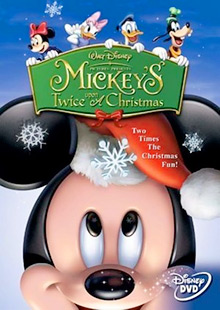
Disney: Mickey's Twice Upon a Christmas (2004)

I'm pretty sure I first realized that this was coming when I bought another Mickey Mouse direct-to-DVD film, The Three Musketeers, that same year and saw the previews before the actual film. I was aware of Mickey's Once Upon a Christmas at that point, although I don't think I'd seen it yet (I do think I saw it before this, though), and my initial reaction was, "Oh, cool, they're making a sequel to that." And then my second thought was, "Oh... it's completely CGI." Back then, CGI hadn't become as prevalent as it is now and, what's more, The Three Musketeers was hand-drawn (in a very well-done manner, I might add), so I was a bit taken aback to see Mickey, Minnie, Donald, Goofy, and everyone else animated that way (which, along with the theme park attraction, Mickey's PhilharMagic, was the first time they'd ever been done in CGI). As long as the portrayals of the characters were the same (which they are), though, it wasn't that big of a deal, just a bit surprising. And I didn't even have to wait to see it on DVD, as it premiered on Disney Channel very quickly, merely a month after it's official release. My impression upon first seeing it is the same now as it was back then: it's a very enjoyable holiday film and worth a watch but I don't think it has quite the same heart and spirit as its predecessor.


Before we really jump into it, let me set this up for you: like Mickey's Once Upon a Christmas, this is an anthology film of Christmas stories featuring the classic Disney characters, with interstitial segments featuring a narrator who introduces each story, but there are several differences here, besides the CGI. First, the interstitial scenes involve a pop-up book with pages depicting the setting and characters of each story. Second, there are five stories here instead of three (sort of the reversal of the progression from Creepshow to Creepshow 2). Third, at least in my opinion, the overall tone of feels different. While the original was nothing groundbreaking, it told three good, heartwarming holiday tales of the characters learning about love, family, and friendship and how important they are around this time of year; this film seems to go more for just comedy and to show off the CGI. That's not say that the film isn't well-made and the Christmas spirit isn't there, because that couldn't be further from the truth, but still, the heart and soul that was so prevalent in the original feels a bit subdued here. As for the CGI, I think it actually looks quite good for what couldn't have been a very big budget. I thought the characters were designed and animated well, as were the environments (the colors really pop) and the lighting and shading effects. It certainly looks a lot better than the CGI for the preschool show, Mickey Mouse Clubhouse (which I honestly thought was a video game the first time I saw a commercial for it). One final thing I have to say about the film as a whole before we delve into the actual stories is that, even though there are more stories here, the film is just barely longer than its predecessor (and even then, this one is only 67 minutes long), which doesn't leave you much time to really get into the stories and the conflicts involving the characters. One tale, in particular, I thought was completely pointless and should have either been either left out or expanded upon much more, but I'll get to that. Why are these movies so short? Is it a written rule somewhere that these direct-to-video films have to be barely over an hour? I'm just saying, maybe if they'd make them longer, they could develop the stories much more successfully.


The first story, Belles on Ice, stars Minnie Mouse and Daisy Duck. The two of them are taking part in a Christmas ice-skating competition but when Daisy gets jealous that Minnie gets to go first and the crowd really likes her routine, she decides to barge in to steal the spotlight. This, of course, doesn't sit well with Minnie and she tries to regain the spotlight and soon, it becomes an all-out skating war as the two bickering friends try to outdo each other... with disastrous results. I thought this was an interesting take on Minnie and Daisy's friendship. In more modern incarnations of the characters, it's become customary for them to be portrayed as friends, despite how Daisy's ditzy personality tends to grate on Minnie's nerves, but I don't think this had ever been done before, where they get jealous of each other and an out-and-out fight breaks out. We all know that Daisy's a bit of a diva, so it wasn't that a big of a surprise to see her become jealous, which Tress MacNeille pulls off well, but Minnie is usually portrayed as being very sweet-natured, so it was a little surprising to see her try to get back at Daisy for stealing the spotlight. She actually gets real uppity with Daisy, at one point shredding ice all over her, putting a carrot on her face to make her look like a snowman, and mockingly saying, "Quack, quack." Apparently, Minnie doesn't like being upstaged either, and it was quite funny to hear sweet Russi Taylor actually pull off that condescending attitude! 


The skating done by Minnie and Daisy is actually quite well animated (the artists actually had skater Michelle Kwan be the model for the skating scenes) and the ways in which they try to outdo each other is quite spectacular (any Disney fan worth his or her salt will get that Minnie and Daisy respectively use the alligators and hippos from Fantasia as part of their acts). The story's best strength, though, is in its visuals: as I said earlier, the whole movie is bright and colorful but this one is especially so, with the icy blue and white color scheme that fully permeates it and the pink and green spotlights used to respectively highlight Minnie and Daisy. As for the way the conflict between the two is resolved, it's simple: Minnie goes too far in trying to outdo Daisy and ends up almost seriously hurting herself when a stunt goes bad. Daisy, frightened that she may be hurt, rushes over to her and when she sees that she's okay, they both realize how awful they've been acting and decide to bury the hatchet in order to perform a big finale together, with each wishing the other a merry Christmas. You know, I was about to argue that their reconciliation had nothing to do with Christmas but, now that I think about it, I think they realized that not only shouldn't they be acting this way in the first place, they really shouldn't during a Christmas celebration so, in a way, it does have to do with the holiday. All in all, not a bad story to start off with.


The second story is Christmas: Impossible, which, like the first film's opener, is another story featuring Huey, Dewey, and Louie. The boys, along with Donald and Daisy, are celebrating Christmas Eve at Uncle Scrooge's mansion and everything's fine... until after dinner, when it's discovered that the boys gobbled up Scrooge's special cookies that he baked for dessert. Donald angrily sends them to their room and later, Scrooge comes in to warn them that, if they don't get their act together and stop being so selfish, they'll end up on Santa's naughty list and, as a result, not get any presents. Scrooge mentions that he never got what he always wanted from Santa because he was the same way. After Scrooge leaves, the boys, after remembering all the pranks they've pulled on Donald over the past year, realize that they're definitely on the naughty list and mail themselves to the North Pole so they can break into Santa's workshop and forge their names onto the good list. But, in the process, they may end up potentially ruining Christmas for everyone in the whole world!


This is a fun story, exemplifying the enhanced comic tone that I feel this film has. The antics of Huey, Dewey, and Louie are enjoyable, especially the flashback to all the trouble they've caused Donald throughout the year and the havoc they wreak at Santa's workshop. I also find it funny how they're logic doesn't make much sense at all. They actually decide that mailing themselves to the North Pole would be simpler than cleaning up their act by morning and what's more, even after they realize how naught they've been, one says, "So, you want to go put some frogs in Uncle Donald's bed?", and another replies, "Maybe later." Still don't quite get the point, do they? I also like the fact that the filmmakers gave Scrooge McDuck a bigger part here than what was basically a cameo in the first movie. He still doesn't get to do much but he's an actual part of the story and an integral one, too, as he's the one who unintentionally prompts the boys to head to the North Pole and is also a big incentive for their learning their lesson. One thing I have to comment on, though, is Huey, Dewey, and Louie's design in this film. Am I the only who thinks they look a little... odd, especially in regards to their heads? They look like big ping-pong balls with eyes and beaks and you can just barely make out some feathers on the top of their heads! They just look weird to me.


The story really gets good once the boys arrive at Santa's workshop. They find out that the room that houses Santa's list is locked, so they head to his office to get the key, crawling through an air vent that overlooks it and use a fishing pole to lower Louie down so as to get the key without waking Santa. After they get the key, they rush to get back to the list room but end up causing a mess in the toy factory in the process. There's one interesting moment where they cause a bunch of toys called Jailbreak Bob to get piled on the floor and end up losing the key amongst those that unlock Bob's cell. Unfortunately, an elf finds the key before they do and, through circumstance, it ends up being wrapped inside a present that's put into Santa's gift bag. The boys then proceed to rip open all the presents inside the bag until they find the key, not realizing that they've just ruined the elves' hard work. Just when they're about to make it to the list room, they run into Santa, who thinks they were trying to return the key to him and promptly takes it. Once the boys realize that they've potentially ruined Christmas for everyone else because of their selfishness, they decide that, while they may not be able to clean up their act, they can, at least, clean up their mess.


Even though they've learned their lesson, Huey, Dewey, and Louie are still bummed that they didn't get on Santa's good list but when one elf enters the list room and leaves the door open, they take the opportunity to sneak inside. I've always thought the design of the room and Santa's list was interesting. Santa would obviously have a very big list, so it's spread out across the entire room, with a bunch of pulleys and conveyors used to keep everything in order and it's controlled by a panel that makes it possible to go from city to city on it. One of the boys even comments, "And he checks this twice?!" They find the list for Duckburg and, sure enough, they're not on the good list. They're about to write their own names on the list when they have a change of heart and, as you find out later, write down Scrooge's name instead. I was originally going to call bullshit on that because I, at first, thought it was kind of sporadic that they would suddenly get a conscience but, now that I think about it, they realized why they weren't on the good list after they caused the disturbance in the toy factory and almost ruined Christmas for everyone, so they understood just from that alone why they didn't deserve to be on it. As a result of this lesson, not only did they help save Christmas but they also decided to do something nice for someone else for a change. These good deeds result in them being rewarded with presents from Santa, who sends them a note telling them that their helping clean up the mess in the factory and putting Scrooge on the good list earned them a spot on it as well. He also takes pity on them by sending them earplugs, as Scrooge can't really play the bagpipes that he's always wanted that well. Now that I think about it, that is a nice Christmas sentiment, so it's good thing I thought about it before I started writing this. It's also funny that Donald's present was The Big Book of Manners, which feels like something someone would give to him. All in all, this was a fairly enjoyable, well-made story.

The third story is Christmas Maximus, featuring Goofy and Max. It centers around Max coming home from college for the holidays with his girlfriend, Mona (no mention is ever made about whatever happened to Roxanne, who was Max's girl in A Goofy Movie and on an episode of House of Mouse, although Mona is voiced by the same actor, Kellie Martin). Max, needless to say, is not so sure he wants Mona to meet his dad and before they leave, he calls Goofy to remind him about her and tells him to try to not embarrass him in front of her during the visit. Goofy assures Max that he'll try to be cool but, of course, Goofy ends up embarrassing Max constantly, frustrating his son.


This is my least favorite story for several reasons. One, it's by the far the shortest in the film, as it can't last any longer than seven minutes, and I don't get why they put this story in if they were going to barely anything with it. Second, most of the story takes place with this song by Scott Leonard called, Make Me Look Good, playing over it, so the voice actors (Bill Farmer as Goofy, Jason Marsden as Max, and the aforementioned Kellie Martin) have little to do. I think they could have done a lot more with it by having it actually play out normally story with the voice actors actually, you know, acting. Finally, and my biggest problem with this story, it's yet another tale about how much Max has to put up with his dad's clumsy and embarrassing antics. How many times have we seen this story? Many episodes of Goof Troop were about that and we've already had two movies featuring teenage Max's conflict with his dad (A Goofy Movie and An Extremely Goofy Movie), so why do we need to devote yet another story, and very small one, to it? Is that really all Disney can come up with in regards to these characters? And what's more, it ends exactly as you would expect: Max realizes how much he loves his dad, despite how embarrassing he can be, and he, Goofy, and Mona have a nice Christmas Eve. So, in essence, the conflict's resolution had nothing having to do with Christmas, which was it was merely a backdrop (unlike the story featuring Goofy and young Max in the original, which was very much about Christmas). I'm sorry if I sound overly harsh but I just find this story to be a waste of space and would have rather have had them put one of the other proposed stories that wasn't used in its spot.

Next up, we have Donald Duck in Donald's Gift. After a bad day of Christmas shopping that involved him missing his bus, being forced to walk, and hearing We Wish You a Merry Christmas sung so much that he's sick of it, Donald makes it home and prepares to simmer down to a night of peace, quiet, and hot chocolate. Unfortunately, he doesn't get to enjoy one sip before Daisy and Huey, Dewey, and Louie burst in, asking if he's ready to go to the mall to see the Christmas decorations, including a new display at a department store. Donald, of course, doesn't want to go, but Daisy forces him to. Before the display is unveiled, Donald wanders off to buy some more hot chocolate but every little noise that he hears in the mall plays the tune of We Wish You a Merry Christmas. He hears it again and again until he finally breaks... and ends up shaming Daisy and the boys with his lack of Christmas spirit.


I like this story, mainly because it's always funny to see Donald lose his cool, although it seems with these Christmas films, they can never decide whether Donald enjoys the holiday season or despises it. But, then again, while I do enjoy Christmas, the holiday rush of buying gifts can grate on you, especially when you're stuck at the mall in huge crowds (which I hate). Sometimes, you do just want to sit back in your warm house and enjoy some hot cocoa, which is why I can't blame Donald for being grumpy when Daisy and the boys force him to go back to the mall. When Daisy tells him to quit being such a grouch, I'm like, "The guy's had a bad day and just wants to have some peace and quiet. Leave him alone!" I can also relate to Donald getting so frustrated at hearing Christmas carols over and over again, especially nowadays when it seems like Christmas comes sooner and sooner every year and they start shoving it down your throat earlier as well (although, I don't know if I would go as far as to destroy a Christmas display at a department store). But, you know what, even though Donald realizes what a jerk he's been and how disappointed Daisy and his nephews are in him, I still can't help but feel, "Daisy, if you'd just left him alone, this wouldn't have happened." Maybe that's just the lazy guy in me talking but that's my feeling. Still, it is nice to see Donald help a group of carolers get back into singing We Wish You a Merry Christmas with heart and for Daisy and the boys to learn that he does have some Christmas spirit after all. Not much else to say. It's an entertaining story but not without its flaws.


The final, and longest, story, Mickey's Dog-Gone Christmas, focuses, as you can guess, on Mickey and Pluto. Mickey returns to his house with a lot of Christmas decorations for the night's Christmas party and, much to Minnie's dismay, he's gone overboard and put up too many decorations in the house (apparently, Mickey is like Tim "The Tool-Man" Taylor from Home Improvement in his habit of going overboard with Christmas). Pluto wants to put the star on top of the tree but Mickey tells him that he has to be patient and wait. Unfortunately, Pluto can't wait and tries to put the star on the tree anyway, which leads to him accidentally causing a chain reaction that destroys all the decorations. Mickey leaves to buy more and angrily tells Pluto to go to his doghouse. Hurt and feeling unwanted, Pluto takes off his collar and runs away from home, hopping aboard a train that leads him to the North Pole and Santa's workshop, where he's adopted by the reindeer, particularly Donner, who names him Murray (as in, "Murray Christmas"; to quote Blitzen, "Oh, my head.") Meanwhile, Mickey discovers that Pluto has run away and, feeling guilty for yelling at him, heads out to find his best pal.


This is undoubtedly the best story in the film. There are two typical characterizations of Mickey Mouse: the feisty, prank-pulling but still overall good guy of a rascal and the squeaky clean boy scout. The characterization here, along with the one in most of the shorts involving Mickey in Mickey's Mouse Works and House of Mouse, is kind of in the middle: Mickey's a nice guy for the most part but has his breaking point and does get exasperated when things go wrong. Even though Pluto is his best pal, he loses it with him big time, so much so that Pluto actually runs away. I personally prefer this characterization of Mickey as it makes him feel more like a real person rather than a bland overall nice guy. I also like Pluto in this film because he really comes across as a pet who doesn't mean to get in the way and cause trouble but just does and most of us have had a dog or a cat like that at some point in our lives. Bill Farmer's vocalizations when Pluto feels sad about Mickey being angry at him and later when he's missing him are quite moving and so is the animation of Pluto's facial expressions, which really convey the emotion in him (just like in the classic Pluto cartoons from the 40's and 50's).


I also can't help but like the other characters in this story especially the two lead reindeer: the gruff leader, Blitzen (voiced by Jim Cummings), and the scatter-brained, slightly dim-witted Donner (voiced by Jeff Bennett). Donner, in particular, makes me laugh just because of how dumb he is and how short his attention span is as well, which really frustrates Blitzen. (The exchange of dialogue between those two that really gets me is when Santa says that Pluto is come homesick and Donner asks, "Who's Pluto?" Blitzen says, "I think he's Murray." "Murray's Pluto?" "Bingo." "Bingo's Pluto?" Blitzen, not wanting to have to talk really slowly, just groans and says, "Yes.") Speaking of Blitzen, as tough and responsible as he seems to be, you find out that a Christmastime disaster that was alluded to in an earlier story was apparently his fault, which Donner blurts out. I also have to mention Chuck McCann as the voice of Santa Claus because, in both of the stories involving him, especially this one, he comes across as the truly kind, jolly soul that you would expect Santa to be. In fact, Mickey is lucky because, when he resorts to going to a department store Santa to help find Pluto, he happens to come across the real one and when Santa talks about Mickey to Pluto, you can hear the genuine kindness in his voice. I also like the ending scene where Mickey and Pluto get back together and reconcile, leading to the ending where all the main characters featured in the stories come together for their party and sing the same mixture of carols that they did at the end of the first movie (which is kind of odd since they use the same audio from Mickey's Once Upon a Christmas, which featured the voice of young Max while teenage Max does show up with everyone else here, but whatever).


As with Mickey's Once Upon a Christmas, this film has several directors: Carole Holliday, Matthew O'Callaghan, and Theresa Pettengill and, also like that film, they manage to make the stories and the interstitial blend together to keep a consistent look and feel with their great CGI animation and vibrant colors. It was also interesting to hear about some of the proposed stories that weren't used on the DVD special features, one in particular which I found intriguing: how Mickey and Minnie met, which involved Minnie being all alone on Christmas Eve and running into Mickey somewhere (I can't remember if it was at a store or what). That would have been interesting to see because, other than cartoons where it's the characters playing parts themselves like in The Three Musketeers and some of the classic shorts like The Brave Little Tailor, they've never tried to do that kind of story with the characters in their own personal scenarios (I hope that makes sense). Maybe if they ever do a third movie, they'll use that one. The directors also put in a running joke involving a grumpy old man character who appears in four of the stories. His most notable appearance is in Donald's Gift, where hot chocolate gets spilled on him twice, and he can also be seen in the crowd in Belles on Ice, in Christmas Maximus with Max spilling something on him on the train, and in Mickey's Dog-Gone Christmas where Mickey gives him a MISSING flier with Pluto on it and he just throws it away. Think of him as this film's version of the man with the bottle who appeared in three James Bond films in a row.

As far as the music by Stephen James Taylor and Jim Wise goes, I really don't have much to say about it. Other than the opening music and the pieces that plays during the skating scenes in Belles on Ice, none of the music left that much of an impression. However, I do have to put over the song that plays over the ending credits: Share This Day by Scott Kelley, which is the best part of this entire movie in my opinion. That song is just so wonderful, catchy, and heartwarming that, if it doesn't put you in the Christmas mood, you either don't have a soul or you must have been sleeping. It's a shame that song isn't more well known because it's just such an awesome holiday medley.

Although it's not quite on the level of its predecessor, without the same amount of heart and is geared more towards just getting laughs than it probably should be, Mickey's Twice Upon a Christmas is still an enjoyable holiday flick. Despite its faults, it's still fun, with great CGI animation and designs, vibrant colors, stories that range from fair to pretty good, good performances by all of the voice actors as usual, and a nice, heartwarming song over the ending credits. While I do prefer the first one, this is still one that I also recommend picking up and enjoying for the holidays.

Wednesday, December 14, 2011

Disney: Mickey's Once Upon a Christmas (1999)

Now here's a little known, direct-to-video Christmas film from Disney that slipped quietly into stores in 1999 and, ever since then, it's been a little hard to find people who've actually seen it even though it's easy to find on DVD and pops up on Disney Channel every now and again. I was twelve when it originally came out and was going through that phase where I decided I was too old for Disney but, as I've said many times, by my senior year in high school, I had regained my child within and sought this movie out. I'd actually seen it on VHS in a Wal-Mart the year before but I got something else instead (another Christmas-related Disney film, Mickey's Magical Christmas: Snowed in at The House of Mouse); this time, however, I scooped up the DVD when I saw it again. In fact, it was actually on my yearly Christmas list for my Mom and she got a little annoyed at me when I got it myself. In fact, I'd actually seen it on Disney Channel not too long before I actually bought it and I knew it was something I had to add to my collection from just that one viewing. I still think this is a very nice, heartwarming little Christmas film with the classic Disney characters. It's nothing groundbreaking, mind you, but it's absolutely charming and has its heart firmly in the right place.

The film is an anthology with three stories, each featuring different Disney characters in a Christmas tale, with a wraparound involving three gifts that relate to each story narrated by Kelsey Grammer. And so, rather than giving an overall synopsis like I usually do, I'll simply go through each story, talking about the characters and what I think of them. The first is Stuck On Christmas, starring Huey, Dewey, and Louie, who wake up on Christmas morning naturally excited, as all young kids do, and, also like most kids, they're more interested in having fun and getting their gifts rather than spending the day with their family. They immediately open their presents even though they're supposed to wait for the rest of the family to arrive, take the sleds Donald got them for a ride without reading the card included with them, pig out on Daisy's Christmas dinner, and play with their toys instead of singing carols with everyone else. Since they enjoyed the day so much and are bummed that Christmas is over already, they wish upon a star that it was Christmas every day. The next morning, they wake up to discover that their wish has come true and they're ecstatic... at first. After a while, though, they start to get sick of the same events happening day after day and do what they can to make it more fun for them. By the end, though, they learn what Christmas really means and why it can't be year-round.


Huey, Dewey, and Louie are the main characters of this story, all three of them voiced by Russi Taylor, who often voices them whenever they appear in contemporary Disney productions. When it's not her, it's Tony Anselmo, the modern voice of Donald Duck, who does them, and since I watched DuckTales a lot, I prefer Ms. Taylor's performance. Whenever Anselmo does them, he just does his Donald voice in a slightly higher pitch but Ms. Taylor is able to actually make them sound like young boys (and plus, I can understand them better when she does them anyway). In any case, their characterizations tend to differ from one cartoon to another: sometimes, they're characterized as just freaking mean little kids, which was the case in many of the classic cartoons, and other times, it's more like, "Boys will be boys." Their characterization here, as it often has since DuckTales, leans more to the latter: they're just very energetic and rambunctious kids who are excited about Christmas. They don't mean any harm by what they do but they also don't quite grasp what the holiday is really about and grow weary of it when they have to live through it day after day. However, they learn what it means when they decide to change things up one day by playing pranks on the family and end up unintentionally wrecking the house in the process. They're about to go sledding before Donald has a chance to get mad at them and that's when they see that, instead, of being angry, he's shattered by what's happened after the Christmas tree has fallen over onto him. They also finally bother to read the card that came with their sleds and discover that Donald and Daisy were trying hard to make this a special day for them full of love and family. Feeling guilty, they make the next day the best Christmas they can, having learned its true meaning and thereby breaking the time loop (very akin to Groundhog Day when Bill Murray stopped being a jerk and started being a good person).


Donald Duck, voiced, of course, by Tony Anselmo, is his usual hot-headed self here but, at the same time, he also wants this to be a great Christmas for everyone and especially for the boys to know how much he and the rest of the family care about them and what this time of year means to them. You wouldn't expect Donald to be this sentimental but, as I said in my review of Mickey's Christmas Carol, his mood tends to change from one appearance to another, as is the case with any character, I guess (ironically, in one of the segments in the sequel to this, his Christmas spirit is almost nonexistent). You've also got Daisy Duck (voiced by Tress MacNeille), Scrooge McDuck (voiced by Alan Young), and a character I'd never seen before this but may have been in the Donald Duck comics, Aunt Gertie (also voiced by Ms. MacNeille). Daisy and Scrooge are mainly just kind of there and don't do much significant: Daisy makes Christmas dinner, as well as tries to get Donald to kiss her under the mistletoe, and Scrooge often tries to get everyone to sing Christmas carols. However, there's a funny running joke with Aunt Gertie being one of those female relatives that kisses you to death whenever you see her and Huey, Dewey, and Louie end up soaking wet each time as a result. With each Christmas day, there's a new spin on it: they forget it's coming; they try to run from her but Donald forces them to let her kiss them; they put wetsuits on to avoid getting waterlogged; and finally kiss her themselves on the last day. Chip and Dale are also shown to be living in a birdhouse next to Donald's, playing with a toy train each time they're seen.

Out of the three stories in this film, I'd have to say that this is my least favorite. Don't get me wrong, I don't hate it, but I like the other two stories about the bond between Goofy and his son and the love between Mickey and Minnie Mouse a lot more. This is a nice Christmas story, too, and it's important not only for Huey, Dewey, and Louie to learn what Christmas is really about, but other kids around that age as well, but when I first saw this as a young man, I gravitated more towards the other stories. Also, here's an unusual little tidbit that I honestly didn't think about until someone brought it up: all of these characters are ducks, right? Then, why are they eating turkey?! Again, I didn't even think about it for the longest time but, you have to admit that it is a little strange. For me, with these characters, they're so much like people that you tend to forget that they're actually anthropomorphic animals and just go along with it. But, yeah, ducks eating turkey. Weird, isn't it?

The second story is A Very Goofy Christmas, which, as you can gather from the title, centers around our favorite dimwitted dog and his son, Max. On Christmas Eve, the two of them rush to get a letter mailed to Santa Claus at the North Pole, causing a lot of slapstick havoc in the process. But, later that day, their neighbor, that big, blowhard jerk Pete, tells Max that Santa Claus doesn't exist because the idea of it is just so unbelievable. Goofy does his best to assure his son that Santa does exist but, when Max exposes Goofy dressing as Santa for some kids, he feels that his father has tricked him and now, Goofy must try to get Max, and later himself, to believe again.

If you've ever watched Goof Troop, you'll notice that this story follows its setup quite closely, with Goofy and Max living next door to Pete, and even I've heard some sources say that this story is supposed to take place a bit before it. That would make sense, considering that Max seems much younger here than he was in that show (his belief in Santa being a big part of that), but, at the same time, I'm not so sure because that show begins with Goofy and Max moving back home after having been away for a while. Could they really have ended up moving into the very same house they lived in before? Also, there's no mention of Pete's wife and kids in this story, particularly Max's friend in the show, P.J., who was roughly the same age as Max. You could argue that you just didn't see them but, taking into account that Max and P.J. meet for the first time in that first episode of Goof Troop, which, again, is supposed to take place after this, it just doesn't make sense. But, then again, Disney never really follows any kind of continuity with the shorts and TV shows featuring their classic characters (particularly in there being no mention of Max's mother), so it's not something you should rattle your brain over.


As is always the case in the modern era, Goofy is voiced by Bill Farmer, but since Dana Hill, the voice of Max on Goof Troop, had died from complications brought on by diabetes by this point, Shaun Fleming voices Max here. In Goof Troop, most of the comedy came from the fact that Max isn't as dim-witted or clumsy as his father and is actually a normal kid and that holds true here as well... for the most part. As usual, Goofy is a well-meaning father and an all-around good guy (he helps out a family that's been going through a rough patch lately) but he's dopey and clumsy, often causing his son a lot of embarrassment, but it's always clear that Max does love his father, even if he is an absolute idiot most of the time. As I said, Max is younger here than in Goof Troop (I'd say maybe seven or eight) and still believes Santa Claus is real, going to the trouble of having his Christmas list mailed to the North Pole. Unfortunately, mean old Pete (voiced by Jim Cummings) makes Max doubt Santa's existence and he starts trying to scientifically examine how Santa could possibly be real. Poor Goofy, who sincerely believes in Santa just like his son, does his best to explain away Max's fears but doesn't do a very good job at it. I do like this dynamic, as it feels like Max is approaching that age where most kids begin to doubt Santa's existence (it was a little later for me, though) and you also can't help but love Goofy for still having the innocence of a child even though he's an adult, no doubt due to his less than average intelligence.


Another interesting part of this story is how much Goofy and Max are actually alike. When Max uncovers his father playing Santa for the kids of that down on their luck family, he feels betrayed, that Goofy lied to him. Goofy tells Max that he was just trying to make those kids happy and also tries to convince Max that Santa is real since he's clearly lost his faith in it completely. Goofy puts sky-watch equipment on the roof and has Max stay up with him to keep a look out for him, but when there's a false alarm at one point, Max leaves Goofy on the roof and tries to go to bed. He can't sleep, though, and wishes that his father would just grow up... and that's when he sees something truly touching: Goofy shoveling the message, DON'T FORGET MAX, in the snow in his driveway. This makes Max realize how much his dad cares about him and that he's doing all of this for his sake. However, another false alarm, this time a burglar coming out of Pete's chimney that Goofy mistakes for Santa, ends up destroying Goofy's own faith in Santa. Now comes  an interesting role reversal where Goofy is just like his son in that he's devastated that Santa apparently isn't real and Max tries to cheer his father up, doing the same stuff that he did earlier, even dressing up as Santa, which Goofy does fall for at first. The ruse doesn't last long but it brings them closer by the end, with Goofy saying that he may have let Max down but Max didn't let him down.

The best part of the story is the ending, with Santa turning out to be real after all and giving Max the snowboard he wanted. You also see the bond between Goofy and Max that this ordeal has no doubt strengthened between them as Goofy says that he always simply wishes for Max to be happy every year which, despite his own innocent belief, is the main reason why Goofy was disappointed when it seemed like Santa wasn't real. Max has also learned about the gift of giving, as he goes to share his new snowboard with the ones of the kids in the family Goofy helped and played Santa for the previous night). Besides all this heartwarming stuff, you also have to snicker at Pete who, after having denied Santa's existence, tries to flatter him when he discovers that he is real.

I must say, I really like this story. I hope I didn't sound like I went too deep and philosophical on something very simple but that's what this segment stirred in me. I really liked the idea of it being about the bond between a father and son, made all the more effective in that it's a father and son that we're familiar with. Like I said earlier, Goofy, to me, has always been a good person despite his idiocy, exemplified when he takes food and decorations to that family that's hit hard times, and I also like Max, mostly when he's a kid and especially on Goof Troop. (I like him when he's a teenager sometimes, although there are moments there where he's kind of cruel towards his dad. That said, some of the stuff his dad does is pretty embarrassing). He's definitely a likable kid here, just as much or even more as he is on the show. You also got to love Pete, even if he is a big jerk (he's also in the third and final story and he's an even bigger jerk there, as we'll see). Anyway, I just think this is a sweet little Christmas story about a father and son.

The last story, and my favorite, is Mickey and Minnie's The Gift of the Magi. Based on the classic short story by O. Henry, it tells how one Christmas, Mickey and Minnie attempt to get special gifts for each other (Mickey intends to buy a golden chain for Minnie's heart-shaped watch, her only heirloom, and Minnie plans to buy a case for Mickey's beloved golden harmonica), even though each of them have very little money. Unfortunately, their respective employers screw each of them over in terms of their pay and they're both left with no possible way of getting the gifts they intended. If you know the short story, you know where this is going: when they meet up on Christmas Eve, each discovers that the other gave away their prized possessions for the gifts but, in spite of that, they still have each other and that's all that matters.


This is my personal favorite story in the film for many reasons. One, I love Mickey and Minnie Mouse to death. They're my favorite Disney characters. I know some may roll their eyes at that but I just can't help but find their relationship, in all its forms, to be very sweet and heartwarming, and I like seeing how much it's grown from their first appearances in the classic cartoons of the late 20's and 30's. It was mainly a love at first sight thing with them but it went on to become a slightly more complex one in some of the shorts in the 40's, which led to more sophisticated stories of their relationship like this one. Some may find it to be very saccharin (as with a lot of Disney's stuff in general) and that's fine, to each their own, but I've always really been drawn to these characters. Second, I really liked the way Wayne Allwine and Russi Taylor played Mickey and Minnie. If you didn't know, the two of them actually became a couple and married in real life. Not only did that make for an odd coincidence, to say the least, but as a result, the chemistry between Mickey and Minnie always felt very natural and strong because it was being done by a real couple (which is why I was quite hurt in 2009 when I heard that Allwine died). I feel that chemistry is particularly strong here. You can see the love these two have for each other, the lengths each of them are willing to go to in order to make the other happy, and the realization at the end of how much they truly mean to each other. It may not be the most realistic thing but I find it to be a nice, heartwarming bit of sentiment that's a breath of fresh air in a very cynical world.


While Pluto, Figaro, and Daisy Duck have small roles in this story, the other characters who are really notable are Mickey and Minnie's horrible employers. Mickey, unfortunately, works for Pete, who owns a Christmas tree lot and, as usual, he's a selfish, greedy jerk who tries to trick a poor family into buying an expensive tree they can't afford and, given what one of the kids says, probably couldn't even fit into their house by telling them that it's the last available one on the lot. Mickey, however, convinces the family to take a much smaller, cheaper tree and he makes a lot of money in tips, but Pete, furious at him for ruining his chance at selling one of the big trees, cruelly takes all of his money to make up for what he would have made and throws Mickey and Pluto off the lot. He ends up getting what's coming to him, though, when he unintentionally puts his lit cigar into his back-pocket and stupidly tries to put it out in paint, which ends up burning down his lot. He also ends up unintentionally spoiling Christmas for other people, as there's this Firehouse Toy Drive going on which Mickey and Pluto get roped into performing for because the band is too busy putting out the fire at the lot. Mickey, at first, isn't willing to perform since he needs to find a way to get Minnie's present before the day's over but, being the good guy he is, he goes through with it when he sees how much it means to the kids. That's what I like about Mickey Mouse: whether he's the rascal he once was or the overly nice character he's typically depicted as nowadays, he's always a good person at heart. (Incidentally, when he's dancing around on the stage, he does a dance move and makes a facial expression that's exactly like what he did in the 1940's short, Mickey's Birthday Party.)


Minnie's employer is actually a character from the past: Mortimer Mouse (voiced by Jeff Bennett). If you've seen the cartoon Mickey's Rival, you'll remember this guy as this obnoxious rat who was apparently an old boyfriend of Minnie's and made Mickey's life miserable for the short time he was around (I'm pretty sure this was his first appearance since that cartoon and he's been a recurring character in most Mickey Mouse-related stuff since then, trying to steal Minnie away from Mickey at every turn). Here, his characterization is a bit different, as he's portrayed as a pompous tycoon who's unable to remember Minnie's name and whose "Christmas bonus" for her turns out to be a big fruitcake. And after giving it to her, he tells her, "Now, scoot along back to the gift-wrapping department where you belong," with Bennett using that uppity, pompous voice he tends to use quite frequently all the while, which works very well for the character. Minnie's disappoint at this is quite heart-wrenching, especially when she wonders aloud how she's going to get Mickey's present now.

The best part of the story is the sweet ending which, just like the short story, gets across the notion that even though the their gifts to each other are essentially useless now, the thought behind them is what matters and Mickey and Minnie also realize how much they mean to each other, which is what's really important. Seeing Minnie lovingly hug Mickey when he tells her, "You're all the music I'll ever need," is as heartwarming as you can get, and I also can't help but smirk at Minnie's closing line: "What some fruitcake?" Well, someone's going to have to eat it!


Going back to what I said in the introduction, in addition to the actual stories is a wraparound segment featuring three gifts underneath a Christmas tree signifying the stories' various themes and significances. Narrating the segment and introducing the stories in rhyme, Kelsey Grammer does a pretty good job of conveying the spirit of the season as well as the meaning of the stories, and to cap it all off, there's an ending segment where all of the main Disney characters come together to sing carols, finishing with, We Wish You a Merry Christmas, which I think is a nice, charming little way to wrap things up. As with most animated films, there were several directors involved, with Alex Mann directing Stuck On Christmas along with Bradley Raymond and some additional material as well as; Jun Falkenstein and Bill Speers directed A Very Goofy Christmas; and finally, Toby Shelton directed Mickey and Minnie's Gift of the Magi, as well as the interstitial segments. You'd think so many different directors would mean each segment would look different from the others but they actually all manage to gel together into a whole that's mostly consistent in style (something that Disney is quite good at), with only some slight differences here and there (for instance, Daisy looks a bit different in her small appearance in the Mickey and Minnie story from the way she did in Stuck On Christmas and Mickey and Minnie look different in their story than they do in the closing piece). One thing I think that the directors really got right is the wintery look of the stories, with those beautiful, pinkish sunsets that you often see this time of year and color schemes that make everything look and feel cold when it's outside and warm and cozy inside. I also thought the animation was quite fair for a direct to video film. Granted, it's definitely not theater-level, but it serves its purpose and does its job well. I know there are many who don't like the very neat and clean-looking animation look that's prominent since the 90's, maybe feeling that it looks a little too cold and sterile, but I myself usually prefer it to the more rough-looking stuff from around the same time (like on the TV show, Mickey's Mouse Works, where some shorts don't like quite as clean and polished as others).

Like everything else in this film, the music by J. Eric Schmidt may not be anything special but it does nothing less than serve its purpose well and exemplify the emotions of the scenes: Christmastime, happy, sad, funny, etc. Most of the music is just instrumental versions of classic Christmas songs and I particularly like the band version of Jingle Bells that plays during the scene where Mickey plays along with them for the toy-drive, as well as the Christmas carols sung by the characters at the end (those voice actors are all really good singers in their own right). Finally, I have to mention the version of Deck the Halls sung by the music group SheDaisy over the ending credits. Some may not like it when modern music groups like this do songs for Disney and other animated films but I think the way they sounded while performing this song was really nice and gives you that Christmas feeling.

Mickey's Once Upon a Christmas may not be anything earth-shattering but I don't think that's really the point. The animation is simple and the look may be too polished and possibly even cheap-looking for some people but I think it's heart is definitely in the right place and that's what matter. The three stories told within are nice, little heartwarming tales of love, family, and the true meaning of the season and, honestly, in a world and time so cynical, full of hateful and, in some cases, downright evil people, I think stuff like this is needed to remind us that there is good in the world around this time of year and should be year-round. That was a little mushy and overly sentimental, I know, but that's how I feel. If you haven't seen it, then by all mean,s get some hot coco on a chilly night near Christmas, gather around the fireplace, pop this in, and enjoy. You might be surprised by how successfully it puts you in the holiday spirit.