Tuesday, October 2, 2018

The Sound of Silence: Dr. Jekyll and Mr. Hyde (1920)

As with Dracula, Frankenstein, and other similar stories, my first exposure to the classic horror tale of Jekyll and Hyde came from the famous film adaptations rather than from Robert Louis Stevenson's original book. More specifically, it was from one of the Crestwood House monster books that I found and often checked out of both my school's library and the public library in the town where my aunt lived twenty minutes away (I wouldn't actually see any of the movies until my 20's!) As I've said before, some of their books simply told a specific film's story, while others told the same as well as gave behind-the-scenes information on many different films of a particular subgenre, and one example of the latter category was a book on "mad scientists," which had an image of what I would, many, many years later, learn was Boris Karloff as Fu Manchu on the cover. The story of Jekyll and Hyde was the first film it went into, but it was about the 1931 version starring Fredric March, and since I have not laid eyes on those books since I was in elementary school, I can't at all remember if it even mentioned the silent version we're talking about here. I don't think it did, though, and the earliest I can recall knowing about this film was in that book I've mentioned before called Monster Madness, which I bought when I was around eleven or twelve years old. It was in the book's smallest section, Science Has Run Amok (the only other entries were on the Invisible Man and the Fly), where the various movie adaptations of Jekyll and Hyde were briefly discussed, with the first one that was specifically mentioned being this. There had already been several film adaptations of Jekyll and Hyde by the time this one came along, with this itself being one of three that were released in 1920 alone, so when they were picking and choosing which ones to feature in their book, it wasn't surprising the authors decided to go with the first really famous version. They didn't say much about it other than commenting on what a tremendous star John Barrymore was at the time and how he, along with Spencer Tracy in the 1941 version, used very little makeup to make the change from Jekyll to Hyde, and the only image from it they showed was the poster, which you see here, but, like so many other books on this subject, it was enough to get me interested. Funnily enough, this would end up being the first of the three major Jekyll and Hyde movies I would see (technically, the first one I ever saw was Abbot and Costello Meet Dr. Jekyll and Mr. Hyde), as it was part of that public domain horror film set I got for Christmas in 2008 that also had The Cabinet of Dr. Caligari. I liked it for what it was when I saw it, in spite of the really bad picture quality, and, after watching better prints of it on YouTube, I can say I find it to be a respectable film and unexpectedly creative at points, but I like the 1930's and 40's versions of the story better.

Dr. Jekyll and Mr. Hyde is definitely the most well-known film from director John S. Robertson, who started off as both an actor and director in the early days of cinema before moving into the latter profession full time by 1917. He worked first for Vitagraph and then the Famous Players-Lasky Corporation, directing shorts before making his first feature, which was a 1917 movie called Intrigue, and in the latter part of his career, he was under contract to bigger, more notable studios like Paramount (where he made this film), MGM, and finally RKO. Though most of them are very obscure or maybe even lost, he made nearly 60 feature films during his career, which ended in 1935 after the movie, Our Little Girl, with Shirley Temple and Joel McCrea, and it seems like the reason why he walked away from films was because, like many directors who began in the silent age, he had a tough time adapting to the new medium sounds and it was obvious at that point that talking movies were here to stay. Robertson died in 1964 at the age of 86, having lost wife, screenwriter Josephine Lovett, six years before. Interestingly, a song by the Byrds called John Robertson is based on him, as Chris Hillman found him to be an intriguing person, and Lovett is mentioned in the song as well.


John Barrymore's performance in the dual title role may be a very lauded one from the age of silent horror but, truth be told, his portrayal of Dr. Henry Jekyll is quite straightforward for the most part, with few complexities. From the outset, Jekyll is shown to be a man who's equally interested in radical ideas in science (the first scene is him studying something beneath a microscope) as he is devoted to the care of the poor at his clinic, which he maintains out of his own pocket. He's so caught up in these two sides of his profession that he doesn't have much of a social life, unintentionally neglecting both his friends and his fiance, Millicent, but other than that, he is an absolute gem of a man and one who is seen as the salt of the Earth by his patients and his peers. As such, this compels Sir George Carew, his fiance's father, to test this apparent purity by taking Jekyll to a music hall and having one of the lovely, scantily-dressed dancers come on to him. Feeling the urge to act on his basic, primal emotions for the first time in his life, Jekyll quickly gets himself away from the dancer and the music hall, although this experience makes him fascinated with the dual nature of humanity, as he ponders, "Wouldn't it be marvelous if the two natures in man could be separated, housed in different bodies?... Think what it would mean! To yield to every evil impulse, yet leave the soul untouched!" He then devotes himself to finding a way to do just that, leading him to develop the serum that transforms him into Mr. Hyde. After he's able to become Jekyll again and realizes that his experiment has worked, he becomes ecstatic and intrigued at the possibilities it affords him to lead both possible sides of life and tells his servant, Poole, to allow Hyde to come and go as he pleases and have full authority of the house. For a time, he indulges in his more primal and savage desires as Hyde, going as far as to bequeath everything to him in his will should anything happen to he himself (in short, should he find himself unable to become Jekyll again), but after a while, he becomes repulsed by the horrible things that Hyde does. Concerned as well for Millicent, he decides to resist Hyde's dark urges, and it works for a while, until he becomes Hyde again during a moment of weakness.

After this latest stint as Hyde leaves a young boy badly injured, as well as suspicion cast on Hyde's link with him, as Sir George and his friend, John Utterson, got caught up in the incident, Jekyll is terrified of the prospect of his evil side now completely dominating his life and he becomes more and more reclusive, staying in his lab for most of the time. When he unintentionally becomes Hyde again when Sir George visits him and he becomes enraged at his questioning him, accusing him of making him, "Ashamed of my goodness... Long for a knowledge of evil!", and ends up murdering him, Jekyll becomes even more of a shut-in, especially when the transformation happens in his sleep one night afterward. Locked inside of his lab, he becomes very tortured and frantic when he runs out of the drug needed to make the chemical that could keep Hyde from emerging and has a full-on breakdown when he's told by Poole that there is no more of it to be found in London anywhere. When Millicent comes to visit him, Jekyll is initially happy at the prospect of seeing her, but when he starts to become Hyde and is unable to convince her to leave, he commits suicide by swallowing some poison before he fully changes. It takes a little bit for it to work and Hyde almost harms Millicent when he lets her in but he ultimately succumbs to the poison and reverts back to Jekyll after he's died, a sight that only his friend, Dr. Lanyon, witnesses.


As straight-laced as his performance as Jekyll mostly is, I can appreciate what Barrymore does with it but, as blasphemous as this is going to be to some, I can't say the same for his performance as Mr. Hyde. While I respect that he pulled off the first transformation live on camera, with no optical effects save for the close-up of his hand transforming, and that he didn't use much makeup at all, I've never found his Hyde to be all that menacing or exceedingly evil, especially when compared with Fredric March's rabid, violent portrayal and Spencer Tracy's sadistic and emotionally abusive one; in fact, with his exaggerated facial expressions and hunched manner of walking, I find him to be kind of silly more than anything else. I understand that during this time period, the acting style was very exaggerated and theatrical, as that's what people were used to, but when I see Barrymore making those weird faces when he first becomes Hyde, which he maintains throughout most of the movie, I can't help but smirk. As they often do with this story, each time he becomes Hyde, he's more and more hideous-looking, and there are moments where his crazed eyes and sharp teeth do make him look intimidating, particularly when he comes at Sir George Carew after transforming, but for the most part, I have a hard time taking him seriously. When it comes to the portrayal itself, this Hyde doesn't do anything so monstrous as to make me hope that he gets his. Yes, he forces the dancer, Miss Gina, to stay at his seedy London apartment, and you can only imagine what he makes her do during the time she's there, before he unceremoniously throws her out, he acts very cruel towards her when he runs into her again at an opium den, and he forces himself on the one poor girl upstairs in that place, but I don't really feel the impact of just how evil and vile he's supposed to be. The one thing he does do that I find really horrendous is when he knocks this really little kid over in the street and cruelly puts his foot on his back to taunt his friend before paying off the kid's father. Had he done more stuff like that, I would've found him to be a more effective villain. If you're wondering, "What about when he kills Sir George?", as violent as that is, as Hyde appears to bite into his neck before beating him with the cane, as I'll get into, I find it hard to feel bad for the guy for a couple of reasons. And as for the ending, where he almost has his way with Millicent before succumbing to the poison, I knew they weren't going to kill her off, so there wasn't much suspense.

When it comes to Mr. Hyde's actual look, it's not as iconic as the way Fredric March looked in the 30's film, with his ape-like makeup, and, again, I find Barrymore's facial expressions to be way too silly most of the time, but it is still very memorable in its own way, especially with that long, stringy hair, sharp teeth, and cone-shaped head that he develops during the latter part of the movie (his head kind of looks like Michael Berryman's but with hair). Those long, creepy fingers with those disgusting-looking fingernails are also a nice touch, and he does manage to look a little bit menacing when he's wearing his traditional cape and top hat... that is, until he starts making bizarre faces again (I know I'm beating that into the ground but I just can't get over it).


The most interesting character in the film to me is actually not Dr. Jekyll but Sir George Carew (Brandon Hurst), the father of his fiance, Millicent. His introductory scene reveals him to be the opposite of Jekyll in many ways, with the intertitle describing him as someone who is, "Always as far from misery and suffering as he could get," and when you first see him, he's reading the gossip column. Having been someone who has most certainly "lived," as it were, he finds it impossible to believe that Jekyll is as pure as everyone says he is, and when he joins him and his colleagues for dinner at his house that night, he tasks him about it, suggesting that he's devoting so much of his time to others that it's at the expense of his own personal life. When Jekyll asks, "Isn't it by serving others that one develops oneself?", Sir George lectures him, saying, "Which self? Man has two, as he has two hands. Because I use my right hand, should I never use my left? Your really strong man fears nothing. It is the weak one who is afraid of experience. A man cannot destroy the savage in him by denying its impulses. The only way to get rid of a temptation is to yield to it." Feeling that Jekyll should live just as he himself has, adding, "I have memories. What will you have at my age?", he takes him to the music hall (it's really little more than a seedy tavern with dancing girls) and has the place's proprietor send one of the dancers to the spot where they're sitting to come on to him. While Jekyll resists this moment of temptation and flees the music hall, Sir George has unknowingly planted the seed of the theory that ultimately leads to the creation of Mr. Hyde in his head, which is why, despite my interest in him, it's kind of hard for me to feel bad for him when Hyde kills him near the end of the film. Even though he had no way of possibly knowing what his actions would bring about, everything that happens is more or less his fault and he also had no business prying into Jekyll's life to begin with. Plus, the smug, all-knowing attitude he exuded while doing so doesn't help his case with me. As Jekyll's friend, Dr. Lanyon, says after the scene at the music hall, the one truly good thing about Sir George is that he clearly does care for Millicent, having sheltered her from the world's impurities (note how he hides the gossip column he was reading in her introductory scene) and comforting her when she's distraught over Jekyll virtually disappearing from her life during the latter part of the film. The latter prompts him to try to find out what's become of Jekyll, leading to him encountering Mr. Hyde for the first time and learn that there's a connection between him and Jekyll. This leads to his confrontation with Jekyll in his laboratory, where he demands to know how someone as pure as he is could be connected to a vile, cruel person like Hyde, and when he threatens to break off his marriage with Millicent unless he tells him, this results in Jekyll becoming Hyde out of rage and killing him.


None of the other characters have that much meat to them, least of all Millicent (Martha Mansfield), Jekyll's fiance. In fact, I had no idea they were even engaged, as it's never brought up until very late in the movie by Sir George Carew when he's threatening to call the wedding off, and before, all I was aware of was that Millicent did have an interest in Jekyll, as she's very eager for him to show up to the dinner party that her father has at their house at the beginning of the film. It also doesn't help that the two of them have very few scenes together (meant to illustrate Jekyll's devotion to his profession but it caused me to think they didn't have much of a bond), they're not shown to be passionately kissing until about the middle of the movie, and even then, I thought they had just then truly become lovers. Moreover, not even Jekyll's friends, such as John Utterson, seem aware of the engagement, as he himself proposes to Millicent, and when she turns him down, he go as far as to ask if there is someone else. Aside from all that, there's really nothing to Millicent as a character, as all she does is pine for Jekyll, become depressed and distraught when he seems to begin neglecting her, is shattered when she learns that her father has been murdered and pleads with Jekyll to help track down the killer, and in the end, attempts to see Jekyll in his laboratory, only to nearly become Mr. Hyde's latest victim before the poison Jekyll swallowed finally kicks in. Having been told by Dr. Lanyon that Hyde killed Jekyll, the last shot of Millicent is of her grieving by Jekyll's body in the lab. Future versions of the story made the relationship between Jekyll and his betrothed far more meaningful but here, it amounts to very little.


Miss Gina (Nita Naldi), who the intertitles describe as someone who "faced her world alone," is an Italian dancer at the music hall who, despite putting on a nice face for the customers, is obviously not thrilled with her lot in life, although she perks up when she's sent over to entertain the gentlemen, particularly Dr. Jekyll, whom she comes onto. While Jekyll rejects her, this encounter makes her a target for Mr. Hyde later on, who she's less than enthusiastic to get to know, being repulsed and frightened by the sight of him. However, after their first scene together, it becomes clear that they did go on to have a relationship, as Gina is later shown to be staying at Hyde's apartment, which he kicks her out of when he's had his fill of her (like I said earlier, one can only guess the awful things he put her through). He later runs into her at an opium den, looking very bedraggled and out of it (I think they're implying that she might've lost her job as well) and he takes the opportunity to cruelly humiliate her by forcing her and another woman he's met there to look at themselves in a mirror and then shove Gina to the floor while gently petting the other woman's cheek, making it very clear that she's nothing more than trash to him. Gina is not seen again after that but, most significantly, she carries a special Italian ring once used for carrying poison which Hyde takes from her and Jekyll later uses to commit suicide. And while he only has two scenes in which he appears, the man who runs the music hall (Louis Wolheim) comes across as the kind of guy who'll do anything to keep his customers happy, including using his dancers to personally entertain the men. You can also easily guess that he probably doesn't treat his employees that well, either. (The way the intertitles for his dialogue is written, it seems to suggest that he has a Cockney accent.)

Jekyll's friend, Dr. Richard Lanyon (Charles Willis Lane), acts as a more conservative counterpoint to his radical experiments and ideas of science, with the very first scene showing his reluctance to look through the microscope at what Jekyll is studying, telling him, "Damn it, I don't like it! You're tampering with the supernatural!", and later adding, "Stick to the positive sciences, Jekyll." Despite their different mindsets, Lanyon still describes Jekyll as, "The finest man I know," to Sir George Carew, and as he joins them in their fateful trip to the music hall, he sympathizes with the position his friend was put into, latter commenting about Sir George's very colorful experiences in life. When Jekyll begins to develop his theory about separating the two halves of a man's soul, Lanyon, naturally, reacts conservatively, denouncing it as sacrilege and immediately leaves his friend's house. He later acts as a witness when Jekyll bequeaths everything he has to Hyde, which puzzles both him and John Utterson, as they've never heard of Hyde before now. Lanyon is one of the men on the scene after Hyde kills Sir George, is tasked with telling Millicent about what's happened, and accompanies her to the crime scene, where he has to comfort and look after her until Jekyll shows up. During the film's final stretch, he becomes as perplexed and worried about Jekyll's sudden reclusive nature as Millicent, commenting on how he won't see him or Utterson either, and he also mentions how Hyde has completely disappeared. Lanyon takes Millicent over to Jekyll's house to try and see her, leading to her almost becoming Hyde's next victim, and after she's escaped when Hyde goes into death throes, Lanyon goes into the laboratory in time to see Hyde turn back into Jekyll after death. Realizing that he's committed suicide as penance for what he's done, Lanyon keeps his friend's secret by telling Millicent and the others that Hyde murdered Jekyll, making him and Millicent's late father the only ones who ever learned of his terrible secret. Jekyll's other friend, John Utterson (J. Malcolm Dunn), who appears to be more around his age, especially when compared to Lanyon, is apparently unaware of Jekyll's betrothal to Millicent, as he actually asks her to marry him at one point. It doesn't seem to take him long to figure it out, though, as when he's acting as a witness to Jekyll signing his will with Lanyon, he mentions how despondent she's becoming over his neglecting her and encourages him to see her, saying, "She is the sort of influence a man needs in his life." I'm not sure what his profession is, as he doesn't appear to be a doctor, but I have a feeling he's connected with the law, given how Jekyll's butler, Poole, tells the other servants to fetch him after Sir George has been murdered. He also accompanied Sir George when he went to see Jekyll earlier, having encountered Hyde along with him, and is also there at the end, unaware of the truth like everyone else but Lanyon.


Like Jekyll's fiance, as well as the other supporting characters in the story, Poole (George Stevens), the Jekyll family butler, would be more developed in future adaptations of the story but here, he's a pretty superfluous presence. He does little more than simply do whatever his young master asks of him without question, including allow Mr. Hyde to come and go as he pleases, and he also informs him of when it's time to attend to his clinic. His most significant part in the story is during the latter part of the second act and early on in the third, when he tells Sir George Carew and John Utterson of how Hyde is the only one with a key to Jekyll's laboratory and that Jekyll instructed him to have full reign of the place whenever he comes by, and when he catches a glimpse of Hyde making his escape after he murders Sir George, telling the police inspector, Dr. Lanyon, and Utterson this and making Hyde the prime suspect. Otherwise, Poole is just as perplexed by his master's absences as everyone else, unable to tell his friends and the police anything significant, and during the final stretch of the movie, he becomes caught up in Jekyll's frantic need for the chemical that will allow him to stave off Hyde, shocked at how he's acting as if it's a matter of life and death. He is clearly upset by what's happened to his master, though, as are the other servants, and at the end, after Jekyll has committed suicide and Lanyon tells Millicent and everyone else that Hyde murdered him, Poole can be seen wiping a tear off his face as he walks away. And finally, even though he's only in a few scenes early on and has no significance to the story at all, I feel I have to mention the character of Edward Enfield (Cecil Clovelly), mainly because of how odd he looks, with his derpy expressions and overly gray hair and eyebrows (which I'm sure was makeup, since Clovelly, who only appeared in a few other films afterward, was only around thirty when this was made). The only notable things he does is how he backs everyone up at dinner when they're telling Sir George of how noble Jekyll truly is, saying that he lost some kind of wager on him, and when he accompanies them to the music hall, he's the one who Sir George sends to tell the proprietor to send Miss Gina over to them. Other than that, I only bring him up because of his strange appearance, which itself left an impression on me.
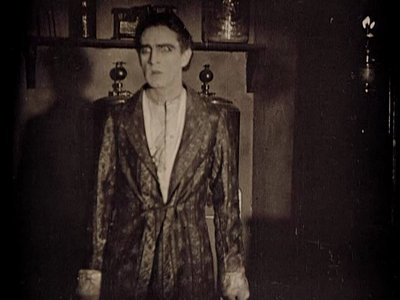


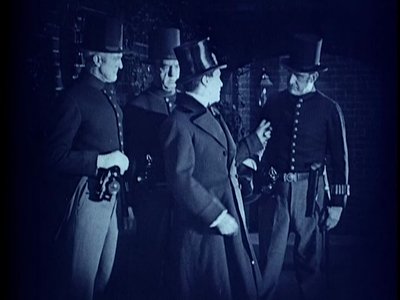
While certainly not the most stylish-looking film of its time, Dr. Jekyll and Mr. Hyde was still one that obviously had some talent behind the camera. For one thing, the sets, while nothing spectacular, do look good, with some coming across as fittingly lavish and upper class, like Jekyll's laboratory, the big sitting room in his house, and the fancy sitting and dining rooms in Sir George Carew's house, while others illustrate the darker, more unsavory aspects of London at this time, like the dark streets, the small, somewhat rundown-looking apartment that Hyde takes, and the very seedy dance hall and opium den that he frequents. The cinematography by Roy F. Overbaugh is also pretty good for the time, especially whenever scenes are dimly lit to create a sense of mood, like Jekyll's laboratory in many of the scenes there, particularly during the latter half of the film, and Hyde's seemingly always dark apartment. Like many silent films, it uses intertitles not only for the dialogue but also to inform the audiences of what's happened in the story during scene transitions that span some lengths of time, as well as to introduce characters when they first appear onscreen (I don't know of many that actually mentioned who played them as well, though), and some of the cards for these captions are accompanied by atmospheric drawings that tie into what the viewer is being told and do manage to give it a little more style than most films of this period, as well as give it a kind of storybook vibe. Unfortunately, as you can see, when it comes to the way the actual film itself looks, most of the really good prints of it that you can find use a rather ugly brown filter for the majority of the scenes, with nice blue ones only being employed for the exterior nighttime scenes and a purple one for the scene in the opium den. A little more variety would've been nice.


The movie also contains some instances of optical effects that are quite skilled for having been created this early in the game. For example, when you actually see Jekyll become Hyde in instances such as when you see a close-up of his hands changing and when he transforms right in front of Sir George Carew (one of only a couple of full-body changes you see in the whole film), as well as when he goes from Hyde back to Jekyll after he's died, they use an early version of the lap-dissolve technique that would become popular in later werewolf movies and it's surprisingly effective. That change from Jekyll to Hyde in front of Sir George, aided by the dark lighting in the scene, looks quite seamless, and is an instance where John Barrymore's overdone acting style helps, as he starts out as a stunned Jekyll feeling the effects of the coming change and transitions into a maniacally-grinning Hyde. There's a nice instance where Sir George's smug face is superimposed over the shot of Jekyll when he initially hesitates to take the formula for the first time, which you can tell gives him the incentive he needs to go ahead with it, and, while it's very subtle, when Miss Gina is first introduced, there's an iris around her as she dances, which suggests how she's already captured Jekyll's attention before they've even met. The best instance of this type of effect in the film, though, is when Jekyll has that bizarre nightmare of Hyde appearing as a big, transparent spider abomination that becomes one with him as he changes in reality. Which leads me into the next bit of discussion...


Holy hell, where did this come from?! Think about how startling this scene is to a first-time viewer: you're watching a well-made but still fairly standard silent film version of the iconic story of Dr. Jekyll and Mr. Hyde, when suddenly, around eleven minutes before the end, you get an intertitle that reads, "And now, in his hours off-guard, outraged Nature took her hideous revenge-- and out of the black abyss of torment sent upon him the creeping horror that was his other self," followed by a scene of Jekyll in bed when he seemingly wakes up and senses another presence in the bedroom with him. Then, in a wide-shot of the room, you see the disturbing vision of a large, ghostly, scuttling spider come around the bed and, if you look closely at it, you can see that it has Hyde's head and body attached to its underside. When I first saw this, I was taken aback, to say the least, as it's not something you'd be expecting by this point, and it's an effectively creepy moment due to that fact, as well as how the way the thing creeps around the bed (it moves in such a way that it looks like either stop-motion was employed or the film was sped up) and then crawls up onto it towards the helpless Jekyll, who loses consciousness as it hovers over him and disappears into his body, with a lap dissolve showing him become Hyde himself as a result. I don't know if it was intentionally supposed to be see-through or if that's just a case of bad matting and compositing but it adds to the otherworldly, eerie quality, giving it a sense of Hyde emerging from the depths of Jekyll's consciousness to take control of him. In the close-up, when it hovers above Jekyll, it looks like John Barrymore in his Hyde makeup, with a big, fake spider attached to his back, but rather than coming across as silly, as it might sound, it is still downright freaky, especially when you see how long and hairy the spider legs really are. I don't how the filmmakers came up with the notion of doing this scene but, regardless, I have to applaud them for the effectively unsettling creativity on display here. Just look at it!

Another moment that's unexpected in this story happens much earlier, when Miss Gina is first introduced to Mr. Hyde and, when he inquires about her ring, tells her of its purpose of hiding poison and that there's a story behind it. Then, suddenly, we see a scene set during the Italian Renaissance where four people are at a dinner table and a guy (who I think may be John Barrymore in a different costume and wig) takes the ring from the man sitting to his left, uses it to slip poison into the cup of wine in front of him, and then switches it with the cup of one of the two women sitting to his right, who are so caught up in their conversation that they don't notice this. The woman takes a drink and immediately keels over from the poison, as we then go back to Hyde and Gina, with the former forcefully taking the ring from her and foreshadowing how Jekyll eventually stops Hyde before he can harm Millicent at the end. Like the scene with the spider, it's not something you expect in a film adaptation of Dr. Jekyll and Mr. Hyde, silent or otherwise, and it's interesting that they decided to relay the story of the ring in this manner. You may think it was so they didn't have to put in a bunch of intertitles of Gina actually telling the story to Hyde but the set that this scene takes place in looks like it cost a lot more, as it comes across as quite lavish and detailed, especially given how briefly we see it and how they had to recreate a completely different time period from the rest of the film for it. Maybe it was another way John S. Robertson and his crew attempted to keep the movie from feeling too standard and, if nothing else, it does accomplish that. (I apologize for the crappy image quality of this shot, but it was the only one I could find of this scene.)


It's interesting how, when we think back to the "classic" age of Hollywood from the 20's into the early 60's, we have this image of the films made during that period being glamorous and classy, with none of the excessive violence and sexual content that we see everywhere nowadays. That's the main reason why, with very few exceptions, my parents didn't allow me to see many movies that were more recent than the 60's, as they considered it to be the period when movies were "safe" and could be watched by anybody, when in reality, films of yesteryear can be very perverse and subversive in their own ways. That's especially true of horror films made during what's referred to as the "Pre-Code" era, before the Motion Picture Production Code, or the Hays Code, started to be rigorously enforced in the mid-30's, and this version of Dr. Jekyll and Mr. Hyde is something of an example. While the 1931 film is much more shocking in how overt its sexual content is for the time, this version doesn't shy away from the seedier side of life either, as it's very clear what Sir George Carew is getting at when he's talking to Dr. Jekyll about truly living and having memories before we get to the "music hall," which, despite that term that they use, is clearly more of a sleazy tavern with showgirls who are asked to sometimes entertain the men who come in. You can see how unclean this place is as soon as the men enter it and it's obvious that Jekyll is feeling some emotions and impulses when he's never felt before when he's watching Miss Gina dance on the stage and when she's sent over to them and comes on to him, which prompts him to get out as quickly as he can. And Mr. Hyde's intentions are very clear and the place's proprietor, as you can see during their conversation at the table while Hyde is smoking a cigar, with a very devilishly pleased expression on his face, is more than happy to help him satisfy them, sending Gina in to see him by herself in a private, murky room. As I've said before, one can only guess what Hyde forced her to do to please him during the time he had her living in his rundown apartment, and later during the scene at the opium den (I honestly didn't know that's what it was until I read up on it; I thought it was a tavern/brothel), we see a guy who's so drugged up that he thinks ants are crawling all over him, Gina looking very worse for wear, no doubt due to her own addiction, and upstairs, Hyde is allowed to have his way with a girl who looks uncomfortably young. That moment is made even worse by how Hyde goes for her throat, and while we can surmise that he's probably kissing or licking it, the fact that we later see him apparently bite Sir George's neck like a vampire before bludgeoning him with the cane makes it all the more unsettling.


Speaking of which, obviously a movie from this time period is not going to have anything on the violence we've seen in movies from the 1970's on but, regardless, that moment where Hyde bites Sir George's neck after jumping on him and forcing him to the ground and before beating him with his cane has a savage feel to it. The moment in the scene before that, when Hyde knocks down a very young boy on the street (just barely older than a toddler, by the looks of him) and cruelly puts his foot on his back to spite the older boy he was playing with is still uncomfortable. And finally, during the climactic scene where Hyde lures Millicent into Jekyll's laboratory and locks her in, it's obvious that he's probably planning to rape and kill her, especially given how downright monstrous he has become at this point in the story. Again, it just goes to show you that old movies were certainly no slouches when it came to content that you'd think only came in fashion in the later decades.

A shorter review than usual but there's not much else I can say about the 1920 version of Dr. Jekyll and Mr. Hyde, as it's just a, mostly, straightforward and well-made adaptation of this classic story. While I do have some qualms, like John Barrymore's performance as Mr. Hyde being so over-the-top that it often comes across as unintentionally silly and most of the other characters being fairly bland, I do give credit to his performance as Dr. Jekyll, the production design, cinematography, the optical effects, and the very unexpected and creative scenes of the Italian Renaissance flashback and, especially, the nightmare with the transparent Hyde/spider creature. While I do think the definitive film versions of Robert Louis Stevenson's story are the 30's and 40's movies, I would recommend that you seek this film out if you're a fan of the book or if you just like classic horror in general.

Monday, October 1, 2018

The Sound of Silence: The Cabinet of Dr. Caligari (1920)

If you ever wanted to find what could be considered the first horror film of true significance in film history, you probably need look no further than this legendary example of German Expressionism (quite possibly the creator of said movement, in fact). While there were certainly horror films before this, with notable examples being the Thomas Edison Frankenstein in 1910 and an early version of Dr. Jekyll and Mr. Hyde in 1913 (Universal's first contribution to the horror genre), The Cabinet of Dr. Caligari has to be the earliest one to have had a major sort of lasting impact throughout the decades since it was made. I often joke that Tim Burton based his entire career on this film but, when I say that, I'm only being partly sarcastic, as you can definitely see a correlation between this film's bizarre visuals and the Gothic style and art direction that he's known for in so many of his films, from Beetlejuice and his Batman movies to Edward Scissorhands, The Nightmare Before Christmas, Corpse Bride, Sweeney Todd, and so on. Caligari is mentioned in the documentary, Universal Horror, which I saw when it was shown on Turner Classic Movies on Halloween night of 1998, but what they showed must not have left much of an impression (unlike Nosferatu, which was also featured there), because the first I can remember really becoming aware of it was around my middle school and early high school years, when I came across an old book on horror films at my school's library. This particular book was unique among others on the subject, as it bypassed movies that featured monsters or had any connections to science fiction, with the author trying to focus on what he referred to as "true horror films." As a result, this was where I first became interested in films such as those that Boris Karloff and Bela Lugosi appeared in during the 1930's and 1940's (outside of their most famous roles, mind you), Vincent Price's movies like House of Wax and the Edgar Allan Poe films he did with Roger Corman, the films of Val Lewton, Night of the Demon, and silent films like this and The Hands of Orlac. In fact, this book in and of itself may have been what first made me aware of German Expressionism, since before then, the only silent movies I really knew of were The Phantom of the Opera, the 1920 version of Dr. Jekyll and Mr. Hyde, and The Hunchback of Notre Dame. I certainly knew of Nosferatu around this time, as I said, but I knew nothing of the term "Expressionism" until I read up on it in sources like this book (I can't, for the life of me, remember what that book's exact title was, by the way; I think it was simply Horror Films, which doesn't help much).

Getting back to Caligari, I always remembered the one image from it that appeared in the book, which was the shot of Cesare standing in his coffin, with Caligari standing on the left and the girl, Jane, on the right, and the first time I saw in actual footage of it wasn't too long afterward, in the summer of 2001, when I got this VHS documentary called The History of Sci-Fi and Horror, hosted by Butch Patrick, as a birthday present (the scene in question was when Caligari first unveils Cesare and has him walk out of his coffin and onto the stage in front of the audience). Over the years, I saw and read more and more on the film, from sources as varied as The Frankenstein Files: How Hollywood Made a Monster, a documentary on the Universal Frankenstein Legacy DVD set, to Joe Bob Briggs' book, Profoundly Disturbing: Shocking Movies That Changed History!, where it was featured amongst the likes of movies like H.G. Lewis' Blood Feast, The Exorcist, The Texas Chainsaw Massacre, and David Cronenberg's Crash. By the time I ended up actually seeing it in early 2008, I knew that it was considered to be an important landmark in the history of the horror film and that it was best known for Caligari himself, Cesare, and the bizarre, surreal architecture and set design that proliferated every bit of it. Unfortunately, my first viewing experience with it wasn't the best, as I saw it on a cheap, public domain horror DVD set that my mother got me for Christmas (one of several such sets she got me over the years), so it was in really poor quality and had very silly music playing along with it in some scenes, which was inappropriate. I also think that print of it was truncated, as I can remember it being only a little over an hour long, when the movie's actually around 74 minutes. All that said, I was still able to appreciate the bizarre atmosphere and visuals that it's known for, although I wouldn't really come to experience everything the movie has to offer until right before doing this review, when I decided to find the best print of it I could. I've watched it a couple of times on YouTube, the second time being a really good-looking version, with the appropriately-colored filters, and I can definitely say that it is a very unique and surreal viewing experience, one that really is like the most bizarre dream you can imagine, even more so than most silent horror films.

While sitting outside on a bench, a young man named Francis tells an elderly man the story of a strange and monstrous ordeal he and his fiance, Jane, have been through. His story takes place in the small village of Holstenwall, as a fair is being held. A mysterious and sinister-looking man, calling himself Dr. Caligari, arrives in town as well and receives permission from the town clerk to operate his show, centered around a somnambulist, at the fair. The following day, the clerk is found stabbed to death in his bed and, when Francis and his friend, Alan, visit the carnival, they decide to see Caligari's show. In his small tent, Caligari presents the crowd with the somnambulist, Cesare, who he awakens from his corpse-like state and walks out onto the stage in a zombie-like manner. Declaring him to have the ability to see in the future, Caligari encourages the spectators to ask Cesare questions, and when Alan asks how long he'll live, he's told that he has until dawn the next day. Initially shaken by this, Alan is able to dismiss his fears after he and Francis have an encounter with the lovely Jane, whom the two of them are both wooing in a friendly competition, but that night, a shadowy, knife-wielding figure breaks into his home and stabs him to death. Upon hearing of this, a grief-stricken Francis vows to get to the bottom of his friend's murder, joining up with Jane's father, Dr. Olsen, to investigate Caligari and Cesare. While doing so, the police arrest a man who attempts to murder an elderly woman with a knife, thinking he is the one who has been doing the killings, but when Francis and Olsen speak to him, he claims that he had nothing to do with the deaths of Alan and the town clerk. Little do they know that Jane, concerned for their safety, goes to the fair looking for them and gets the attention of Caligari, who shows her Cesare. That night, Francis keeps an eye on Caligari as he sleeps in his small shack, with Cesare apparently doing the same in his coffin; however, Cesare actually makes his way to Jane's house and, instead of killing her, attempts to kidnap her, only to be chased by an angry mob to the outskirts of the village, where he drops her before collapsing out of sight. Francis is perplexed when Jane claims that it was Cesare, but when he learns that the attempted murderer was kept securely in jail during the night, he and the police investigate Caligari's shack again to discover that the "Cesare" they see sleeping inside is actually just a dummy. His cover blown, Caligari flees and is chased into a mental institution by Francis, who discovers that he's actually the place's director. However, is it the director or rather Francis himself who isn't what he appears to be?


Caligari was the brainchild of two devout pacifists whose experiences in World War I had made them very distrusting of authority: Hans Janowitz and Car Mayer. They met in 1918 through a mutual friend and, despite their not having connections to the film industry, decided to collaborate on a screenplay together, pulling from a number of different personal experiences from both their friendship and their own, separate lives, among them a military psychiatrist Mayer had dealt with, a visit with a fortune teller that accurately predicted the death of someone whom Janowitz loved, a murder Janowitz believed he might have possibly witnessed at an amusement park in Hamburg in 1913, and a circus sideshow both writers witnessed in Berlin where a hypnotized man performed feats of incredible strength. It's often been said that, when writing the film, the two of them had a strong political agenda in mind, with Dr. Caligari meant to be a symbol of totalitarian power, i.e. the German government of the time, and Cesare those who blindly commit the horrific acts they're ordered to with no question whatsoever, although whether or not that truly was their intent at the time is up to debate. Janowitz claimed that it happened subconsciously and he only realized that they had done what they had many years later, though some feel he was simply saying that to placate those who had interpreted the film in this way in the decades since its release. Also, one of the film's own art directors said that he felt Mayer had no political intentions when he wrote the film. In the end, it's unclear as to what the writers' intentions were, as there are so many contradictory stories about the making of the film and exactly how involved Janowitz and Mayer were during actual production. Regardless, Janowitz wrote a few more screenplays after Caligari, including a couple for the legendary director, F.W. Murnau, but left the industry in 1922; Mayer (who also worked with Murnau), on the other hand, managed to make it as a screenwriter into the late 1930's, although he left Germany in 1933 to escape the Nazi regime and lived in London for the rest of his life, working as an adviser to the British film industry.

Fritz Lang, who introduced Janowitz and Mayer to Erich Pommer, the head of Decla-Bioscop, which would produce the film, was originally meant to direct Caligari but, although Lang did meet with Janowitz in preparatory sessions involving the screenplay, he ultimately had to drop out when he became involved with another movie, The Spiders. In his place, Pommer brought in Robert Wiene, who had a number of films under his belt as both director and writer at the time, although Caligari would end up becoming his most famous work. It's been said that the film's surreal imagery and the feeling of madness that permeates it, especially when the truth behind the framing device is revealed at the end, is due in large part to Wiene, as his father, a German theater actor, apparently went mad near the end of his life when he learned he could no longer perform. Said framing device is sometimes attributed to Wiene himself, while other sources claim it was Pommer and the studio who came up with it and Wiene was simply supportive of it (going back to Lang, he also once said that he came up with the idea of a framing device but, as I said in my review of his movie, M, he wasn't somebody whose claims you could easily believe). Wiene also claimed that he was the one who conceived of the film's surreal, expressionist style, which is often refuted as being the work of the art directors themselves, so, again, it's nearly impossible to put a finger on who was responsible for what. Nonetheless, there's no denying that Wiene's direction helped give the movie its very bizarre and dream-like feel, and while he went on to make more expressionist films, none were as successful or had as strong an impact. His other most noteworthy movie was The Hands of Orlac, which also starred Conrad Veidt, who played Cesare here, and was later remade as Mad Love, with Peter Lorre and Colin Clive, and again as The Hands of Orlac in 1960, with Mel Ferrer and Christopher Lee. He continued making films in Germany into the early 1930's, but in 1933, his film Typhoon was banned by the Nazi regime, which had just taken power, because of its unflattering portrayal of Europeans. Wiene then fled to Budapest to direct One Night in Venice and then moved to London and finally to Paris, never again returning to Germany. He tried unsuccessfully to get more films off the ground during this time, including a sound remake of Caligari, but by the time he got around to directing 1938's Ultimatum, he ended up dying of cancer at the age of 65 before filming completed, with Robert Siodmak having to step in to finish the film.


Going back to the film's framing device and the revelation it entails, several of our main characters are at the heart of it, not the least of which is the film's ostensible lead, Francis (Friedrich Feher). The main story of the film is told by him, as he relates a horrific experience that he and his "fiance," Jane, have recently been through to an elderly man he's sitting next to on an outside bench. He talks about how it happened in the small village where he grew up, beginning when Dr. Caligari came to town with his exhibit, bringing with him some brutal murders, including that of his best friend, Alan. Because of Cesare's prophesy that Alan would die the night before his body was found, the grief-stricken Francis feels that he must have had something to do with and becomes obsessed with finding out the truth, along with the aid of Jane's father, Dr. Olsen. The two of them investigate Caligari and Cesare together and, despite some occasional roadblocks they run into, such as another man being charged with the murders after he attempts to kill someone himself and Cesare apparently being with Caligari during the time when Jane is attacked, Francis soon reveals that Caligari is behind everything. In chasing after him, he makes an even more incredible and disquieting discovery: Caligari is actually the director of an insane asylum and has lately become obsessed with a previous story of a man who used a somnambulist to commit murder, to the point where he's willing to do the same in order to understand the methods used by his predecessor. By the end of his story, it seems as though Francis exposed a dangerous madman and had him put away in his own asylum, but when we go back to "reality," it's revealed that Francis is himself an asylum inmate and that some of the characters in his story are also inmates, with Caligari actually being the director. In short, everything we've been told was the ramblings of a complete lunatic, a dark fantasy world that he himself created and is still trapped in, as right to the end, he continues insisting that he's as sane as can be and that the director is the one who's crazy. But, as he's restrained and confined to a cell for attacking the director, the film's last shot highly suggests that he's not the only one who's insane.


From the moment he's first introduced, Dr. Caligari (Werner Krauss) himself is most definitely a sinister figure, with the way he's dressed, with that black cloak, stovepipe hat, and cane, to his fiendish facial expressions and shifty, suspicious mannerisms and way of moving. It's not all that surprising that murders begin happening in Holstenwall the minute he arrives in town, nor is that the victims happen to be the town clerk, who seemed to have sealed his fate by repeatedly insulting Caligari during their first meeting, and Francis' friend, Alan, who asked Cesare how long he would live and was given the answer until dawn the next day. Caligari never once comes across as anything other than suspicious and sinister with a capital "S," acting rather uncooperative with Francis and Dr. Olsen when they try to examine Cesare, refusing to awaken him, even though we know he can, as he did it during his show, and menacingly inviting Jane backstage to see Cesare when she wonders into the carnival while searching for Francis and her father. He seems to have a pretty airtight alibi when Francis spies on him in his shack at the carnival, watching him sleep next to the box that apparently contains Cesare, all while Jane is nearly abducted, but it's soon revealed that the figure in the box was actually a dummy and Cesare truly was the attacker (it's not a revelation for us but for the characters). Realizing the jig is up, Caligari makes a run for it, followed by Francis, who chases him into a mental asylum and is shocked to learn that he's the place's director. That night, after Caligari has gone to bed, Francis is able to convince members of the staff to let him into his office, where he discovers that the director has become obsessed with the story of another man named Caligari who used a somnambulist to commit murder. He was so obsessed with learning how he managed to get someone to do such horrific things that he decided to become Caligari himself and make a somnambulist that was admitted to the asylum his own personal Cesare. When he learns that his plot has been uncovered, as he's presented with Cesare's body, Caligari attacks a member of the staff and is straitjacketed and placed into a cell in his own madhouse. But, in the twist ending, it's revealed that he really is the asylum's director and that he was Caligari only in Francis' diseased mind, with the man having to be restrained to the very room Caligari was confined to at the end of the story when he attempts to attack the director. However, as the film ends with the director saying that he's confident he can cure Francis of his delusion, the last shot is of an iris around his head as he looks right at the camera, suggesting that he may be just as mad as his patient.


Along with Dr. Caligari, the character that everybody remembers from this movie is the murderous somnambulist, Cesare (Conrad Veidt). He may not be much of a character, as he's little more than a pawn for Caligari's deadly experiments, but he's definitely a striking and eerie presence nonetheless, with his tall, thin form, slow, zombie-like movements, and his pale face and very striking eyes. There's a reason why scene where Caligari unveils him to the crowd at the fair is one of the movie's most iconic moments, as he slowly opens his eyes and shambles out of his coffin-like box with his arms outstretched (I wouldn't be surprised if this wasn't the inspiration for Imhotep's creepy resurrection scene in The Mummy). It's also the only time Cesare speaks, when he tells Alan that he'll only live till dawn the next day, as Caligari, just as he had with the town clerk, sends him out to ensure that the prophesy comes true. However, when Caligari attempts to make Jane Cesare's third victim, something goes awry, as just as he's about to stab her to death while she sleeps, he decides at the last minute to abduct her instead, a move that isn't completely spontaneous, as he did seem rather fascinated with her when Caligari brought her to him at the fair earlier. He drags her out of her home and into the village streets but, when a mob chases after him (this could very well be the earliest instance of that trope), he drops her on the outskirts of the village and, after walking a little farther, falls off into a ravine and is later revealed to have died when the police bring in his body to show Caligari that his plot has been uncovered. After the story, it's revealed that, like the somnambulist he represented, Cesare really is an inmate at the asylum, although he appears to be gentle and not dangerous in the slightest.


Jane (Lil Dagover) is introduced in the film's opening along with Francis when she wanders by both him and the elderly man he's talking to on the bench in a kind of daze, looking more than a little ghostly and giving the first hint that something isn't quite right here. In Francis' story, she's little more than the object of a friendly competition between him and his friend, Alan, as the two of them compete to see which one she'll decide to be with, and is as horrified as Francis is when she hears of Alan's murder. She also unwittingly catches the attention of both Caligari and Cesare when she wonders to the fairgrounds, searching for Francis and her father, Dr. Olsen, who were there earlier to investigate both the somnambulist and his exhibitor. After Caligari lures her into his tent and shows her Cesare, causing her to run off in fright, he sends him to kill her that night, for Cesare to instead attempt to kidnap her. Upon being left behind by Cesare on the outskirts of Holstenwall, she's taken back to her home, raving upon his abducting her, which initially puzzles Francis, as he'd been watching Caligari during the attack and it looked as if Cesare was in his shack with him. However, this claim ultimately leads Francis to discover that Caligari was behind everything, leading to his chasing him down to the nearby mental asylum. After Francis' tale ends and the truth of the situation is revealed, Jane is shown to be an inmate who believes that she is a queen and that, as a result, she cannot follow her heart and marry Francis the way he wishes she would. (Eerily, when Hans Janowitz wrote the screenplay with Carl Mayer, he intended for his lover at the time, Gilda Langer, to play Jane but she's the one whose death was apparently foretold by a fortuneteller Janowitz visited, prompting to use it as the basis for Alan's fate in the film.)


Since none of the other characters in Francis' story appear in the asylum, you can surmise that they were simply creations of his warped mind, including Alan (Hans Heinrich von Twardowski), his supposed friend in Holstenwall, who is depicted as being rather carefree, in spit of being momentarily frightened of Cesare's prediction of his impending death, and who is caught up in a friendly rivalry with Francis for Jane's affections before he's murdered. Jane's father, Dr. Olsen (Rudolf Lettinger), does little more than act as an authority figure who Francis is able to trust, getting permission from the police to investigate Caligari's shack at the fair and examine Cesare, as well as interview the man who is arrested and charged with the murders after attempting one himself. Said man (Ludwig Rex), who has a very sinister look to him that's on par with Caligari, admits to trying to murder someone but that he had nothing to do with the deaths of Alan or the town clerk, saying that he took advantage of the situation, knowing that the death of his intended victim would be blamed on the one who killed them. Later, his having been kept under lock and key during the time when Jane was nearly abducted gives Francis further proof that Caligari and Cesare are the cause of what's going on. (When I first got a good look at his face, I thought that Rex might have gone on to have a bit part in the Spanish version of Dracula that Universal produced alongside the Bela Lugosi film, as he looks an awful lot like a terrified sailor on the Vesta when Dracula rises from the hold to kill them all. But, according to all sources, Rex had stopped acting by 1927, so it doesn't seem like this is the case.) And finally, there's the distraught landlady (Elsa Wagner) who is the one who finds Alan's body and informs Francis of what's happened. I also have to mention the temperamental and abrasive town clerk, who makes the mistake of berating and acting dismissive towards Caligari when he's asking for a permit to exhibit his show at the fair, becoming Cesare's first victim offscreen in the process; whoever played him, though, is unlisted.


The Cabinet of Dr. Caligari is one of the earliest examples of the type of movie where the characters and the story are less significant than the visuals and the atmosphere that it creates, akin to the films of Italian horror maestros like Dario Argento and Lucio Fulci (other examples from around this time may include Haxan, aka Witchcraft Through the Ages, and Carl Theodor Dreyer's very unearthly early sound film, Vampyr). Indeed, the one aspect of the film that stays with people, whether they actually watch it or see clips of it, is how bizarre and unearthly everything looks. This is thanks to art director Hermann Warm who, working under the philosophy that films should be drawings brought to life, brought in his two friends, Walter Reimann and Walter Rohrig, painters and set designers who were associated with the Berlin art magazine, Der Sturm, and the three of them decided to go for a very fantastical, stylized look to best accentuate the film's subject matter. They were given free reign to do whatever they wanted by both Robert Wiene and the producers and, as a result, what they created is a world that is just as nightmarish and eerie as it is impressive. For starters, nothing about this place feels natural, which is helped by the fact that it was shot entirely in a studio. Everything looks like it's made out of cardboard and paper, rather than wood or metal (even the few potted plants and flowers that you see don't look right), and there are very few straight lines to be found in the architecture; it's all weirdly curved, has sharp points, or built at weird, unnatural angles. This goes for both the streets of Holstenwall, where the buildings are twisted and clustered around each other, with back-alleys that are just as dark and unnatural-looking, and the interiors, which are dominated by everything, from the windows and doors to even the furniture, being shaped unnaturally, be it in strange and sharp angles or being unnaturally tall, like the chairs. You can often see unusual black lines on the walls, along with instances of bright white and deep darkness, meant to represent light and shadow that are painted directly onto the sets and making them even stranger to look at. The scenes that are meant to be set on the outskirts of the village and the countryside don't feel natural either, with the wide-shots of Holstenwall looking exactly like what they are, which are of an abstract, painted backdrop, sometimes with slight pieces of actual set in the foreground (particularly that merry-go-round at the fair), and the latter coming across as claustrophobic as the inside of the village, with plants that have tentacle-like vines reaching out. For that matter, even the intertitles for the dialogue are stylized and strange, with the words written in a jagged prose in front of an abstract painting rather than normal white text on a black background. In short, it's no exaggeration to say that literally every frame of this movie could be blown up and made into a creepy work of art, which it already is in and of itself.


I'm not kidding or following the crowd in praising the movie when I say this: when I watched it those couple of times before I did this review, the images and atmosphere that it evokes did make me rather uncomfortable. What mainly got me is not just how unearthly Holstenwall looks and feels but also the fact that people have to live there. I couldn't imagine having to live in such a bizarre place, where even the interiors of people's homes feel unnatural and alien. Some have said that Jane and Alan's homes break with this notion, that they come across as secure and comforting, but not to me, as Alan's apartment still has the bizarre architecture and claustrophobic feeling of everything else, as does Jane's home, in spite of its being more spacious, with a very high ceiling in her bedroom. That's another thing about this place: the claustrophobia. It all feels very closed in and smothering, both out on the streets and in the homes and other places, such as the police station and the town clerk's office. The rooms that have the very high ceilings, with other examples being the shadowy, twisting staircase leading up into the main office of the police station (something like that just screams both Gothic and Expressionism to me) and the cell where the suspected murderer is kept, still have an uncomfortable vibe, especially to me, as those types of enormous interiors have always gotten under my skin, for some reason. And when we come out of Francis' story, there's no comforting return to "reality" waiting, as was already clear from the eerie opening and punctuated by the revelation that he's an inmate at the very madhouse where he supposedly chased Dr. Caligari and exposed him. Some viewers and critics have said that Francis' strange depiction of Holstenwall in his story was a hint at the revelation to come right from the start, as it can only be viewed as something a deranged mind would come up with, but then again, when we go back to what is ostensibly the real world, everything is still unusual and out-of-balance, suggesting, as others have said, that the asylum director Francis sees as Caligari really is just as mad as his patient. Personally, that's the way I look at it, especially given the last shot of the iris around the director's face, which feels sinister to me, despite his facial expressions coming across as fairly normal and benign.


The term "nightmarish" is very apt in describing the film, in more ways than one. Silent horror films tend to be inherently dream-like anyway, due to the lack of audio, the virtually ever-present music used to accompany them, the exaggerated acting style of the time, and the flickering images and the filters making things feel all the more surreal (for me personally, that's the way to watch these films, rather in complete black-and-white, as you get in public domain copies), but Caligari is a major example of a movie where watching it is like having a waking dream because of its sheer otherworldly quality. This is due to those inherent qualities of silent films that I've mentioned combined with the visual style, along with the effectively eerie mood that permeates the movie throughout. Its very opening makes it feel as if there's something ghostly going on, as the old man on the bench with Francis talks about spirits being all-around, right before Jane walks by with a dazed, trance-like expression on her face and dressed completely in white. If it weren't for Francis' saying that she's his "fiance," it wouldn't be unreasonable for you to think that she's one of the spirits the old man is talking about, and even then, as the two of them sit on the bench and Francis begins telling his story, it does feel as if you're looking at ghosts the whole, due to how pale they and so many of the other characters are, often with dark circles around their eyes. The same also goes for the famous scene where Dr. Caligari unveils Cesare at the fair, especially that creepy close-up of his face as his eyes slowly open and he walks out onto the stage like a ghoul, when you see his shadow nothing more than his shadow on the wall when he breaks into Alan's home that night and murders, and his entering Jane's home and being chased out of the village. In fact, even the most benign of scenes, like those in Jane's home and Francis and Alan meeting her on the street after the fair, are made to feel off-kilter because of the surroundings and the way everything is lit and filtered, as is the scene depicting the aftermath of Alan's funeral, which should be somber and sad but is still just plain unsettling.


The eerie, dream-like vibe is enhanced even further by some odd optical effects, most notably irises that often lead into or close out a scene by enveloping around a person's head or some random part of the frame and staying there for a few seconds before the transition actually happens, making the screen completely black except for whatever the iris is highlighting. Irises are nothing special in and of themselves and they were commonplace in films, especially cartoons, made around this time and into the 50's and 60's, but I don't think I've ever seen them utilized in this manner, where they highlight a specific part of a scene or setting before transitioning into or out of the scene in question. It makes for even more bizarre and uncomfortable imagery, especially when the iris is enveloping Dr. Caligari's sneering or evilly smiling face in an otherwise black screen. Another noteworthy, surreal effect in the film happens when Francis and the asylum staff read the director's diary and see how obsessed he's become with the real-life Dr. Caligari, to the point where he's tried to become him. In the dramatization of the events they read up on in the diary, you see the director walk onto the grounds of his asylum, when German words that translate as, "You must become Caligari," or simply the name, "Caligari," suddenly appear in the air around him, materializing letter by letter as if they're flashing neon signs. It's a memorable scene, one that visualizes how the director's obsession has consumed him and driven him mad, but like everything else in Francis' story, it's revealed to be the twisted but still creative figment of an insane mind, one that we already knew he had to have concocted himself since such a scene couldn't have actually happened in the reality of his account.

Going back to the twist ending for a minute, the fact that, by all accounts, it was a creation of the producers and was not present in the original screenplay (there was a framing device in it but it was completely different and didn't subvert the integrity of Francis' story like the one in the final film) led to one of the biggest controversies of the production, one that further emphasizes how contradictory so many of the accounts from those involved with it were. Even though he would claim that he didn't realize that he and Carl Mayer had written something of political significance until years later, Hans Janowitz also said that the two of them were unhappy with the framing device because it reshaped the story into a state where, "The symbolism was to be lost." That's an exact quote from a 1941 interview with Janowitz, the same one where he made the statement about his not realizing the political statement he'd made at the time, and he went on to add that the two of them attempted legal actions to keep them from adding it, as well as that when they saw a preview of the finished film, they weren't shy about making their displeasure know. That would suggest that he did intend for there to be a political agenda in the film and felt that, by making the man who exposes the tyrannical Caligari for what he is a lunatic, one whose delusions center around the director of the asylum, the producers made it a story that glorified authority and promoted conformity rather than revolution. Of course, given how the ending suggests that director may not be the kind, caring doctor that he appears to be, due to the asylum looking as bizarre in reality as it did in Francis' story and that last iris around his face, it doesn't seem like the point was entirely muted, as it still suggests that authority figures can't be trusted 100%, but I digress. I only brought this up again to again show how hard it is to pinpoint the thinking of those involved with the film. I think it is pretty clear, though, that like Fritz Lang, Janowitz wasn't a very trustworthy person, given how often he contradicted himself in the same interview. Here's even more proof: in that very same interview, he said that he and Mayer came up with some of the ideas of the film's unique visual style (remember, Robert Wiene himself made that claim as well) and that they wrote stage directions to that effect in the script, a claim that was proven to be false when the original script was found and it contained no such stage directions.


Some people have read even more into the film's perceived themes of irrational and tyrannical authority, particularly German film theorist and sociologist Siegfried Kracauer, who wrote that Dr. Caligari and Cesare can be seen as premonitions of the rise of Adolf Hitler and the way he bent the German people to his will to commit and condone acts of unbelievable evil (the book where he wrote about this is even called, From Caligari to Hitler). He even went as far as to say that Caligari was symbolic of some kind of subconscious need in German society for a tyrant, which others have strongly disputed, as the film itself does not glorify authority, which it doesn't. As I said, even the frame-story doesn't completely undermine this theme, given how the asylum director's trustworthiness is still brought into question in the final scene, and in the context of the main story, the citizens of Holstenwall and the staff at the asylum had no idea who Caligari really was or what he was up to, reacting in horror and acting against him once they knew. Some critics and viewers have seen other tyrannical figures in the film, particularly the temperamental and dismissive town clerk, who sits up on his high chair while barking orders at those below him and treating Caligari himself with disrespect when he tries to get a permit to exhibit Cesare at the fair (the fact that he becomes Cesare's first victim can be seen as an act of anti-authoritarianism on Caligari's part, in spite of his being a symbol of that very notion himself). They've also pointed out how the high chair is one of several visual motifs that point to the hierarchy of authority figures like, such as that long, twisting staircase that leads up to police headquarters and the stairways that lead to the asylum director's office. And there are some who say that the bookends of the film might, in fact, not undermine the validity of Francis' story at all, that his story is true and that he's been institutionalized by the director to keep him quiet. One could argue that the idea doesn't hold water, given how Cesare is shown to have died in the story, despite being alive and well as an inmate in reality, that Jane is a delusional inmate who thinks she's a queen rather than his fiance, and that Francis' story ended with the director being restrained and made a patient in his own madhouse, while he's actually running the place like normal, but there are others who will say that he may have embellished aspects of the story while telling it but that doesn't mean the whole thing is false. That's true, but then again, it doesn't negate the whole notion of his being insane either, as it could be seen as a scenario he's come up with to give credence to his belief that everyone else is mad and he isn't. As I've said, I personally believe that both Francis and the director are insane, living in their own nightmarish worlds that they themselves have created.


That leads into another theme of the movie: duality. The main characters each have a double life to them, some of them both within the context of Francis' story and when the film's two sides are looked at as a whole. For instance, not only is Dr. Caligari presented in the story as a murderous madman and a respectable authority figure in the framing device but, when you look at just the story, he fits into both molds there as well: a seemingly benign asylum director by day and a sinister carnival showman who sends his somnambulist subject out at night to commit murder. Moreover, he's serving as a double for the historical Caligari, having become so consumed with knowing his secrets that he's decided to literally try to be him. As a result, the somnambulist who is delivered to his asylum unwittingly leads a double life as well, one as a patient who's supposed to be receiving help from the asylum director and the other as a pawn in his homicidal experiments. In short, he's both victim and antagonist in the story (it's made even more apparent when, instead of killing Jane like he has everyone else, he disobeys Caligari's instructions and attempts to act on his apparent infatuation with her from before by abducting her), and you could say the same for his representation in Francis' story as a monster with no will of his own and of his true existence as a gentle inmate in reality, one who's been victimized by Francis' warped mind. Of course, we've already discussed Francis' double life in this film to the nth degree, and the same goes for Jane, who serves as his beloved in the story but, in reality, is a woman who's deluded into thinking that she's royalty. And going back to Siegfried Kracauer and his theory of the film representing Germany's subconscious need for a tyrannical dictator, he said that the notion of Francis overthrowing a tyrant like Caligari in his story but remaining under his thumb in reality alludes to a two-sided aspect of German life, that they question their traditional belief in authority even while they continue to go along with it like usual. (Kracauer was someone who was really hung up on the frame story and its effect on the film's political relevance, as much or even more so than Hans Janowitz claimed to have been.)


One last bit of symbolic interpretation of Caligari that I'll mention here is the notion that it represents the fragile condition of Germany during the time it was made, particularly after the end of World War I. Historian Vincent LoBrutto has said that the basic premise of a madman preying on a society as distorted as the one depicted here is indicative of how Germany was a country in absolute chaos at the time, while Anton Kaes sees it as a statement of the psychiatry of war. For instance, he says that when Alan asks Cesare how long he'll live, it ties into what both the soldiers on the battlefront and their friends and families back home must have been thinking during the war, going further with it by noting that Cesare murders him when it's close to dawn, which is when attacks during the war often occurred. He also says that the overwhelming grief that Francis feels after he learns of Alan's death is symbolic of that felt by soldiers who survived the war but were forced to watch their friends die horrible deaths. There are many more ways to read into this film and you can look them up if you want, but I just wanted to talk about some of the interpretations that really fascinate me in particular.

All thematic interpretations and political statements aside, there's no denying the fact that The Cabinet of Dr. Caligari is one of the more effective silent horror films one can see and a prime example of the art of German Expressionism. It may not have much strength in regards to the majority of its characters or story, and some may not care for how the framing device essentially pulls the wool over your eyes for the majority of the film, but the unsettling, dark, nightmarish world that the bizarre angles, shapes, and overwhelmingly artificial nature of the art direction create, iconic scenes like Cesare's unveiling and his attempted abduction of Jane, and the eerie, dream-like atmosphere that permeates the movie from beginning to end more than makes up for it. You may think that a movie this old couldn't get to you but, if you watch a really good print of it, one with the appropriate filters and the right music accompanying it, it can be a genuinely creepy experience and one that you're not likely to forget any time soon. (I wouldn't recommend Kino International's release, though, as the film flickers a lot and the music they put to it is really strange and off-putting, sometimes reminding me of Howard Shore's score to Naked Lunch. It's like the alternate music track they put on their release of Nosferatu.)