Thursday, December 14, 2017

Invisible Agent (1942)

My road to this film took the very same path to that of The Invisible Woman. Like a number of follow-ups to classic horror films, I knew of it from a fairly early age thanks to a filmography in the back of the book, Monster Madness, which I bought at an On-Cue (a now defunct store chain) when I was around eleven or twelve, and a couple of years later, I bought John Stanley's Creature Features book. As he did with The Invisible Woman, he gives it a supportive review, with a three-star rating, and describes it as entertaining, although he describes the script as "preachy and preposterous" and outlines memorable moments such as cigarettes floating in mid-air (which always stuck with me ever since I read it) and Nazis getting kicked in the behind. I finally saw it myself, along with all of other follow-ups to The Invisible Man, when I bought the Universal Legacy box-set in the summer of 2005 and, as it was with The Invisible Woman, I found myself mostly agreeing with Stanley's feelings. Obviously, this is strictly an exercise in propaganda, made in order to boost morale on the homefront (the movie's production began in April of 1942, so it was more than likely conceived as a direct response to the attack on Pearl Harbor, which is the catalyst for the story) and glorify the image of the he-man American hero, while completely demonizing and mocking the Germans and the Japanese, so it's most definitely of its time and very archaic when viewed today, something you have to take into account when you sit down to watch it. And in regards to being an espionage thriller, it's not the most deep or complex, with the characters being pretty two-dimensional for the most part, and the action scenes are very standard, even though the film had a considerable budget for the time. But, like The Invisible Woman, while it may not be much on the whole, it's not completely without its merits, either. It benefits from good performances, particularly from Sir Cedric Hardwicke and Peter Lorre, some fair comedic bits, and especially fine effects work, some of the best John P. Fulton ever handled, in fact. Not spectacular by any means and, again, it can feel unavoidably dated at times, but it does come with some recommendations, as we'll get into.

At his print shop in New York, Frank Raymond gets an unexpected visit from four men, two of whom reveal themselves to be Conrad Stauffer, a high-ranking Nazi official, and Baron Ikito of Japan. They also tell Raymond that they know his surname is actually Griffin and that he is the grandson of a man who discovered a formula for invisibility. They offer to pay him a great deal of money for the formula and make no secret of their intending to use it to benefit their countries during the war but when he refuses to give it to them, initially feigning ignorance about it, they threaten to slice off his hand. Griffin manages to escape from them but, despite reporting the incident to a government official, he remains reluctant to allow anyone to use the invisibility formula, including the American government. However, following the attack on Pearl Harbor and America's entry into the war, he reconsiders but only on the condition that he himself be the person injected with the serum and sent on an intelligence mission. Washington agrees and Griffin is then tasked with being dropped into Germany and using his invisibility to learn when and how the country plans to launch an attack on the United States. Once there, he meets up with his contact, a German coffin-maker named Arnold Schmidt, who points him in the direction of Maria Sorenson, a young, female agent who knows some of the most high-ranking Nazis, despite being secretly against the regime. After making his way to her house and introducing himself to her, Griffin listens in on a dinner between Maria and Gestapo officer Erik Heiser, as she tries to get the right information out of him, but when he gets a little too tipsy on champagne and also doesn't like how Heiser is moving in on her, he decides to play tricks on him. When the Nazi loses his temper over whatever's happening and places Maria on house arrest before storming out, Griffin realizes he's messed up and decides that she'll have to meet with Heiser again to make up for it. However, things become complicated when Stauffer returns to Germany, learns of Heiser's botched dinner with Maria, and has him arrested for trying to usurp his position and move in on Maria, whom Stauffer himself has an interest in. He attempts to trap Griffin in his office but the invisible agent manages to escape with a list of German and Japanese spies currently in America and, after having Schmidt pass the information on to England, visits Heiser in prison and learns of a planned attack on New York that very night. Griffin must now reach England with the information but, with Stauffer and Ikito each on their own missions to track him down, Heiser proving himself to be very treacherous, and Griffin having his own suspicions about where Maria's loyalties lie, it'll be easier said than done.

Invisible Agent was directed by Edwin L. Marin, who started out in the industry as an assistant cameraman during the silent era and made the transition to director in 1932 with The Death Kiss, a mystery thriller starring Bela Lugosi, along with David Manners, who played Jonathan Harker in Dracula. At the beginning of his career, Marin worked in very low budget movies, particularly for tiny Tiffany Pictures, but he eventually found himself working for the majors, most notably when he directed MGM's 1938 production of A Christmas Carol, starring Reginald Owen as Scrooge. From there on, he worked steadily throughout the 1940's and into the early 50's, directing nearly 60 films during his lifetime and working with notable actors like John Wayne, Randolph Scott (whom he worked with several times), George Raft, and Judy Garland. His last film was Fort Worth, a 1951 western starring Scott; two months before its release, Marin died at the age of 52.

As Marin was mainly a director for hire, working under contract to various studios and probably being loaned out to others, I have a feeling that he just did whatever film he was assigned because it was work and might not have had much personal involvement in the material here (I don't know that for sure; I'm just making an educated guess). If so, the same more than likely can't be said of its screenwriter, Curt Siodmak. At this point in his Hollywood career, Siodmak had really made a name for himself in writing screenplays for a number of science fiction and horror films, having worked on The Invisible Man Returns, the initial story for The Invisible Woman, and most notably, The Wolf Man, but I have a feeling he may have had a particularly strong emotional connection to Invisible Agent. Being a German man born of Jewish descent, Siodmak left Germany in the 30's when he became aware of the Nazis' antisemitism, particularly after hearing a tirade by Joseph Goebbels, and so, no doubt relished the opportunity to take a bite out of their regime with this film, as you can tell by the depiction of the Nazis as bumbling, backstabbing idiots and with dialogue where they out-in-out call themselves the superior species and talk about how they reap the fruits of the countries they've conquered. Of course, the way in which they're depicted here, as well as in other movies of the time, comes across as feeble when put into context of just how monstrous the Nazis really were but, regardless, it's likely that this was quite a personal project for Siodmak. (I wish he would have been asked about this film during the the many times he was interviewed so I could really confirm his feelings on it but I don't know if he ever was, since he always asked about The Wolf Man instead.)


Jon Hall is interesting among the actors who appeared in Universal's classic science fiction and horror films in that he's the only actor to play an invisible person in more than one of their movies (in fact, he may be the only person to play an invisible man more than once, period), as he would become invisible again a couple of years later in The Invisible Man's Revenge. Here, he plays Frank Griffin (the same name of the character that John Sutton played in The Invisible Man Returns), the unwitting custodian of the invisibility serum, which he sees as a dangerous burden that must not be used by anybody under any circumstances, least of all the Axis, who target him for the formula. It takes the Japanese attack on Pearl Harbor to make him realize that it could be very useful to help defend his country but even then, he stipulates that he must be the one who's injected with it and use it to carry out the mission, as only he understands how potent it is. After being given the first step of his mission and injecting himself with it before parachuting out of a plane and into Germany, he gets down to business, meeting his contact, Arnold Schmidt, and is pointed in the direction of the lovely spy, Maria Sorenson, whom he hopes will get Nazi second-in-command Karl Heiser to reveal the date and details of a planned attack against the United States. However, this is where Griffin reveals himself not to be the best secret agent, as he gets a little drunk on the champagne they're serving and when he decides that he doesn't care for Heiser's flirting with Maria, he uses his invisibility to pull pranks on him. By the end of it all, Heiser is so flustered and embarrassed by whatever's going on that he puts Maria under house arrest and storms out. Realizing that he messed up, Griffin tries to make up for it, as well as comfort her when she becomes upset over how the Nazis treat women, by making himself partly visible by using a robe, cold cream to make his face and hands visible, dark glasses to cover his eyes, and a towel to cover the top of his head. It's clear that there's an attraction between the two of them, as Maria is intrigued by what little of Griffin she can see, but the invisibility serum's unpredictability comes into play when it fatigues him to the point where he falls asleep in her room. When Heiser returns to the house later, accompanied by Conrad Stauffer, Maria has to quickly remove every part of his getup from him while he's still sleeping; fortunately, he wakes up at some point and manages to escape detection, and although he falls for an obvious trap by Stauffer, he's able to get away with a list of the German and Japanese spies in America. He then visits Heiser after Stauffer puts him in prison and manages to get him to confess when the attack on America by Germany is happening and how they're going about it. He keeps the promise he made to Heiser and helps him to escape, but things become complicated when he's trapped by Baron Ikito and his men. With the help of Maria, he does manage to escape captivity and make it to England, but he doesn't trust at her at this point, as he suspects that she may actually be working with the Nazis and is only convinced of her sincerity once they're in England.

Performance-wise, Hall does okay in this role, coming across as a patriot who's willing to do anything to help his country. He definitely reflects the sentiments of the times when he angrily denounces the Nazi regime during the scene in Heiser's cell, describing them as a bunch of backstabbers who'll ultimately wipe each other out, adding, "I pity the devil when you boys start arriving in bunches," and when he tells Ikito, "I can't tell you Japs apart." He also proves himself to be pretty brave and cool-headed when he gets caught up in the situations that he does, as well as a man of his word when he helps Heiser escape once he has the information he needs. That said, though, he is more than little a bland and, in the end, does come off little as a typical, ruggedly handsome leading man without much else to him, save for his being invisible. And as I've described, he's far from flawless, as he stupidly complicates matters during the scene where Maria tries to get information of Heiser, takes some very obvious bait when Stauffer loudly mentions some important papers in his office, and, while I guess it's better to be safe than sorry in this kind of work, is overly suspicions towards Maria during the third act. I can understand his thinking she's not the ally she claims to be when he arrives at Schmidt's carpentry shop to find her there, Schmidt gone, and the Secret Police waiting outside, as well as when she reveals that she knows he's going to England when there's no way she should be able to, but once she helps him escape from Ikito and Stauffer, you'd think that would clue him in to her sincerity. But instead, he remains suspicious of her even when they've stolen a plane to fly to England and have bombed some of the planes there, refusing to allow her to radio the British to tell them they're coming in a German plane and only becomes convinced that she is an Allied spy once they've made it to England.


While we're on the subject of Griffin himself, this would be a good time to discuss the film's connection to the original Invisible Man. As he's described as the grandson of the one who discovered the invisibility formula and was eventually shot by the police, it seems that there is a very concrete connection to the original, except when his grandfather is referred to as Frank Griffin Sr. rather than Jack Griffin. This isn't the first time they've gotten the name of the original Invisible Man wrong, as when you see his file in The Invisible Man Returns, his first name is John (they also inexplicably changed the name of the drug in the serum that caused madness), but this makes it seem like the Griffin here is related to Jack's brother in the second film, who was most definitely not shot down by the police. And maybe I'm wrong but how can a grandfather be "senior" and the grandson "junior?" Isn't that strictly a father and son thing? Plus, even though the serum is described as being potentially dangerous, which alludes to the fact that it can cause madness, it seems to cause moments of extreme fatigue more than anything else, as Griffin falls asleep from it a couple of times. When he said that only he should be the one to use it because he's aware of its potency, does that really mean that Griffin has used it before and has become immune to its maddening effects? Who knows? Continuity was never much of a factor during this period, especially since people didn't have the ability to see earlier movies again and again, and it's such a small part of the story, that it's not that important. It's just something that's fun to think about. And while he remains invisible for the majority of the film, Griffin does manage to put together a disguise that's very similar to that of the original Invisible Man's. He uses cold cream to make his face and hands visible rather than bandages and wears a bathrobe and a towel atop his head to make the rest of himself visible. The cold cream may not be as iconic as the bandages, and the towel on his head is pretty silly-looking, but his look is still a very memorable one and is definitely one of the film's best remembered images, as it is when he puts on the uniform of a Nazi guard and pulls his collar up and puts a cap on to hide his invisible head.


Ilona Massey, who I feel was one of the loveliest women to appear in these movies and who would go on to play Baroness Frankenstein in Frankenstein Meets the Wolf Man, plays Maria Sorenson and, while she doesn't get to bring much to the character, she does, however, actually manage to make her a little more than Frank Griffin's love interest. She's been trained as a spy by the Nazis and puts up with the unwanted attention of both Conrad Stauffer and Erik Heiser but, in reality, despises them and the entire regime for their cruelty and how they treat women, be it when Heiser says that a lovely woman like her shouldn't be a spy and when the Nazi guards shove her aside while searching her bedroom, making her more than willing to help Griffin in his mission against them. However, during their first encounter, she has to deal with both Griffin's own clear interest in her and also with how he ruins her plan to get information out of Heiser, getting her put under house arrest in the process. Regardless, it's clear that she's just as infatuated with Griffin as he is with her, doing what she can to keep him hidden from Stauffer and Heiser when they come to her house later that night and continues to aid him however she can, hoping that she can leave Germany with him. Unfortunately, due to circumstance and being in the wrong place at the worst possible time, Maria causes Griffin to distrust her and he continues to do so even when she helps him escape from both Stauffer and Baron Ikito, make it to the nearby airbase, steal a plane to use to fly to England, and drop bombs to delay the Nazis' planned attack on New York. He doesn't allow her to radio England that they're coming in a German bomber because he thinks she'll betray him and contact the Nazis (again, seriously, Griffin?), which causes their plane to get shot down by the British defense force as he falls asleep at the controls before he has a chance to contact them. He's just lucky that Maria was able to parachute them to safety and get Griffin safely to a hospital, where he's informed that she truly is an Allied spy. The movie ends with them officially becoming lovers, with Griffin having regained his visibility and Maria able to really see him for the first time, which is definitely forced and tacked on but it's to be expected from Hollywood movies of this time, so whatever. Okay, so she's not the deepest, most complex character, but at least Maria is memorable and likable enough, and for me, that's often what matters.

This is definitely a film where the most interesting and memorable characters are the villains, including Sir Cedric Hardwicke, who also played the villain in The Invisible Man Returns, as Conrad Stauffer, a high-ranking Nazi official. Hardwicke really owns this part, as he portrays Stauffer as calm, cool, collected, and charming in some regards, but undeniably ruthless and sadistic in his methods. He's completely preoccupied with getting the invisibility serum from Griffin, before and after America enters the war, and when Maria and Erik Heiser mention how he's gone on a mission of his own accord, it's suggestive that he went back to the U.S. to try to get the formula again. As a result, when he returns to Germany, he's intrigued by the claims of a vanishing man who parachuted into the country and is even further interested when Heiser tells him of the strange things that happened when he had dinner with Maria earlier that evening. Knowing that Griffin has to be hiding in Maria's house (watch his mannerisms when he and Heiser are there), he baits him out by saying there are important documents in his office and, trapping him there, tries to get him to give up the formula, this time telling him that he'll merely let him stay alive rather than offering him a lot of money for it. But, not only does Griffin manage to outwit Stauffer and his men and escape, he also manages to steal a list of German and Japanese spies in the United States, which Stauffer becomes obsessed to recover (it was really dumb of him to tell Griffin that that's what it was in the first place). This is one of the few times where Stauffer shows genuine fear and anxiety, as he knows the trouble he's in with that thing in the wrong hands; otherwise, he remains calm and calculating, cutting through anybody who gets in his way. He not only has Arnold Schmidt interrogated and tortured in order to find Griffin when a call he makes from the carpentry shop is traced there, he also doesn't hide his disdain for both Heiser and Baron Ikito. He's had Heiser monitored during his absence and knows that he's been after both his position and Maria, who you get the feeling that Stauffer feels he owns, and has him put away for his treachery, hinting that he plans to arrange it to where he'll suddenly die while in prison. When Heiser later escapes prison and contacts him to tell him of what's going on in a desperate attempt to save his own life, Stauffer acts nice and ingratiating towards him, promising to reinstate him into his position, when in reality, he tells two of his men to find him and kill him, which they eventually do. As for Ikito, he hides the theft of the spy list from him and refuses to answer his question about its whereabouts, making it clear that their alliance is merely a useful one rather than one of trust or respect and adding that his personal welfare, which he says is tied to the safety of the list, is none of his concern. The feeling turns out to be mutual when Griffin and Maria manage to escape and Ikito murders Stauffer for his failure before doing the same to himself.

Speaking of Ikito, when I think back on it, I believe that this was the first movie with Peter Lorre that I actually ever saw. I certainly knew of him and was aware of many of the films he'd been in but, at the point when I first saw Invisible Agent, my main interest was on the classic Universal movies, none of which he appeared in aside from this. And once I finally did see him here, it didn't take me long to realize why he was such a fondly remembered actor. He takes the calm but menacing nature that Hardwicke has as Stauffer to the next level in his role as Baron Ikito, always talking in that same reserved, soft voice but with an unmistakable undercurrent of disdain and pure malice. In the opening scene, where both he and Stauffer are introduced while standing outside of Frank Griffin's print shop, they overhear a newsboy shouting a headline about Oregon State playing Duke University in the Rose Bowl and after he clarifies what he said to Stauffer, he sneers, "An incident of great national importance." Later when they're interrogating Griffin about his grandfather's invisibility formula, Stauffer mentions that he's been looking for him many years and immediately, Ikito, who's looking over a razor-sharp paper-cutting machine, chimes in, "Would you mind informing Mr. Griffin that it was I who found him?" He's also the one who clarifies the identity of his grandfather when Stauffer is unable to and when Stauffer says that German logic is what led them to Griffin, Ikito softly scoffs. He shows how sadistically inventive is when they're finding it difficult to make him give up the formula and he suggests using the cutter, calmly commenting, "This is a very useful machine. You know, if a person weren't careful, uh, it could cut off his fingers or his whole hand. Very handy machine, huh? Handy, isn't it?" Stauffer gets the idea and has Griffin's hand locked inside the machine, as Ikito slowly inches the blade towards his fingers, and when Griffin says that this won't help much, Ikito calmly responds, "No?" And when it appears that Griffin is going to cooperate, Ikito says, "I told you, it was a very useful little machine." Scenes like this, coupled with the way Ikito is dressed, with his glasses and the hat he sometimes wears, makes me wonder if he was the specific inspiration for the character of Arnold Toht in Raiders of the Lost Ark. I know that Steven Spielberg and George Lucas chose Ronald Lacey for that role because of how much he looked and sounded like Peter Lorre but I was reminded so much of Toht when I re-watched Invisible Agent for this that I wonder if this was the particular film with Lorre that influenced them.


The less than amicable relationship between Ikito and Stauffer comes out in the open during the second half of the film, particularly when Griffin manages to escape with the list of spies in the United States. Ikito, who's staying at the Japanese embassy, visits Stauffer in his office after he hears about what happened and when Stauffer comments on how fast his news service is, saying that he could have beaten the fire engines if he'd been a minute sooner, Ikito adds, "And perhaps caught Griffin?", making no secret of how incompetent he thinks the Nazis are. Suspecting that it's been taken, Ikito brings up the list, which he himself gave Stauffer, saying that it'll cost him his life if it falls into the wrong hands, hinting at the tradition of seppuku, and asks him to show it to him to set his mind at ease. Stauffer, however, refuses, stating that they're on German soil and that their code demands that they each do what's best for their own, individual welfare. Though he remains calm and polite, Ikito, now knowing for sure that their partnership is most definitely not one of trust or good will, decides to take matters into his own hands and track Griffin down himself so he can acquire the invisibility formula for Japan. He also tells Stauffer that he's going to tell the Japanese government of what's happened and Stauffer says he can do what he likes but that he must remember that he's still in Germany; Ikito tells him, "I've never been more aware of it." (However, he later admits that their alliance was only for the benefit of Japan, so that feeling was definitely mutual.) Having overheard Stauffer mention the call that was placed to Maria Sorenson's house, Ikito sets a trap for Griffin at Schmidt's carpentry shop after the Nazis take him in for interrogation, using a net with hooks tied on the inside to ensnare him. He and his men take him back to the Japanese embassy, where the hooks are removed and Ikito tries to persuade Griffin to give up the formula in exchange for Maria, who his men took prisoner along with him. However, the two of them manage to escape, and when Stauffer unintentionally aids them in doing so when he and his men storm the embassy, Ikito decides to punish the Nazi official as well as himself for their part in the failure. Telling him, "I'll make an honorable man even of you," Ikito stabs Stauffer to death before turning the knife on himself.

Of the main villains, the most laughable and least threatening is Karl Heiser (J. Edward Bromberg), who acts as second-in-command for Stauffer. While it's made clear that he is well-connected, with Adolf Hitler having given the date of an impending attack on the United States, and he has sent many to rot away in Nazi prisons, Heiser is really little more than a bragging, sneaky, and bumbling manchild of a comic foil, one who throws a tantrum when his dinner date with Maria is ruined by some unseen force he doesn't understand, angrily places Maria under house arrest simply for laughing at his misfortune, and storms out like a bratty child. Before the dinner is ruined, however, it becomes quite clear that Heiser is after both Maria, who Stauffer asked him to look after while he was away, and his commanding officer's position, having managed to work his way all the way up to Hitler behind his back. This hasn't gone unnoticed by Stauffer, however, who has Heiser thrown in prison for his treachery, where he's treated like a dog by the Nazi guards who clearly have a powerful disdain for him and the fancy lifestyle he's been living up until them (they relish forcing him to eat the slop that they have to), which even Frank Griffin describes as poetic justice for all the people he's sent to prison. But when Griffin offers him a chance to escape in exchange for information pertaining to the attack on the U.S., Heiser is more than willing to tell him, although he tries to hold off giving him the exact date of the attack until after he sets him free (he has to forget about that, though, when the guards arrive to execute him). Griffin knocks out the two guards and he and Heiser wear their uniforms to slip out of the prison to try to make it to the airfield, although Griffin stops at Schmidt's carpentry shop in order to radio England that they'll be coming in, which Heiser isn't too thrilled to hear since he figures it means he'll be arrested by the RAF. When they arrive at the shop, Heiser has to stay in the car since the Secret Police are watching nearby, and after Griffin and Maria are captured by Ikito, Heiser becomes terrified and desperate when he realizes his invisible benefactor is gone. To that end, he calls Stauffer and tells him what Ikito is up to, in exchange for Stauffer reinstating him in his position, unaware that he's already told two of his men to shoot him on sight. Heiser witnesses Stauffer's death at Ikito's hands in the embassy, which delights him, as he now knows that he truly is his successor, but he doesn't get to enjoy the power for very long, as he's unable to stop Griffin and Maria from taking off and escaping, and immediately afterward, Stauffer's men blast him full of holes and kill him instantly.

Arnold Schmidt (Albert Basserman), the old carpenter who serves as Griffin's main contact, doesn't have much of a role in the film but he comes across as being very loyal to the invisible agent and supportive of him in his mission, transmitting any important information he comes up with to England. He's also downright amazed that he actually is invisible and sees him as a valuable asset to the struggle against the Nazis. Unfortunately for him, his connection to Griffin is traced by the Nazis and he's interrogated and tortured by Stauffer and his men to try to get him to talk. He never does but it comes at a heavy prize for Schmidt himself, as they end up breaking his fingers by the time they're through. There are a few other notable actors in very minor roles here, some of which aren't even credited: one of the guards who comes to execute Heiser while he's in prison is played by Philip Van Zandt, who appeared as villains in many Three Stooges shorts and also had a very small role in House of Frankenstein a couple of years later; the Japanese surgeon who removes the fishhooks from Griffin's invisible body is a young Keye Luke; and one of the two soldiers who Stauffer sends out to execute Heiser after he's escaped is Matt Willis, who played Armand Tesla's werewolf servant Andreas in The Return of the Vampire the following year.


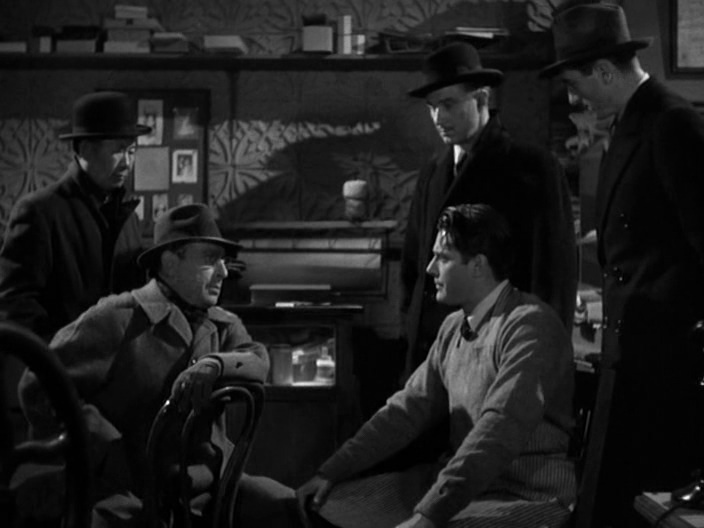
Like The Invisible Woman, Invisible Agent was given a pretty big budget (again in the $300,000 range) for what was essentially a B-picture but, while the money on that film mainly went into the special effects, here the film itself benefits. While some of them are pretty standard, like the carpentry shop and the prison, there are sets in the movie that are fairly lavish, like Maria's nice, fancy house, where white is the predominant color, Stauffer's large office, and good use of the Universal backlot for scenes that take place on the town square, in the surrounding countryside, and the Nazi airfield. Some of the setpieces are pretty elaborate, like when Griffin parachutes from the plane as it's being fired upon and, once he's invisible, escapes from some Nazis waiting for him; when Stauffer traps him in his office and Griffin starts a fire and uses the intervention of the firefighters who arrive along with his invisibility to escape; and the climax, which involves a lot of chaos as Nazis storm the Japanese embassy, Griffin and Maria creating havoc when they arrive at the airfield, using a bomber that they commandeer to destroy a good number of planes to impede the attack on America and create chaos and confusion on the airfield in the process, and their plane being shot down by the RAF, with Maria having to parachute the both of them to safety (there's some pretty noticeable stock footage during these sequences but it was common practice around that time). The film is also well shot by cinematographer Lester White, with instances of deep, noirish blacks and contrasts in scenes such as when Schmidt first meets Griffin and later when he's being interrogated and tortured by Stauffer and his men, Heiser is in prison, Griffin is captured by Ikito in the abandoned carpentry shop, and in the Japanese embassy during the climax. The camerawork is definitely not fancy or arty in any way but there are some nice shots and setups, like how the opening interrogation towards Griffin is often filmed to show nearly all of the characters in one shot, with Stauffer sitting in front of him and two men keeping him in his chair from behind (once again, I feel like this scene had to have inspired Raiders of the Lost Ark, as it's very similar to when Arnold Toht comes in to interrogate Marion, and the action scene that follows where Griffin escapes is similar to when Indiana Jones fights them off and rescues her), and the close-up of Ikito as he murders Stauffer and prepares to kill himself, with the actual suicide photographed at a distance from behind him.


One of the film's strongest elements is the effects work, and I wasn't exaggerating when I said that it was some of the finest John P. Fulton and his crew ever created for one of these "invisible" movies. In fact, the astounding effects aren't limited to Frank Griffin, as you have a nice use of miniatures, matte paintings, and compositing for shots of the planes flying through the sky and when those at the airfield are destroyed by the bomber, which is quite spectacular. Getting to the invisibility, you can tell that Fulton and company were becoming more adventurous with how they pulled the effects off, with Griffin becoming invisible and kicking off his clothes while parachuting down from a plane, combining the matting technique with a process screen of the night sky in the background and it looks quite good. As in the previous films, you can sometimes see John Hall's matted out silhouette, a faded, soft halo around him sometimes, transparency of certain objects and other things that he comes into contact with (in the first scene between him and Arnold Schmidt, if you look closely, you can see Albert Basserman's own hand disappear when he feels around for Griffin), and wires suspending various items in midair to make it seem as if Griffin is carrying them, but it's easy to overlook because of the restrictions of the times and also because the rest of the effects are very impressive. Case in point, the moments where he's washing up in Maria's bathtub and when he puts cold cream on his face and hands to make himself partially visible for her. Those are simply amazing to look at, as you can see the soap suds sitting on an otherwise completely invisible set of arms and legs (there is a silhouette there but you have to strain to see it), and the cold cream slowly creating an impression of his invisible face and hands. In the latter, the silhouette is more obvious but it's still so cool to look at, especially when the face is half-formed, and the same goes for when Maria takes his glasses and head-towel off and wipes away the cold cream to hide him from Stauffer and Heiser. There are some other noteworthy instances of invisibility, like when Griffin is putting on and wearing a guard's uniform and when the net drops on him, but those, along with the non-invisible effects I mentioned earlier, are where Fulton's work really shines and it's small wonder that he once again received an Oscar nomination (he never won for any of these movies but later in his career, when he began working on more prestigious movies like The Ten Commandments, he would eventually rack up three awards).


Given how far our relationships with Germany and Japan have come since World War II, it's always interesting to look back at films, theatrical shorts, and cartoons made around this time as propaganda that completely demonized and mocked them. For starters, you have only fleeting instances of Nazis either speaking German or, at the very least, in German accents, and the two commanding officers of the regime here, Stauffer and Heiser, are played by a British actor and a Romanian-born American actor respectively. That's to say nothing of Peter Lorre, a man of Austrian and Hungarian birth (and who was also Jewish, having fled Germany in the early 30's to escape the Nazi regime), playing a Japanese. That in and of itself is a little easier to swallow, as Lorre was so odd-looking in the face that he could pass for Asian, especially when wearing the glasses he wears here, but at the same time, it fits with the stereotypical image of the Japanese around that time, as weird and menacing killers (at least they didn't give him buckteeth and have him say, "So, so," in an over-the-top accent). Speaking of which, that's another thing about them: the way in which they're portrayed. While Lorre, Sir Cedric Hardwicke, and J. Edward Bromberg all play their roles as the villains well, there's not much complex or multi-faceted about them, as they're just a group of sadistic, menacing, and evil men who are willing to back-stab and betray one another in order to benefit their own personal causes, with the alliance between Germany and Japan being portrayed as distrustful and anything but respectful. Both Stauffer and Heiser make no secret of the fact that they believe the Nazis are the "master race" that's meant to rule the whole world, with Stauffer telling Griffin early on, "German thinking is the clearest in the world," and, when he's bringing out the food he brought for them, Heiser says, "Every country we conquer feeds us... Slaves working for us everywhere, while we sit back with a fork in our hands and a whip on our knees." Speaking of Heiser, he also makes a comment on the tyrannical, controlling nature of the Nazis, telling Maria, "The Fuhrer doesn't like people who think their own thoughts." And let's also not forget how he in particular is shown to be a buffoon that Griffin makes a complete fool of during the dinner and acts like a big baby when Maria laughs at what's happened, storming out and putting her under house arrest. In fact, the Nazis as a whole are portrayed as incompetent, with Griffin easily besting them whenever he comes up against them, such as when he first lands in Germany, escapes the trap Stauffer sets for him in his office, and during the climax. (Supposedly, there was originally a scene where Griffin gives Adolf Hitler himself a kick to the rear that was cut from the final film when images like that were banned altogether.) All of this is indicative not only of the time period but also the sentiments of Curt Siodmak, given his connection to the material. However, the film only demonizes the Nazis rather than the German people as a whole, with Arnold Schmidt (played by an actor who was German) and Maria Sorenson shown to be friendly to the Allies and staunch anti-Nazis, again obviously due to Siodmak, so it's a little more fair than other such films of the time.


While not a big spectacle movie by any means, there are some nicely done, fairly exciting and entertaining sequences to be found here. At the beginning, when Stauffer, Ikito, and their men interrogate Griffin about his grandfather's formula and he initially refuses to talk, he seems to relent when they threaten to slice his fingers off with one of the cutting devices in his print shop (there's a nice bit of suspense there as Ikito inches the blade down towards his hand, as he's held there by the other men). But, when he takes out a hidden drawer that he seemingly uses to hide the formula, Griffin uses it to knock away one of the guards holding him, smash the overhead light, use the darkness to punch away the other attackers and smash the big window out in front, managing to avoid the gunfire in order to run for safety. Later, when he's dropped into Germany, the plane carrying him is fired upon by Nazi troops on the ground and he quickly injects himself with the serum before jumping, disappearing and removing his clothes as he floats down to the ground, much to the surprise and confusion of the troops who watch him. He lands atop a nearby barn and the Nazis attempt to trap him there but he smashes his way into the barn, uses the hay inside to distract the soldiers who walk in, and manages to get by the others who surround it, commandeering a vehicle and getting rid of its drive in order to make it to Berlin. We get a bit of comedy during the scene where Griffin eavesdrops on Maria's dinner with Heiser and decides to pull a number of pranks on the second-in-command, like making it seem as if Maria's cigarette lighter is automatic but only for her (he continues trying to make it work for him through this section of the movie), popping the champagne before Heiser can do so himself, helping himself to some champagne and food behind Heiser's back, pushing an ice bucket onto him, shoving a fork with mashed potatoes on in into his face, turning the entire table onto Heiser and getting food all over his uniform, and putting a fork on his chair when he sits down. And when Stauffer traps Griffin in his office, Griffin initially tries to escape but finds the door locked and the only other way out a window four stories up with no fire escape. Stauffer forces him to sit in his chair and rock back and forth so he knows where he is, again trying to get him to give up the formula in exchange for his life but when Griffin still refuses, he uses Stauffer's attempt to bring his men in to create a distraction by starting a fire in the room using a floor heater, a waste basket full of papers, and documents in his desk. Griffin then calls for the fire department using the radio on the desk and uses his fists and other objects on the desk to fend the Nazis off until the firefighters arrive, using the ladder they put up to the window to escape with the list of spies in the United States.


The third act begins when Griffin helps Heiser escape from prison in exchange for telling him when and how they plan to attack America, knocking out the guards who come to execute him and using their uniforms so the two of them can slip out undetected, with Heiser adding a touch of firing several shots so the guard at the front desk will think he's been executed (whether or not he actually killed the guards with those shots off-camera is never revealed). But things get complicated when, at Arnold Schmidt's carpentry shop, Griffin and Maria are captured by Ikito and his men and taken to the Japanese embassy, prompting Heiser to attempt to save himself by telling Stauffer what's happened in exchange for being reinstated in his position. But, just as the Nazis arrive outside the embassy, Griffin manages to knock out Ikito's men who try to remove him and Maria from the scene, and when Stauffer and his men storm into the embassy and battle the Japanese, the two of them use the chaos and confusion that breaks out to escape, commandeering a truck outside to drive to the airfield. Heiser takes command after Ikito murders Stauffer and tries to chase them down, unaware that two of Stauffer's men are after him, but is unable to stop them from reaching the airfield. There's a lot going on here, as Griffin barrels past motorcycles, guards, and other obstacles in his way to reach the field, turns over a gas tank there, creating a fire that engulfs much of the field and distracts the Nazis while he carries Maria over to a nearby bomber. Heiser arrives just in time to see the bomber take off and orders them to man the other planes and shoot it down, but Griffin destroys the remaining planes with the bombs, turning the airfield into a full on warzone. He and Maria fly away, avoiding the big turret guns that shoot at them, and Heiser is gunned down by Stauffer's men. They run into some more trouble when they enter English airspace, as Griffin refuses to let Maria notify the British that they're in a German plane because he doesn't trust her and as a result, they're fired upon. To compound things, Griffin falls asleep from the serum again and Maria has to parachute them both to safety, as the plane is soon shot down. They have a rough landing and English troops arrive to take them in but the next scene shows that they're now in safe hands, with Griffin recuperating and Maria's sincerity proven to him, before they officially become lovers.

This was during the period where Universal, in order to cut costs, reused music from their past films to score new films and Invisible Agent, as I don't think there's a single bit of original music to be found here. It's all taken from other movies, notably horror films like The Wolf Man, and is re-orchestrated and re-arranged to sound somewhat different but it's instantly recognizable if you've watched a number of these movies like I have. As a result, there's not much I can say about this. What they used fits the movie okay but it's just a shame that a number of flicks made during this period, like Frankenstein Meets the Wolf Man, House of Frankenstein, the latter Mummy movies, and so on weren't afforded their own musical identities, as it really affected the memorability of some of them.

Invisible Agent is one of those movies where it's hard for me to say whether or not I recommend it, as it's not horrible nor great but rather just average. The story isn't that complex or involving, the characters are fairly two-dimensional, the film is such a product of the War Years from the early-to-mid 40's that it's unavoidably dated in many ways, and the music score is just a collage of pieces from past Universal movies, so it's disappointing on that part especially. On the other hand, though, it does benefit from the memorable performances of Sir Cedric Hardwicke and Peter Lorre as the main villains, the presence of the lovely Ilona Massey, a fairly brisk pace of just 81 minutes, nice production values and cinematography, fairly entertaining action and comedic setpieces, particularly during the third act, and some truly impressive special effects work, both in regards to the invisibility and the miniature and compositing work. So, it's about equal in terms of the pros and cons in my opinion. Like The Invisible Woman, I'd ultimately say that if you go into it not expecting anything earth-shattering and keep in mind the time period it was made in, it is worth at least one watch.

Saturday, December 9, 2017

The Invisible Woman (1940)

Back in October, I reviewed three of Universal's "invisible" series, The Invisible Man, The Invisible Man Returns, and The Invisible Man's Revenge, as part of my horror film review marathon but I left out a couple of other films that are considered part of that series, mainly because they don't fit into the horror genre at all. Case in point, our subject here is an out-and-out screwball/slapstick comedy, with the only fantastical elements being the invisibility part. Hardly appropriate for a marathon reviews, I decided to put it and the next film, Invisible Agent, aside for another time and, now I've decided that that time has come. Like the other follow-ups to The Invisible Man, I knew that this film existed for a while due to a filmography in the back of a book called Monster Madness that I bought around 1998 or 1999, when I was twelve years old. It wasn't mentioned at all in the actual entry on the Invisible Man in the body of book, so I had no idea what kind of movie it was until I bought John Stanley's Creature Features review book around 2000 and I used it to look up all of the films that I knew very little about save for their titles. There, he gave The Invisible Woman a pretty fair rating of three stars, saying that it's pretty standard stuff but worth watching for the cast, which includes Shemp Howard (I had no idea he was in the film until I read that review and that piqued my interest, as I'm a big Three Stooges fan), and that's pretty close to how I feel about it. As a comedy, it's not laugh-out-loud funny by any means, save for a couple of moments here and there, and there are instances of slapstick that are pretty pedestrian, as well as not as much use of the invisibility gimmick for comedic effect as there could be, but I wouldn't go as far as James Rolfe in his CineMassacre's Monster Madness review and advise someone to skip it altogether. If you like classic Hollywood, the movie has that feeling of charm and sophistication that comes with it, many of the characters are likable in how quirky they are, and, like the films that came before and after it, the invisibility effects are still quite impressive, for the most part.

Dick Russell is a wealthy young playboy whose latest adventure with the opposite sex has cost him $100,000 in a court settlement with the young woman in question and now, he's flat broke. What's more, Prof. Gibbs, an eccentric old scientist who used to work for his late father and whose experiments Dick continues to fund, needs $3,000 to go on. When Dick is unable to pay him, Gibbs, undeterred, goes to the offices of the city's newspaper and changes his advertisement for a human test subject for his experiment, saying that there will now be no remuneration for participating in it. The goal of the experiment? To make a person invisible with a special machine Gibbs has built, an endeavor that he insists will make millions for Dick. And sure enough, he soon gets an answer to his ad from a K. Carroll, who happens to be Kitty Carroll, a lovely but much put upon fashion model who's far behind on her rent and has had it with her cruel, mean-spirited boss, Mr. Growley. After a particularly bad day on the job, Kitty quits her job and shows up at Gibbs' house for her appointment. The experiment is a complete success, as Kitty is made completely invisible, but before Gibbs can present his success to Dick, Kitty leaves the house to get even with Growley, frightening him into being more kind and understanding with his employees. When Gibbs is unable to come up with any evidence that has made a person invisible, Dick loses all faith in the professor and prepares to have everything taken away from him. When the invisible Kitty returns to Gibbs and manages to scare off a man who claims to be a fellow scientist but is actually one of several gangster who are interested in the machine, she agrees to help the professor prove himself to Dick, but they're forced to follow him to his country lodge. Although Dick is eventually convinced, he and Kitty don't exactly hit it off with each other, which is complicated when she drinks a lot of brandy and the alcohol causes her to remain invisible longer than she should. Even worse, the leader of the gangsters, Mexican crime boss Blackie Cole, is determined to use the machine so he can return to the home he's been banished from and will stop at nothing to get what he wants.

The Invisible Woman was directed by A. Edward Sutherland, a London-born filmmaker who came from a show business family and who started out as an actor in the silent era, appearing in a Keystone Cop film (as one of the original cops, no less), a 1918 film called Which Woman?, directed by Tod Browning, and was directed by Charlie Chaplin, whom he'd co-starred with before, in A Woman of Paris. Chaplin later helped Sutherland begin his directing career, with his first major film being a 1926 comedy with Wallace Beery and Raymond Hatton, and he went on to direct more than fifty movies in his career, working steadily well into the late 40's. One of his notable movies aside from this is The Flying Deuces, a 1939 Laurel and Hardy film, although Sutherland did not get along with Stan Laurel at all, to the point where he said something to effect of he'd rather eat lunch with a tarantula than work with Laurel again. After a 1946 film called Abie's Irish Rose, Sutherland's directing career slowly began to wind down, and he wouldn't direct another movie until a decade later, with Bermuda Affair, which proved to be the last movie he ever did direct. He directed episodes for television series like Martin Kane, Overseas Press Club: Exclusive!, and International Detective but after the latter, which lasted from 1959 to 1961 and which he directed 22 episodes of, he pretty much retired and died on New Year's Eve in 1973 at the age of 78.


As two-dimensional as they are, many of the characters in the film are likable in their own ways, chief among them the Invisible Woman herself, Kitty Carroll (Virginia Bruce). She's a fairly intelligent, witty woman, kind of in the vein of Carole Lombard, and is also adventurous, leaping at the opportunity to become invisible in order to escape her unenviable life, where she has to endure the unimaginable cruelty of her boss, Mr. Growley, on a daily basis in her position as a fashion model, a job that doesn't pay much and has caused her to fall far behind on her rent. After a particularly insufferable day on the job, she becomes more determined than ever to have her appointment with Prof. Gibbs and, once she becomes invisible, she heads back to the company's offices and uses her newfound ability to terrify Growley. She does this not only for herself but also for all of the other women Growley cold-heartedly pushes around and steps on, and she puts the fear of God in him to the point where he becomes far more understanding and nice in his position so as not to upset "the voice of his conscience." In her haste to get back at Growley, though, Kitty unintentionally makes Gibbs look like even more of a fool to Dick Russell than he actually is, when he tries to convince the young millionaire that he's succeeded in his experiment, only to learn she's not there, and when she realizes what she's done, she apologizes and agrees to help set things right for him (she already did him a favor beforehand by getting rid of Foghorn, one of Blackie Cole's cronies who was posing as a fellow scientist to try to get at Gibbs' machine). She makes the long drive up to Dick's country lodge with Gibbs and proves to him that the professor isn't as much of a crackpot as one would think, although she and Dick initially get off on the wrong foot because of his attitude and her being well aware of his playboy reputation, as well as losing her inhibitions when she gets drunk. Speaking of which, she also unintentionally complicates matters by doing so, as the alcohol's mixing with the formula causes her to stay invisible longer than she normally should, leading to further tension between her and Dick as he makes comment about her walking around in a dress with no head. But, as things go on, their relationship becomes less antagonistic, as Dick begins to realize what a beautiful woman she truly is, especially when she regains her visibility thanks to Gibbs. However, she and Gibbs get kidnapped by Blackie's cronies and brought to his hideout in Mexico, as Blackie tries to force the professor to make the machine work. Fortunately for Gibbs, Kitty drinks some alcohol that she finds, which causes her to become invisible again and she uses it, along with her wits, to defeat the criminals, and when Dick and the others come to the "rescue," she decides to see how much he wants her by making it seem like the hideout is more heavily guarded than it is. When he proves his devotion, they officially become loves and the movie ends with a scene some time later where they've married and had a baby boy who's a lot like his parents... in more ways than one.

In most movies of this type, Dick Russell (John Howard) would be the handsome but bland leading man but, while he still can hardly be called a multi-faceted character, there is a little more to him than that. He's depicted as a young, wealthy playboy who's had many, many escapades with women, which have often landed his picture in the newspapers, and has a very carefree, nonchalant attitude about it all, regardless of the fact that the latest scandal cost him $1,000. Even when his attorney, Hudson, tells him that he's now broke, Dick doesn't seem all that concerned about it, down to his still intending to help Prof. Gibbs in his experiments, despite the fact that he's recently asked him for $3,000 to continue them. He feels obligated to Gibbs, since the professor used to work for his father and feels that his experiments have to eventually lead to something, although Dick is talked into telling him that he can't give him any more money. Even then, despite how outlandish Gibbs' claims that he can turn a person invisible are, Dick doesn't lose his faith in him and is ensured that he'll become rich again when they both see Kitty's acceptance letter for the job. His faith in him crumbles, though, when Gibbs tries to prove to him that the experiment was a success, unaware that Kitty left immediately after becoming invisible, and as the old professor tries to search around for someone who isn't there, Dick is now convinced that he is a deluded old fool and prepares to lose everything that he has. To get away from everything, especially Gibbs, he and his much-suffering butler, George, drive up to his country lodge, where the professor and the invisible Kitty follow them and manage to make him see that he was right. Like I said, Dick and Kitty themselves don't exactly become the best of friends right off the bat, due to Kitty's talking about him as little more than tabloid fodder in her drunken state and Dick, in turn, feeling that any woman who'd want to make herself invisible can't be that much to look at in the first place and continuing to make comments to that effect. They have a lot of back-and-forth banter in which they passively-aggressively rib each other, but as time goes on and Dick gets hints of what a lovely woman she really is, he softens towards her and his women-chasing nature makes him eager to see what she really looks like. He does finally get to see to her when she becomes visible again, but it's only for a few seconds, as he's knocked out by Blackie's cronies when they take her and Gibbs hostage and run off to Mexico. Thanks to Foghorn, who's out for revenge on Blackie for making him an unwitting guinea pig for the machine, Dick and George find out where they are and race to rescue them, with Dick proving his devotion to her despite the "danger" she adds to the situation. Once he gets inside the hideout, he declares his love to Kitty and they eventually marry and have a child.

Legendary actor John Barrymore plays Prof. Gibbs but, while his presence may have seemed like a big coup for the movie, by this point, his heyday was long behind him and he was a complete drunk, getting less and less film roles as a result (he only made two more films after this before he died in 1942 at the age of 60). According to future Wolf Man screenwriter Curt Siodmak, who wrote the initial story for the film with Joe May (director of The Invisible Man Returns), Barrymore was so drunk during filming that they had to keep him steady with wires to ensure he didn't sway out of focus onscreen and, according to John Howard, who'd costarred with him before, his memory was so bad that he cut up parts of the script and hid them throughout the set so he could read his lines from off-camera. It's sad, too, because Barrymore's performance, which consists of an odd way of speaking and interesting mannerisms, is one of the movie's most memorable aspects. He plays Gibbs as the typical old, eccentric inventor: unquestionably brilliant in his own way but so erratic and stuffy that, aside from Dick Russell, everyone thinks he's a complete fool who doesn't know what he's doing. He's very dismissive towards his housekeeper, Mrs. Jackson, hardly ever listening to her, even when she has something important to tell him, and no matter what, he never stops trying to reassure Dick that his machine can make people invisible and that he'll be rich from it as a result. Gibbs is completely confident in his machine, as he claims he once made his cat invisible, and it's soon shown that he does know what he's talking about when he successfully makes Kitty Carroll invisible (he was initially reluctant to use her, due to the nudity involved in the process). Unfortunately for him, Kitty's single-mindedness in using her newfound invisibility to get back at Mr. Growley causes Dick to think he really is as nutty as everyone else says he is, and he's very angry at Kitty when she comes back, although he does reluctantly thank her for getting rid of Foghorn when he's posing as another scientist. When she makes it clear that she's willing to help set things right with Dick, Gibbs decides to forgive her and they follow the millionaire to his country lodge, although the professor has to deal with Kitty's constant drinking and mischievous shenanigans, much to his exasperation. The adverse reaction the invisibility chemical within her has with all the alcohol she drank forces him to search for a way counteract it and, as he does so, he seems happy to find a way to bring her and Dick together in the process, giving her a nice dress to put on for Dick when she regains visibility. As backwards as he sometimes is (like how he just goes along with Blackie's men when they arrive to kidnap them and later doesn't realize that his feet are still tied up), Gibbs proves that he isn't completely foolish when he manages to stall Blackie and the other gangsters with scientific jargon long enough for Kitty to become invisible again and dispense with them. Again, Barrymore's oddness really make this character work, especially at the end when Kitty and Dick's baby boy is shown turning invisible when George puts rubbing alcohol on him and Gibbs' simply explains, "Hereditary."

One character whom you can't help but feel pity for is Dick Russell's constantly suffering butler, George (Charles Ruggles). This poor guy has to put up with so much from both his employer and Prof. Gibbs, who he sees as a complete quack Dick should've disowned years ago, and it gets to the point where he tries to quit his job several times throughout the film. The movie begins with him tripping as he walks down the stairs in Dick's mansion and getting smacked up against the wall when he answers the door for his attorney, Hudson (when he tells him to get up, George says, "I am up. I was up. And I've been up all night. I would have stayed up if you hadn't knocked me down,"), and it doesn't get much better for him afterward. For one, Dick drives him crazy when it comes to what's ultimately going to happen to the house and his fortune. At first, it looks like they're going to lose everything, so George packs everything up, covers the windows up, and such, and Dick, confident that Gibbs is going to make millions for him with his experiment, tells him to go ahead and put everything back, much to George's consternation. And later, when Dick thinks Gibbs really is a crazy old fool who doesn't know what he's doing and it's all over, he tells George to pack everything up right after he's finished putting it all back. The poor guy just can't catch a break, and later, when he attempts to follow Dick up the stairs to talk to him, he's so frazzled by everything that he unknowingly walks up a ladder beside the stairs and falls over the top. Even when he and Dick go up to the country lodge, George isn't spared any more exasperation when Gibbs shows up with the invisible Kitty and he only gradually realizes that she's there, as her making things appear to be floating in midair about cause him a nervous breakdown, as does the revelation that there is an invisible woman about. During the third act, George faints in abject fear when one of Blackie's cronies points his own shotgun at him, is forced to come along with Dick and Foghorn when they track Kitty and Gibbs down to Mexico, and nearly has a heart attack when, in her scheme to force Dick to prove how much he wants her, Kitty fires a machine gun at George's feet. Even at the end, after Dick and Kitty have married and have had a kid, George's suffering doesn't end, as the kid turns invisible after he's rubbed down with rubbing alcohol, causing the poor butler to faint. Despite his suffering, George is definitely one of the film's more memorable characters and has some memorable lines, like when he tells Dick, "Looking at a woman is only the first step to trouble. You look, she smiles. You soften, she sues." He also has a moment that did make me laugh out loud when I heard it, when Dick tells him to call the airport and he actually goes, "Oh, airport!"

George isn't the only person who has to put up with a lot from his employer. Mrs. Jackson (Margaret Hamilton, i.e. the Wicked Witch from The Wizard of Oz) is Prof. Gibbs' housekeeper and she has to deal with his eccentricities on a daily basis, but unlike George, she's a much cooler customer, handling it mostly with a straight-man type of sarcastic humor and taking whatever's thrown at her in stride. When she's first introduced, George slips a note from Dick telling Gibbs that he can't loan him any more money under the front door, rings the doorbell, and then promptly walks away. When Mrs. Jackson answers the door and finds that there's nobody there, her confused response is, "Well, what is this?! Halloween?!" After she brings the note down to Gibbs in his laboratory, she's horrified to see him guzzle down a liquid in a beaker that had a flame on it for a second, although he explains that it was simply something to help with his indigestion, and when he reads the note and rushes off to make a change to his advertisement in the paper, he leaves her holding a long, cylindrical beaker full of liquid, telling her, "Hold it carefully. It might explode." When Kitty shows up to take part in the experiment, Mrs. Jackson is only too happy to tell Gibbs that it's a woman, and when he says, "You mean skirts and things," she matter-of-factly responds, "Mm. Skirts and things." Uncomfortable but desperate not to lose the opportunity, Gibbs talks Mrs. Jackson into telling Kitty that she'll have to take her clothes off for the experiment, as well as being present for it, and when Mrs. Jackson says, "Well, I don't know if I want to see folks get invisible. Might give me a turn," Gibbs makes her agree by saying that he'll use her instead if Kitty doesn't work out. Sure enough, when the experiment works, Mrs. Jackson is so overcome with it that she's constantly shaking. She tries to get Kitty to stay when Gibbs heads out to get Dick but to no avail, and Gibbs, of course, doesn't listen to her when she tries to tell him, only learning what's happened later when Dick has written him off. Later, when Blackie's cronies break into the laboratory to take the machine, she does her best to fight them off, breaking a chair over them, but gets locked up in the cupboard in the cellar and isn't let out until the next day when Gibbs, Kitty, and Dick arrive and find that the machine has been taken. She's not seen again afterward and it's a shame, because even though she doesn't have much to do, Hamilton is still fairly entertaining in this role.

Despite the trouble and irritation they go through, George and Mrs. Jackson should be glad that their respective employers aren't anything like Kitty's boss at the fashion company, Mr. Growley (Charles Lane). This guy is just a complete asshole, treating the models who work for him like absolute dirt and acting like a drill sergeant, baking at them, "Eyes front! Chin up! Shoulders back!" He docks Kitty an hour's pay even though she's only two minutes late, threatens to fire Jean, who has a cold, if she sniffles in front of the customers, tells Mrs. Bates, the girls' supervisor, to mind her own business when she tries to intervene, adding, "There are plenty of younger women for your job," and, in a move that proves to be the last straw for Kitty, forces her to apologize to two bitchy women who end up tearing the dress she's modeling for them, insisting that the customer is always right. Even worse, two of Kitty's fellow models stick up for her, he threatens to fire them as well unless Kitty apologizes, which she begrudgingly does. When she returns to the building invisible, she sees him cruelly making good on his threat to fire Jean for sniffling in front of the buyers and, after she struts out in a dress with her head invisible, horrifying the two women she had to deal with earlier, she confronts him in his office. Growley, needless to say, is freaked out of his mind by what's going on, as Kitty admonishes him for being such a horrible person, throws one of his designer dresses out the window, and forces him to put his head in the window sill, where she traps him before giving him three kicks in the behind. He watches this invisible force trash the outside of his office, throwing away dresses, smashing the time-clock, and such, causing him to faint. When you next see him, he's being much nicer to the women, telling them that they'll get rid of the time-clock, that Jean can have her job back when she gets better, and that they'll serve tea at 4:00 every day. Kitty calls him to ask for the rest of the day off in order to help Gibbs with Dick and he tells her to take whole weekend off, before hanging up and, meaning to talk to the voice of his conscience Kitty identified herself as, asks, "How am I doing?" The fear of retaliation from her is going to keep in line for a long time, it seems.


As you might expect, the bad guys can hardly be called menacing or threatening; in fact, they're complete bumbling idiots for the most part. Even the Mexican mob boss, Blackie Cole (Oskar Homolka), for all of his threats and yelling at his cronies, is not nearly scary as this type of character is often portrayed. In fact, he has a legitimate, personal interest in Prof. Gibbs' invisibility machine that doesn't involve crime: he wants to use it to return to his Mexican home, which he's been banished from, and he's actually very sentimental about it, prone to breaking down and crying whenever he thinks about it for too long (Gibbs is able to pick up on this trait of his personality simply by looking at him). Ultimately, Blackie is defeated, along with his other cronies, and Foghorn ends up paying him back for forcing to be a guinea pig for the machine once they bring it to Mexico. Speaking of Foghorn (Donald MacBride), his name comes from the fact that he has a nice, deep voice and he's also more intelligent and eloquently-spoken than Blackie's other cronies, able to pass himself off as another scientist to Gibbs (before Kitty exposes him as a gangster) and reassemble the machine by making a diagram when they take it apart to get across the border. Unfortunately for him, they didn't realize they needed a chemical to inject into the subject before being put through the machine's process and, when Blackie forces him to allow them to test it on him, instead of making him invisible, it gives him a falsetto, Mickey Mouse-like voice. Enraged at this, Foghorn turns on his boss and eventually manages to make his way to Dick Russell's house after Blackie's other cronies have kidnapped Kitty and Gibbs. He tells Dick and George where they've been taken, leads them to the hideout in Mexico, and manages to get back at Blackie, knocking him into the machine and causing him to become a falsetto as well. Luckily for him, Blackie giving him a punch to the head beforehand was all that it took for him to get his voice back. Among Blackie's other cronies is Shemp Howard as Frankie, also known as "Hammerhead," by the far the most bumbling member of the gang. If you've seen Shemp in the Three Stooges shorts, just imagine him as a gangster and you've pretty much got his performance here, as he has that same street-smart but clumsy persona and doesn't get to do much other than fumble around like an idiot. It's interesting to see him in something outside of those shorts (this was during the long period between his leaving the act with Ted Healy back in its vaudeville days and when he rejoined Moe and Larry onscreen after Curly had his stroke, during which he appeared in many films and shorts all his own) but there's little else to it other than that. And finally, you have Bill (Edward Brophy), and while he doesn't have much to him that makes him stand out from the other gangsters, other than being short and stocky, it's interesting to note that Brophy went on to costar with the Three Stooges in the movie, Swing Parade of 1946 (at the tail end of Curly's tenure).


There are some other small but notable characters in the film, including Hudson (Thurston Hall), Dick's exasperated family attorney who tires of all the trouble the young playboy gets himself into, informs Dick at the beginning that he's broke thanks to the lawsuit he just caught up in, and tries to get him to cut ties with Prof. Gibbs and stop giving him money, only to be told later on that the professor's latest invention is going to make him rich again. You don't see Hudson again after that, making me wonder if, unlike George, he was able to quit. Jean (Ann Nagel) is the poor woman who's forced to work as a model, even when she has a cold, Mrs. Patten (Kitty O'Neil) is Kitty's sympathetic but still business-minded landlady, and Mrs. Bates (Mary Gordon) is the models' supervisor who is treated no better by Mr. Growley and is so freaked out when Kitty returns to the building while invisible that she runs off in fear. And finally, Maria Montez, who would go on to have a glamorous career in a number of big budget, Technicolor movies throughout the next couple of decades, makes her screen debut here as one of the other models, although she only has one line.


At first glance, The Invisible Woman may seem like a pretty standard, B-level movie of the time. There are no big stars in the cast (save for John Barrymore but, like I said, he was basically a has-been at this point), there's nothing particularly glamorous about it, in spite of the inherent charm and sophisticated nature of studio movies of this era, the film's look and camerawork is nothing special, and the same goes for the production values. Indeed, the sets and location work, which consist of Dick Russell's fancy mansion, the more average house on the property where Prof. Gibbs lives and his laboratory in the basement (which is just a bunch of scientific equipment in an otherwise ordinary-looking room), the country lodge Dick and George retreat to, the offices of the modeling company where Kitty works and the apartment building she lives in, and Blackie Cole's hideout in Mexico, which is another big, luxurious place with scientific equipment inside and armed guards outside, are very average-looking and give no hint of a lot of money backing the movie they're in. For that matter, when Gibbs first makes Kitty invisible, there are shots of the equipment working that I'm sure at bits of stock footage from past mad doctor movies Universal had produced, including some of the Frankenstein films. But, in actuality, this was one of the studio's most expensive films of that year, with a budget of close to $300,000, which was far more than they usually spent on their B-pictures. Its high level of prestige might have been more noticeable at the time had the studio's first choice for the lead, Margaret Sullivan, had done it to finish off her contract, but as her career was really taking off at that point and she was getting offers for more glamorous movies, she felt this film was beneath her and passed. (In fact, they didn't know she'd rejected the role until she failed to show up for rehearsals, prompting Universal to file a restraining order to keep other studios from hiring her!)


So, where did all that money go, you may be wondering. Why, the special effects, of course. As it was with The Invisible Man and The Invisible Man Returns, John P. Fulton headed the special effects, creating them by shooting Virginia Bruce in a black velvet bodysuit up against a black velvet background and compositing her into the scenes, as well as wires and similar techniques to manipulate the environment to make it seem as if Kitty is carrying things, opening doors and windows, etc. Also like The Invisible Man Returns, Fulton's efforts would win an Oscar nomination and, while I don't know if the effects work here is that good (the follow-up, Invisible Agent, has instances of invisibility and partial invisibility that are far more impressive), it's still pretty impressive for the time, especially when other people are interacting with Kitty. Some of the best occur at the country lodge, where Kitty is picking up glasses, pouring herself drinks, and picking up and swaying a cat in the air to mess with George. The effects are practically flawless in those scenes, as they are when Kitty is putting stockings on her invisible legs, wearing a bedspread around herself and later a veil around her face that she pulls up from time to time to reveal her invisible head, and when her face disappears in Blackie's hideout, as well as when her baby boy disappears during the final scene. Mind you, I said they're "practically" flawless. Like before, there are hiccups in the effects, as you can often see soft edges around the clothes and other objects that Kitty comes into contact with while she's invisible, some instances of them being see-through, as well as a very vague outline of Bruce's head and other appendages in some shots (not nearly noticeable as it was before, mind you), and wires that you can pick out when things are being moved around. The most glaring mistake occurs when Kitty confronts Mr. Growley in his office and begins disrobing in front of him. At one point, she puts her arms in front of her white skirt and you can very plainly see the black velvet Bruce was wearing for the compositing process (it's only onscreen for a couple of seconds and I never knew it was there until I read up on it on IMDB). But, despite those flubs (which have their own archaic charm to them), these effects are still fun to watch and you can see how far Fulton and his team had come from the already very impressive work in The Invisible Man.


While we're on the subject of the invisibility effects, it's worthwhile to mention that the rules of invisibility and how it's administered here is played with a little bit. Instead of a simple injection with a special serum like before, here it's created via the combination of a serum and being exposed to the power of a special machine that Prof. Gibbs has built, and if you don't have the serum, the machine, for whatever reason, will mess with your vocal cords and cause your voice to go a few octaves. Plus, alcohol causes the invisibility to be prolonged longer normal, forcing Gibbs to find a way to counteract it when Kitty drinks way too much brandy for her own good. And somehow, this effect is passed on to her and Dick's baby boy, as he instantly turns invisible when George rubs him down with rubbing alcohol. It's nothing brilliant, mind you, and the effect alcohol has on the invisibility is little more than a convenient way for Kitty to easily be able to thwart Blackie Cole and his men, but it is nice that they decided to do something a bit different with the gimmick rather than it simply being an invisibility serum (I think it would've heightened the comedy a little bit, though, if they kept the madness side-effect in the previous films, albeit in a more lighthearted and comical fashion). It's also noteworthy that they take into account the fairly risque notion that, even though she's invisible, the lead character is a woman who's naked for a good portion of the movie and make it part of the comedy, with Gibbs being initially reluctant to use her as a test subject since she'll have to be nude, instances where Kitty isn't sure if she is invisible and is, understandably, reluctant for the men to get near her, a moment where she passes out drunk and Dick feels around for her before stopping, saying, "Oh, I forgot. She's..." and Gibbs says, "Yes, she certainly is," Dick failing to hide his growing interest in what she looks like, Kitty putting a pair of stockings on her invisible legs so he can get an idea as to where she is, and so on. Nowadays, you wouldn't bat an eyebrow at this stuff but it was considered pretty daring for the time and it's also why they couldn't go further than they did, causing the comedy to suffer.


That really is the biggest failing of The Invisible Woman, at least for me: the comedy is very standard and will hardly make you bust a gut. I love slapstick (like I said, big Three Stooges fan) but the antics of George and Frankie and the other baddies here are little more than very typical instances of falling, tripping, getting whacked over the head, and such. As he later would in the Three Stooges shorts, Shemp has a moment where a big, glass bowl gets stuck on his head and yells for help while trying to get it off, but it's not as funny as you would think, and the same goes for when you see that the gangsters stole a car that has a JUST MARRIED sign on the back. The same goes for the comedic bits where people interact with Kitty while she's invisible, as it's exactly what you'd expect: they're freaked out, often because they think that what they're encountering is some kind of ghost, and those who know what's going on simply try to grasp the concept of there being an invisible person around them. That said, it is kind of funny when Kitty gets absolutely hammered while at the country lodge and falls over faint while invisible, slurring her words and laughing, mumbling, "I can't stand up on my good-lookin' legs." The reason why she gets so drunk is to try to warm herself because of it being really cold and her nudity, which is mentioned not only for the fact that she's a naked woman but also that she's nude in general, as she says while she's taking her clothes off outside the lodge, "Kinda chilly. I wonder how the nudists stand it," and is later sniffling and sneezing while trying to keep her presence secret from George. She does acknowledge some of the other cons of invisibility, like trying to find your feet to put socks on, saying, "This is worse than dressing in the dark." There are also some chuckles to be had in the sexual tension between her and Dick, as they bicker constantly from the moment they meet, although Kitty can sense that Dick has an interest in her and constantly jabs at him about it, especially when she's drunk. One of her best lines comes when she's putting those stockings and tells Dick she's a model by profession. When he asks, "What for? Piano legs?", she responds, "Any time you hear of a piano with legs like mine, sonny, run, do not walk, to your nearest music store." There are some funny bits of dialogue here, like when Gibbs first arrives at the lodge and when he asks George if he shot the elk whose head is mounted on the wall, he says, "No, I think it was born there." Another one is when Foghorn tries to hold up the want-ad clerk at the post office and he completely ignores him, saying, "Aw, go on home to your mother!", forcing Frankie and Bill to prove that they're not joking around.


The most laughs that the film gets come from the quirkiness of some of the characters and the inherent ridiculousness of the premise. You can't help but at least smirk when you see other characters putting up with Prof. Gibbs' eccentricities (like that aforementioned moment where Mrs. Jackson sees him drink something you wouldn't expect him to and when he's trying to hide Kitty's presence from George at the lodge by making like he's the one who's sniffling and sneezing, much to George's bewilderment), George and Hudson, especially the former, dealing with Dick's flippant attitude about the trouble he gets into and his going back-and-forth on what needs to be done with the house, and Blackie Cole trying to be a threatening gangster when he's homesick to the point where he often cries about it. As for the premise, it is funny to see how Kitty uses her invisibility to get back at those who have caused her misery, with the image of a dress with no head up top strutting out and scaring the crap out of those who see it being inherently snort-inducing, and the same goes for when Foghorn's nicely deep, rich voice gets turned into an over-the-top falsetto. In fact, the funniest bits in the entire movie come during the moment when he tells Dick and George where Kitty and Gibbs have been taken. Right before the, "Oh, airport!" line I mentioned earlier, there's a bit where Dick gets so excited when Foghorn tells him that he knows where they are that, for a split-second, he voice goes high as well. The timing on both of those gags made me laugh out loud and, for my money, are the funniest parts of the movie. However, in addition to all of the run-of-the-mill comedy here, there's also some that you can see coming a mile away and falls flat, the biggest example being when Gibbs can't find Kitty after he first makes her invisible and feels around on the floor, going, "Kitty! Kitty! Kitty!", when, what happens? His cat runs up to him and he goes, "Not you!" Really predictable. Other gags just plain don't make sense, like when Blackie is talking to a guy in his hideout who keeps saying "si" again and again. He asks him, "What is all this 'sí sí'? Are you Spanish?", which is an odd thing to say, since they are in Mexico and he himself is Spanish, and then, the guy responds, "I'm a Pomeranian!" ...What? Maybe there's something I'm not getting but when I watched the movie to do this review and heard that, I was utterly baffled and still don't get what it's supposed to mean. And the climax, where Kitty becomes invisible again and uses it to dispense with Blackie and his gang, as well as try to make Dick prove how devoted he is to her, is really "meh" and not as funny or exciting as it could be.

By far the least memorable aspect of the film is the music score, which is really disappointing because it was done by Frank Skinner, who came up with a number of memorable scores for Universal's horror films during this period. Besides scoring The Invisible Man Returns the same year, he most notably did the music for Son of Frankenstein and The Wolf Man, creating themes and motifs for those scores that you would hear time and time again in the sequels to those movies. Having also worked on both musicals and other comedies (he started out in the former), he was obviously just as adept at lightweight music as he was scary and dramatic work, but I guess the rather bland nature of this film was something even he couldn't overcome. The score is made up of generic-sounding comedy music of this period that leaves no impression whatsoever, other than a piece that's very bouncy, lighthearted, and goofy, which is orchestrated either to be really fast or slow, depending on the scene; the same goes for the music used for the more tender moments, and I can't even recall a single melody in those instances. Really, the only piece that sticks in my mind is this upbeat, snappy piece that closes the movie out, and I've heard that at the end of other films, so I'm not sure if it was even originally for this one. I hate being so vague about the music but it's such a major example of "in one ear and out the other."

The Invisible Woman is definitely a mixed bag of a movie. On the bad side, it's not exactly hilarious, most of the comedy is pedestrian, to say the least, and not taken to the extent that it could be, especially given the premise, the characters are two-dimensional, there's nothing that sticks out about its production values or the way it's shot, and the music score is generic and forgettable. But that said, it's not a complete waste of time, either (it's only 72 minutes, so it's not like watching it is a huge chore, in any case). The characters may not be deep but they are quirky enough to be likable, especially Prof. Gibbs, Mrs. Jackson, and George; if you're a Three Stooges fan, you'll appreciate being able to see Shemp Howard; the invisibility effects are still very well-done for the time; there are some genuinely funny moments amidst all of the other lackluster comedy; and the film goes at a good enough pace to where it's never boring. In the end, if you want a very funny screwball comedy, you'd best look elsewhere, but if you can deal with a movie that won't make you bust a gut but does have likable characters and the inherent charm of Hollywood's Golden Age, I don't think it would hurt to give it at least one watch.