Wednesday, December 14, 2011

Disney: Mickey's Once Upon a Christmas (1999)

Now here's a little known, direct-to-video Christmas film from Disney that slipped quietly into stores in 1999 and, ever since then, it's been a little hard to find people who've actually seen it even though it's easy to find on DVD and pops up on Disney Channel every now and again. I was twelve when it originally came out and was going through that phase where I decided I was too old for Disney but, as I've said many times, by my senior year in high school, I had regained my child within and sought this movie out. I'd actually seen it on VHS in a Wal-Mart the year before but I got something else instead (another Christmas-related Disney film, Mickey's Magical Christmas: Snowed in at The House of Mouse); this time, however, I scooped up the DVD when I saw it again. In fact, it was actually on my yearly Christmas list for my Mom and she got a little annoyed at me when I got it myself. In fact, I'd actually seen it on Disney Channel not too long before I actually bought it and I knew it was something I had to add to my collection from just that one viewing. I still think this is a very nice, heartwarming little Christmas film with the classic Disney characters. It's nothing groundbreaking, mind you, but it's absolutely charming and has its heart firmly in the right place.

The film is an anthology with three stories, each featuring different Disney characters in a Christmas tale, with a wraparound involving three gifts that relate to each story narrated by Kelsey Grammer. And so, rather than giving an overall synopsis like I usually do, I'll simply go through each story, talking about the characters and what I think of them. The first is Stuck On Christmas, starring Huey, Dewey, and Louie, who wake up on Christmas morning naturally excited, as all young kids do, and, also like most kids, they're more interested in having fun and getting their gifts rather than spending the day with their family. They immediately open their presents even though they're supposed to wait for the rest of the family to arrive, take the sleds Donald got them for a ride without reading the card included with them, pig out on Daisy's Christmas dinner, and play with their toys instead of singing carols with everyone else. Since they enjoyed the day so much and are bummed that Christmas is over already, they wish upon a star that it was Christmas every day. The next morning, they wake up to discover that their wish has come true and they're ecstatic... at first. After a while, though, they start to get sick of the same events happening day after day and do what they can to make it more fun for them. By the end, though, they learn what Christmas really means and why it can't be year-round.


Huey, Dewey, and Louie are the main characters of this story, all three of them voiced by Russi Taylor, who often voices them whenever they appear in contemporary Disney productions. When it's not her, it's Tony Anselmo, the modern voice of Donald Duck, who does them, and since I watched DuckTales a lot, I prefer Ms. Taylor's performance. Whenever Anselmo does them, he just does his Donald voice in a slightly higher pitch but Ms. Taylor is able to actually make them sound like young boys (and plus, I can understand them better when she does them anyway). In any case, their characterizations tend to differ from one cartoon to another: sometimes, they're characterized as just freaking mean little kids, which was the case in many of the classic cartoons, and other times, it's more like, "Boys will be boys." Their characterization here, as it often has since DuckTales, leans more to the latter: they're just very energetic and rambunctious kids who are excited about Christmas. They don't mean any harm by what they do but they also don't quite grasp what the holiday is really about and grow weary of it when they have to live through it day after day. However, they learn what it means when they decide to change things up one day by playing pranks on the family and end up unintentionally wrecking the house in the process. They're about to go sledding before Donald has a chance to get mad at them and that's when they see that, instead, of being angry, he's shattered by what's happened after the Christmas tree has fallen over onto him. They also finally bother to read the card that came with their sleds and discover that Donald and Daisy were trying hard to make this a special day for them full of love and family. Feeling guilty, they make the next day the best Christmas they can, having learned its true meaning and thereby breaking the time loop (very akin to Groundhog Day when Bill Murray stopped being a jerk and started being a good person).


Donald Duck, voiced, of course, by Tony Anselmo, is his usual hot-headed self here but, at the same time, he also wants this to be a great Christmas for everyone and especially for the boys to know how much he and the rest of the family care about them and what this time of year means to them. You wouldn't expect Donald to be this sentimental but, as I said in my review of Mickey's Christmas Carol, his mood tends to change from one appearance to another, as is the case with any character, I guess (ironically, in one of the segments in the sequel to this, his Christmas spirit is almost nonexistent). You've also got Daisy Duck (voiced by Tress MacNeille), Scrooge McDuck (voiced by Alan Young), and a character I'd never seen before this but may have been in the Donald Duck comics, Aunt Gertie (also voiced by Ms. MacNeille). Daisy and Scrooge are mainly just kind of there and don't do much significant: Daisy makes Christmas dinner, as well as tries to get Donald to kiss her under the mistletoe, and Scrooge often tries to get everyone to sing Christmas carols. However, there's a funny running joke with Aunt Gertie being one of those female relatives that kisses you to death whenever you see her and Huey, Dewey, and Louie end up soaking wet each time as a result. With each Christmas day, there's a new spin on it: they forget it's coming; they try to run from her but Donald forces them to let her kiss them; they put wetsuits on to avoid getting waterlogged; and finally kiss her themselves on the last day. Chip and Dale are also shown to be living in a birdhouse next to Donald's, playing with a toy train each time they're seen.

Out of the three stories in this film, I'd have to say that this is my least favorite. Don't get me wrong, I don't hate it, but I like the other two stories about the bond between Goofy and his son and the love between Mickey and Minnie Mouse a lot more. This is a nice Christmas story, too, and it's important not only for Huey, Dewey, and Louie to learn what Christmas is really about, but other kids around that age as well, but when I first saw this as a young man, I gravitated more towards the other stories. Also, here's an unusual little tidbit that I honestly didn't think about until someone brought it up: all of these characters are ducks, right? Then, why are they eating turkey?! Again, I didn't even think about it for the longest time but, you have to admit that it is a little strange. For me, with these characters, they're so much like people that you tend to forget that they're actually anthropomorphic animals and just go along with it. But, yeah, ducks eating turkey. Weird, isn't it?

The second story is A Very Goofy Christmas, which, as you can gather from the title, centers around our favorite dimwitted dog and his son, Max. On Christmas Eve, the two of them rush to get a letter mailed to Santa Claus at the North Pole, causing a lot of slapstick havoc in the process. But, later that day, their neighbor, that big, blowhard jerk Pete, tells Max that Santa Claus doesn't exist because the idea of it is just so unbelievable. Goofy does his best to assure his son that Santa does exist but, when Max exposes Goofy dressing as Santa for some kids, he feels that his father has tricked him and now, Goofy must try to get Max, and later himself, to believe again.

If you've ever watched Goof Troop, you'll notice that this story follows its setup quite closely, with Goofy and Max living next door to Pete, and even I've heard some sources say that this story is supposed to take place a bit before it. That would make sense, considering that Max seems much younger here than he was in that show (his belief in Santa being a big part of that), but, at the same time, I'm not so sure because that show begins with Goofy and Max moving back home after having been away for a while. Could they really have ended up moving into the very same house they lived in before? Also, there's no mention of Pete's wife and kids in this story, particularly Max's friend in the show, P.J., who was roughly the same age as Max. You could argue that you just didn't see them but, taking into account that Max and P.J. meet for the first time in that first episode of Goof Troop, which, again, is supposed to take place after this, it just doesn't make sense. But, then again, Disney never really follows any kind of continuity with the shorts and TV shows featuring their classic characters (particularly in there being no mention of Max's mother), so it's not something you should rattle your brain over.


As is always the case in the modern era, Goofy is voiced by Bill Farmer, but since Dana Hill, the voice of Max on Goof Troop, had died from complications brought on by diabetes by this point, Shaun Fleming voices Max here. In Goof Troop, most of the comedy came from the fact that Max isn't as dim-witted or clumsy as his father and is actually a normal kid and that holds true here as well... for the most part. As usual, Goofy is a well-meaning father and an all-around good guy (he helps out a family that's been going through a rough patch lately) but he's dopey and clumsy, often causing his son a lot of embarrassment, but it's always clear that Max does love his father, even if he is an absolute idiot most of the time. As I said, Max is younger here than in Goof Troop (I'd say maybe seven or eight) and still believes Santa Claus is real, going to the trouble of having his Christmas list mailed to the North Pole. Unfortunately, mean old Pete (voiced by Jim Cummings) makes Max doubt Santa's existence and he starts trying to scientifically examine how Santa could possibly be real. Poor Goofy, who sincerely believes in Santa just like his son, does his best to explain away Max's fears but doesn't do a very good job at it. I do like this dynamic, as it feels like Max is approaching that age where most kids begin to doubt Santa's existence (it was a little later for me, though) and you also can't help but love Goofy for still having the innocence of a child even though he's an adult, no doubt due to his less than average intelligence.


Another interesting part of this story is how much Goofy and Max are actually alike. When Max uncovers his father playing Santa for the kids of that down on their luck family, he feels betrayed, that Goofy lied to him. Goofy tells Max that he was just trying to make those kids happy and also tries to convince Max that Santa is real since he's clearly lost his faith in it completely. Goofy puts sky-watch equipment on the roof and has Max stay up with him to keep a look out for him, but when there's a false alarm at one point, Max leaves Goofy on the roof and tries to go to bed. He can't sleep, though, and wishes that his father would just grow up... and that's when he sees something truly touching: Goofy shoveling the message, DON'T FORGET MAX, in the snow in his driveway. This makes Max realize how much his dad cares about him and that he's doing all of this for his sake. However, another false alarm, this time a burglar coming out of Pete's chimney that Goofy mistakes for Santa, ends up destroying Goofy's own faith in Santa. Now comes  an interesting role reversal where Goofy is just like his son in that he's devastated that Santa apparently isn't real and Max tries to cheer his father up, doing the same stuff that he did earlier, even dressing up as Santa, which Goofy does fall for at first. The ruse doesn't last long but it brings them closer by the end, with Goofy saying that he may have let Max down but Max didn't let him down.

The best part of the story is the ending, with Santa turning out to be real after all and giving Max the snowboard he wanted. You also see the bond between Goofy and Max that this ordeal has no doubt strengthened between them as Goofy says that he always simply wishes for Max to be happy every year which, despite his own innocent belief, is the main reason why Goofy was disappointed when it seemed like Santa wasn't real. Max has also learned about the gift of giving, as he goes to share his new snowboard with the ones of the kids in the family Goofy helped and played Santa for the previous night). Besides all this heartwarming stuff, you also have to snicker at Pete who, after having denied Santa's existence, tries to flatter him when he discovers that he is real.

I must say, I really like this story. I hope I didn't sound like I went too deep and philosophical on something very simple but that's what this segment stirred in me. I really liked the idea of it being about the bond between a father and son, made all the more effective in that it's a father and son that we're familiar with. Like I said earlier, Goofy, to me, has always been a good person despite his idiocy, exemplified when he takes food and decorations to that family that's hit hard times, and I also like Max, mostly when he's a kid and especially on Goof Troop. (I like him when he's a teenager sometimes, although there are moments there where he's kind of cruel towards his dad. That said, some of the stuff his dad does is pretty embarrassing). He's definitely a likable kid here, just as much or even more as he is on the show. You also got to love Pete, even if he is a big jerk (he's also in the third and final story and he's an even bigger jerk there, as we'll see). Anyway, I just think this is a sweet little Christmas story about a father and son.

The last story, and my favorite, is Mickey and Minnie's The Gift of the Magi. Based on the classic short story by O. Henry, it tells how one Christmas, Mickey and Minnie attempt to get special gifts for each other (Mickey intends to buy a golden chain for Minnie's heart-shaped watch, her only heirloom, and Minnie plans to buy a case for Mickey's beloved golden harmonica), even though each of them have very little money. Unfortunately, their respective employers screw each of them over in terms of their pay and they're both left with no possible way of getting the gifts they intended. If you know the short story, you know where this is going: when they meet up on Christmas Eve, each discovers that the other gave away their prized possessions for the gifts but, in spite of that, they still have each other and that's all that matters.


This is my personal favorite story in the film for many reasons. One, I love Mickey and Minnie Mouse to death. They're my favorite Disney characters. I know some may roll their eyes at that but I just can't help but find their relationship, in all its forms, to be very sweet and heartwarming, and I like seeing how much it's grown from their first appearances in the classic cartoons of the late 20's and 30's. It was mainly a love at first sight thing with them but it went on to become a slightly more complex one in some of the shorts in the 40's, which led to more sophisticated stories of their relationship like this one. Some may find it to be very saccharin (as with a lot of Disney's stuff in general) and that's fine, to each their own, but I've always really been drawn to these characters. Second, I really liked the way Wayne Allwine and Russi Taylor played Mickey and Minnie. If you didn't know, the two of them actually became a couple and married in real life. Not only did that make for an odd coincidence, to say the least, but as a result, the chemistry between Mickey and Minnie always felt very natural and strong because it was being done by a real couple (which is why I was quite hurt in 2009 when I heard that Allwine died). I feel that chemistry is particularly strong here. You can see the love these two have for each other, the lengths each of them are willing to go to in order to make the other happy, and the realization at the end of how much they truly mean to each other. It may not be the most realistic thing but I find it to be a nice, heartwarming bit of sentiment that's a breath of fresh air in a very cynical world.


While Pluto, Figaro, and Daisy Duck have small roles in this story, the other characters who are really notable are Mickey and Minnie's horrible employers. Mickey, unfortunately, works for Pete, who owns a Christmas tree lot and, as usual, he's a selfish, greedy jerk who tries to trick a poor family into buying an expensive tree they can't afford and, given what one of the kids says, probably couldn't even fit into their house by telling them that it's the last available one on the lot. Mickey, however, convinces the family to take a much smaller, cheaper tree and he makes a lot of money in tips, but Pete, furious at him for ruining his chance at selling one of the big trees, cruelly takes all of his money to make up for what he would have made and throws Mickey and Pluto off the lot. He ends up getting what's coming to him, though, when he unintentionally puts his lit cigar into his back-pocket and stupidly tries to put it out in paint, which ends up burning down his lot. He also ends up unintentionally spoiling Christmas for other people, as there's this Firehouse Toy Drive going on which Mickey and Pluto get roped into performing for because the band is too busy putting out the fire at the lot. Mickey, at first, isn't willing to perform since he needs to find a way to get Minnie's present before the day's over but, being the good guy he is, he goes through with it when he sees how much it means to the kids. That's what I like about Mickey Mouse: whether he's the rascal he once was or the overly nice character he's typically depicted as nowadays, he's always a good person at heart. (Incidentally, when he's dancing around on the stage, he does a dance move and makes a facial expression that's exactly like what he did in the 1940's short, Mickey's Birthday Party.)


Minnie's employer is actually a character from the past: Mortimer Mouse (voiced by Jeff Bennett). If you've seen the cartoon Mickey's Rival, you'll remember this guy as this obnoxious rat who was apparently an old boyfriend of Minnie's and made Mickey's life miserable for the short time he was around (I'm pretty sure this was his first appearance since that cartoon and he's been a recurring character in most Mickey Mouse-related stuff since then, trying to steal Minnie away from Mickey at every turn). Here, his characterization is a bit different, as he's portrayed as a pompous tycoon who's unable to remember Minnie's name and whose "Christmas bonus" for her turns out to be a big fruitcake. And after giving it to her, he tells her, "Now, scoot along back to the gift-wrapping department where you belong," with Bennett using that uppity, pompous voice he tends to use quite frequently all the while, which works very well for the character. Minnie's disappoint at this is quite heart-wrenching, especially when she wonders aloud how she's going to get Mickey's present now.

The best part of the story is the sweet ending which, just like the short story, gets across the notion that even though the their gifts to each other are essentially useless now, the thought behind them is what matters and Mickey and Minnie also realize how much they mean to each other, which is what's really important. Seeing Minnie lovingly hug Mickey when he tells her, "You're all the music I'll ever need," is as heartwarming as you can get, and I also can't help but smirk at Minnie's closing line: "What some fruitcake?" Well, someone's going to have to eat it!


Going back to what I said in the introduction, in addition to the actual stories is a wraparound segment featuring three gifts underneath a Christmas tree signifying the stories' various themes and significances. Narrating the segment and introducing the stories in rhyme, Kelsey Grammer does a pretty good job of conveying the spirit of the season as well as the meaning of the stories, and to cap it all off, there's an ending segment where all of the main Disney characters come together to sing carols, finishing with, We Wish You a Merry Christmas, which I think is a nice, charming little way to wrap things up. As with most animated films, there were several directors involved, with Alex Mann directing Stuck On Christmas along with Bradley Raymond and some additional material as well as; Jun Falkenstein and Bill Speers directed A Very Goofy Christmas; and finally, Toby Shelton directed Mickey and Minnie's Gift of the Magi, as well as the interstitial segments. You'd think so many different directors would mean each segment would look different from the others but they actually all manage to gel together into a whole that's mostly consistent in style (something that Disney is quite good at), with only some slight differences here and there (for instance, Daisy looks a bit different in her small appearance in the Mickey and Minnie story from the way she did in Stuck On Christmas and Mickey and Minnie look different in their story than they do in the closing piece). One thing I think that the directors really got right is the wintery look of the stories, with those beautiful, pinkish sunsets that you often see this time of year and color schemes that make everything look and feel cold when it's outside and warm and cozy inside. I also thought the animation was quite fair for a direct to video film. Granted, it's definitely not theater-level, but it serves its purpose and does its job well. I know there are many who don't like the very neat and clean-looking animation look that's prominent since the 90's, maybe feeling that it looks a little too cold and sterile, but I myself usually prefer it to the more rough-looking stuff from around the same time (like on the TV show, Mickey's Mouse Works, where some shorts don't like quite as clean and polished as others).

Like everything else in this film, the music by J. Eric Schmidt may not be anything special but it does nothing less than serve its purpose well and exemplify the emotions of the scenes: Christmastime, happy, sad, funny, etc. Most of the music is just instrumental versions of classic Christmas songs and I particularly like the band version of Jingle Bells that plays during the scene where Mickey plays along with them for the toy-drive, as well as the Christmas carols sung by the characters at the end (those voice actors are all really good singers in their own right). Finally, I have to mention the version of Deck the Halls sung by the music group SheDaisy over the ending credits. Some may not like it when modern music groups like this do songs for Disney and other animated films but I think the way they sounded while performing this song was really nice and gives you that Christmas feeling.

Mickey's Once Upon a Christmas may not be anything earth-shattering but I don't think that's really the point. The animation is simple and the look may be too polished and possibly even cheap-looking for some people but I think it's heart is definitely in the right place and that's what matter. The three stories told within are nice, little heartwarming tales of love, family, and the true meaning of the season and, honestly, in a world and time so cynical, full of hateful and, in some cases, downright evil people, I think stuff like this is needed to remind us that there is good in the world around this time of year and should be year-round. That was a little mushy and overly sentimental, I know, but that's how I feel. If you haven't seen it, then by all mean,s get some hot coco on a chilly night near Christmas, gather around the fireplace, pop this in, and enjoy. You might be surprised by how successfully it puts you in the holiday spirit.

Monday, December 12, 2011

Disney: Mickey's Christmas Carol (1983)

There have been so many film adaptations of Charles Dickens' legendary Christmas tale from virtually the dawn of cinema that it's quite a task to list them all. You have straightforward adaptations, such as those with George C. Scott, Seymour Hicks, Reginald Owen, and Albert Finney; parodies, like Scrooged with Bill Murray; and adaptations with classic characters like the Looney Tunes gang, the Muppets, and even the Flintstones and the Jetsons! And, of course, you also have this little classic from 1983, which, as you can see, I didn't put as an installment of "Stuff I Grew Up With," mainly because, while I did see it once or twice when I was a little kid, it wasn't that big a part of my childhood. It wasn't because I didn't like it; I just didn't see it that often during my childhood. In fact, it wasn't until I got back into Disney in my late teens that I begin to really see it (it's pretty easy to find, as it's featured on Volume Two of the Disney Treasures collection, Mickey Mouse in Living Color, on Disney Christmas DVD sets, and even plays during the film, Mickey's Magical Christmas: Snowed In at the House of Mouse) and understand what a great little gem it is.The general consensus on it seems to be mixed, though: most seem to like it, but others feel it to be too streamlined a telling of the book, with some of the "casting" of the characters being a little bit questionable. Personally, I think it's a great little film that really captures the basic feeling of its source material, as well as succeeds in giving you that warm, Christmas feeling. Incidentally, that comment about the casting of the characters ties into the best way to think of this cartoon, which is as a stage production of A Christmas Carol acted out by the classic Disney characters (and no, I'm not going to give a plot synopsis because, if you don't know the story, you seriously must be living under a rock).

The film's director is Burny Mattinson, whose only other directing credit is The Great Mouse Detective, produced a few years after this. He's mainly an animator, having started out as an in-betweener on Disney animated features back in the 50's, moving up to an assistant to Eric Larson (one of Walt Disney's famed "Nine Old Men"), and eventually becoming a character animator in the early 70's. He's also been a storyboard artist and contributed to the stories of many beloved Disney films from the 80's and 90's, like Beauty and the Beast, Aladdin, The Lion King, and so on. He supposedly also pitched an idea for a full-length, animated feature starring Mickey Mouse in early 2011 (I really hope something like that gets made at some point because Mickey really needs a proper comeback). While Mattinson hasn't directed much, he still deserves some notoriety for having been with the studio since the 50's and his contributions to its filmography, which earned him a Disney Legends back in 2008.


This is going to be an odd review to do because, not only do I have to talk about the voice actors, but I also have to mention what roles in the story the Disney characters themselves play and how they come off. Let's start with the main character: Scrooge McDuck as Ebenezer Scrooge, which was an absolute no-brainer when they were putting this film together since Scrooge himself is based off the character in the story. He's voiced by Alan Young, who'd voiced him in an audio adaptation of the story in a Disneyland Records edition and would go on to voice him in every incarnation since then until his death in 2016 and it's no wonder why, because he was awesome. As I mentioned, Scrooge is definitely the star of this short and it's amazing what a nasty miser he is at the beginning, bossing Bob Cratchit around, treating him like crap, being cruel to his nephew, Fred, and even going as far as to smooth-talk his way out of giving anything to two guys collecting money for the poor by telling them that if they collect money for the poor, they won't be poor anymore and they'd be out of job. He then shoves a wreath that Fred gave him in their faces, saying, "I suggest you give this to the poor and be gone!", before slamming the door on them. He even admits that he skimped on paying for Jacob Marley's tombstone by having him buried at sea! Yeah, the term "selfish bastard" aptly describes him but, as nasty as he is, you still can't help but like him, especially when he learns his lesson through the teachings of the three ghosts, realizes what a horrible person he's been, how he's messed up his life, and that he needs to change, leading him to become a kind, jolly guy by the end of the film (the last shot of him sitting in a rocking chair, with the Cratchits' children climbing into his lap, is genuinely very touching). Young's voice acting is what really makes this film work, though, because he's able to convincingly play both the cruel miser and the happy redeemed man sides of Scrooge. He's just great.


Even though the short is called Mickey's Christmas Carol, Mickey Mouse is actually not in it that much, although that should be obvious since he's playing the role of Bob Cratchit, who's only a side-character in the story. That's why I don't get Gene Siskel's criticism that it didn't focus enough on Mickey Mouse: because he's not the main character; Scrooge is! In any case, there's really not that much to say about Mickey's portrayal of Cratchit, as it's mainly just Mickey Mouse being Mickey Mouse: optimistic and kind, but shy around Scrooge because of his cruelty, which leads to him being overworked and underpaid, forced to do Scrooge's laundry when he's not working in the freezing cold of his office for just two shillings and a hay-penny. However, one moment in this short that is quite striking for Mickey is in the vision that the Ghost of Christmas Yet To Come shows Scrooge of Cratchit mourning the loss of Tiny Tim. Even though I know it's not really supposed to be Mickey, the sight of him shedding a tear for his deceased son is very shocking and downright dark for Disney period, let alone something involving their mascot, which is to say nothing of it being just plain sad. Other than that, Mickey really doesn't have much to do here but, regardless, he's still the likable character he always has been. What's really notable about Mickey's appearance here is, one, this was actually the first time he'd been featured in any new animation in thirty years, and two, it's where the late Wayne Allwine made his debut as Mickey's voice and continued doing the character in all incarnations until his death in 2009. Although, the fact that it is his first time out, as well as his youth, is quite apparent because it does sounds like he hasn't quite found his footing in doing the voice and wouldn't develop the familiar texture his performance as Mickey eventually accrued for a little while. That's not meant as a slam, just an observation.

I've heard a lot of people question the casting of Goofy in the role of Jacob Marley, one I do agree with to an extent, as it is kind of suspect and you really can't take him seriously in this part. It's also not helped by how they play up the fact that it is Goofy, with the usual slapstick of him tripping on Scrooge's cane and falling down the stairs. Still, I don't think it was completely bad; in fact, I think Goofy actually sounds kind of creepy when he's moaning Scrooge's name and I also think he did good when he tells Scrooge of his eternal punishment for being such a horrible person in life and warns him that the same thing will happen to him if he doesn't change. But, again, it's offset by his silliness and, what's more, can you honestly buy Goofy as someone who was able to swindle the poor? Not only is he so stupid that I doubt anybody would fall for his attempts to do so, he's always been such a good-natured character that I just can't buy him doing that, even if he is just playing a part here. Hal Smith, best known for playing Otis on The Andy Griffith Show, voices Goofy here but, I must say that I've never really cared for the way he voiced him. I know Goofy's supposed to be stupid but I think Smith made him sound a little too dopey. My favorite voice actors for Goofy are either Pinto Colvig in the classic shorts or Bill Farmer in the modern era.


Now on to the other ghosts, starting with Jiminy Cricket as the Ghost of Christmas Past. Not much to say about him, though, because, like Mickey Mouse, it's basically just the character being himself. In deed, when he admonishes Scrooge for his cruelty and shows him the mistakes he's made in his life, he doesn't act any different than he did in Pinocchio or any of his other appearances. Again, like Mickey, that's not a criticism; just an honest assessment. But, in that respect, Eddie Carroll's voicing of Jiminy is very suitable and a nice compliment to Cliff Edwards' performance in all of his previous appearances. The weirdest casting choice for the ghosts has to be Willie the Giant as the Ghost of Christmas Present. I've heard others say that, like Goofy as Marley, they find it hard to accept Willie in the part of a ghost who's meant to be both jolly and, more significantly, wise. Sure, he's happy enough and he's the only giant character they had, so it was probably another no-brainer, but still, can you really buy it when he speaks lines similar to those in the book about there being so many good things to enjoy in life and about the inevitable death of Tiny Tim if things stay the way they are in that dimwitted voice of his? As for Will Ryan's performance, I think he tries for the dim-witted voice too much, which, granted, was part of Willie's characterization in the Mickey and the Beanstalk section of Fun and Fancy Free but, at the same time, Billy Gilbert also managed to sound booming and threatening. If Ryan had done more of that, it may have been possible to take him seriously. Finally, there's Pete as the Ghost of Christmas Yet To Come. Since he's the only real bad character in the Mickey Mouse universe (not counting the Disney animated features), it was natural for him to be put here but you'd wonder if he could pull it off, since he's normally characterized as being an idiotic bully. However, he actually looks quite menacing when you can't see his face and Will Ryan, in the few lines he's given, voices him very menacingly when he shows Scrooge his grave and laughs evilly as Scrooge falls into the grave. In fact, with the fire coming out of the grave and Pete laughing as it happens, he looks downright satanic! It was brief but it was a memorable and startling bit of eerie imagery.

Another odd bit of casting is Donald Duck as Nephew Fred. How in the world could Donald, one of the grouchiest, most short-fused cartoon characters ever, be taken seriously as the innocent, Christmas-loving nephew of Scrooge? (Well, Scrooge McDuck is technically his uncle anyway, so I guess they had no choice.) And yet, even though he only appears twice in the film, I thought Donald fit into it surprisingly well. Donald kind of has a split personality to his characterizations: sometimes, he's the usual grouch you expect him to be, and other times he's a rather kind character, as he is here and I thought they pulled it off well. Clarence Nash, who'd been voicing Donald since his first cartoons in the 30's, voiced him for the last time here, dying just two years later. While I think it's cool that this guy voiced Donald for decades and they thought enough of him not to replace him (probably because they couldn't find anybody who could do that voice), I don't think he sounds that good here. It's not his fault, (my God, the guy was 78 or 79 when he did this), but he sounds like he's about to keel over any minute. I don't know if Tony Anselmo, Nash's successor in the role, had come along yet or not but, regardless, I think they should have tried to get a younger person to do Donald here because Nash's ill voice is kind of distracting.

Tiny Tim is played by one of Mickey's nephews, Morty and Ferdie, and since those characters weren't in many cartoons, except for one in the 30's where they were a couple of trouble-making toddlers, I have no idea which one is supposed to be playing the part and, what's more, there's not much to go on about whether or not the character fits into the role. All I can say is that Dick Billingsley's small speaking performance is nothing less than very charming and kind, making Tim come across as a very sweet little soul, which adds to the heart-wrenching power of the vision that the Ghost of Christmas Yet To Come shows Scrooge. 

Finally, Daisy Duck plays Isabelle, Scrooge's old love whom he lost due to his overwhelming and consuming greed. Her appearance in the flashback is very brief but she comes across as a sweet young lady who loved the young Scrooge and the scene where she's literally heartbroken by how cruel he's become when he forecloses the mortgage on her honeymoon cottage is quite sad (I mean, come on, the way he said that to her was downright dickish!). As for Patricia Parris' performance, there's not much to it, mainly because she's not given much to do other than make Daisy come across as a typical young woman who's head over heels in love and whose love is eventually shattered, but she doesn't have the fire of the past actors who've voiced Daisy or the sassy vibe that Tress MacNeille would bring to the character. But, that said, this didn't call for it anyway, which makes Parris' innocent performance perfectly acceptable.


Plenty of other Disney characters make appearances here, although they don't speak. The most obvious one is Minnie Mouse as Mrs. Cratchit (they hadn't cast Russi Taylor yet, so that's why she's completely silent) but, despite her lack of dialogue, I like the little beat she has where Tiny Tim says that they must thank Scrooge for the food and she looks down at Tim's crutch with a very sad expression, since Scrooge's selfishness and not paying Bob enough is the reason why they can't afford to get Tim the medical help he needs. (I know I'm probably looking into this more than I should but I just love little subtle moments like this in anything animated.) One of Minnie's nieces, Melody, appears as their little daughter, who crawls into Scrooge's lap at the end, adding to that sweet image I mentioned earlier. The Big Bad Wolf and the Three Little Pigs can be seen in the opening on the streets (the Big Bad Wolf raising money for charity, of all things); at the party in the past at Fezzywig's, Scrooge's former employer, Mr. Toad from The Adventures of Ichabod and Mr. Toad plays Fezzywig and you can also spot Lady Kluck and the rabbit children from Robin Hood, Horace Horsecollar and Clarabelle Cow, Huey, Dewey, and Louie, and Chip and Dale. Other obscure characters from other Disney films and comics are also there, like Donald's cousin. Gus Goose, and his grandmother, Uncle Waldo from The Aristocats, and Angus MacBadger, another character from The Adventures of Ichabod and Mr. Toad.


You have to admire this short's ability to squeeze down the entire story of the book into a coherent and meaningful 26 minutes, which couldn't have been an easy feat. Not everybody felt that way, though, as one of Roger Ebert's criticisms in his and Siskel's negative review of it was that it felt far too forced in going through the story, with no ironic spins on the material. Again, I think they did a good job in streamlining the story while keeping the main feel constant and, as for any "ironic spins," I don't know what he was expecting. It's just a straightforward and fairly faithful telling of a legendary Christmas story with Disney characters; what more could you want? I mean, obviously they couldn't include everything from the story. Granted, I haven't read it myself, so I'm not 100% sure what they left out, but if the other film versions are any indication, they excised major portions of Scrooge's childhood, like his overbearing father and his beloved sister who died after giving birth to his nephew. Not only did they probably cut these mainly for time and pacing but I don't really think they belonged in this version. Do you really want to see Scrooge McDuck having an overbearing, cruel father or losing his beloved sister by having her die in childbirth, which would be why he kind of resents Fred (aka, Donald)? I'm all for family stuff tackling dark material, which Disney has certainly done over the years, but I think that wouldn't have been appropriate or needed for this. There are also some other, minor changes to stuff they leave in, like Scrooge deciding to give Cratchit a day off without pay, whereas in the book, he's furious because he has to give him a day off with pay, and Scrooge's harsh break up with Isabelle whereas in the book, it's quite amicable (ironically, the Flintstones Christmas Carol managed to retain a lot of these elements, including the death of Scrooge's sister). There might be other minor differences but those are the main ones I can gather and it's beside the point anyway. The point is, for the dense material they had to adapt in the restrictions they had to work with, I think what came out of it is more than satisfactory.


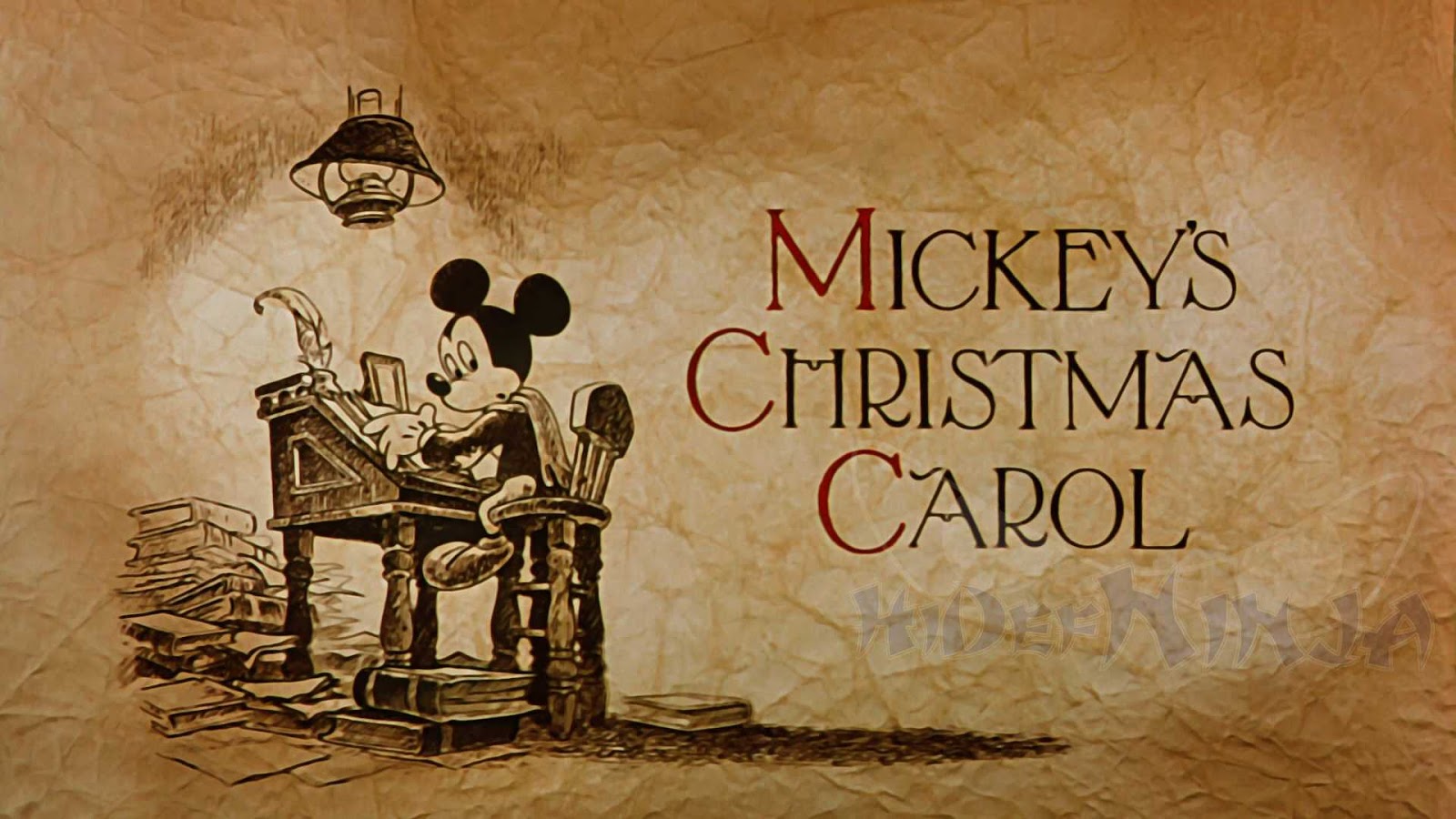
In my opinion, this film's greatest strength is in its visuals and art direction, which are very well done. Instead of the usual brightness you'd expect from Disney, it mainly has a rather dreary look to it, which is both a good visual motif and an emotional compliment to the cold setting and Scrooge's dark, bitter mood. I don't know if the snow was hand-animated or if it was an early computer effect, although I'd like to think it was the former because you know that a lot of hard work had to go into that. I like how the interiors of Scrooge's house in the scenes with Marley are drawn in a virtually sheer blue color, accentuating the cold and the creepy vibe it's meant to have. The section with the Ghost of Christmas Yet To Come in particular is really well-designed in how dark and downright creepy it looks, especially when Scrooge almost falls into his own grave, which is now a flaming pit, which brings to mind the dark Disney film, The Black Cauldron. The look of the distant shot of Cratchit and his family visiting Tiny Tim's grave, with the low lighting, the coldness of all the snow, and the pink, sunset sky in the background, fits the somber mood of that moment perfectly. The movie's design reminds me a lot of the look and feel that former Disney animator-turned-director Don Bluth always put into his films around this time, like The Secret of Nimh and The Land Before Time. Once Scrooge awakens on Christmas morning, the film becomes much brighter, reflecting how he's become brighter and jollier in his soul and life. And I also like the sepia tone artwork of the opening credits and the final image becoming that, reminding you (or, at least, it reminds me), of old storybooks you used to read when you were a little kid. Nothing more I can say other than it is a very well designed film overall.

The music by Irwin Kostal adds the final Christmas touch to the film. First off, you have that wonderful song, What a Merry Christmas Day, that opens and closes the film which, if that doesn't put you in the Christmas spirit, I don't know what will. Kostal's score also does well in ranging from the overall Christmas feel to the tone of Scrooge's miserly bitterness and the creepy factor of his hellish visions from the Ghost of Christmas Yet To Come to the happiness of his finally becoming a kind person by the end. The score is simple, granted, but it does its job and does it suitably. There's not much more I can say other than that.

I know it may have seemed that I'm overly praising Mickey's Christmas Carol but I really do think it's a nicely done, small piece of Disney's animation legacy. Since it came out in the early 80's when Disney was in huge financial straits due to under-performing animated features, I think it kind of gets lumped in as part of the studio's most uncreative period (you ever noticed that around that time, nearly all of Disney's stuff kind of had that dark, dreary look to them that I mentioned before, as if the animators themselves were depressed?), even though it did get nominated for an Academy Award. It's a shame that it's apparently thought of in such a dismissive way because it really doesn't deserve that, in my opinion. I think it truly has both the Disney heart and the Christmas spirit of its source material, so much so that, if you've never seen it or haven't seen it in a while, I'd say check it out with your loved ones this Christmas. It really is a heartwarming holiday special from the happiest place on Earth.

Friday, December 2, 2011

Video Game Corner: Jurassic: The Hunted (2009)

Jurassic: The Hunted? This was a title that pretty much begged my attention. I can't remember when I saw it for the first time, although it was probably in a Wal-Mart or Gamespot, but the minute I did, I knew I would probably enjoy it, being a fan of Jurassic Park, the Turok game, and any first-person shooters involving dinosaurs. Eventually, I got it one afternoon in July of 2011 when I was in a Gamespot and had some money to burn. It was just twenty bucks so I figured, "What the heck?" I got the version for the Nintendo Wii. Having not played it before, I wasn't sure what to expect. I wasn't looking for anything groundbreaking. I just wanted a fun shooter with dinosaurs, nothing special. It's a good thing I didn't have sights set too high because this game may be enjoyable but it's very run-of-the-mill and brings nothing new to the first-person shooter genre. Bottom line, it's a fun game but not original at all.

The story is as basic as you can get. You play former Navy Seal Craig Dylan, your typical wise-cracking, sarcastic, gruff-voiced action hero who's accompanying a war buddy of his on a mission to find a young lady scientist's father, who disappeared in the Bermuda Triangle. The opening animation shows the plan sucked into a time vortex, with the group being separated. You wind up in the age of dinosaurs, tasked with marching through the dinosaur-infested jungles to find your party, including the scientist you were originally sent to search for, and also find a machine that can transport you back to your own time. Even the plot of this game isn't noteworthy. Granted, I usually don't look for deep stories in games but they could have at least tried to do something different.

The gameplay is your typical first-person shooter: you walk around the jungle, following the path you must take (it's usually clear where you need to go), killing whatever dinosaurs and other nasty creatures that attack you until you advance to the next level. Simple. There are other situations that you run into along the way but most of the time, that's what the game consists of. It's fun for the first few levels but after a while, it kind of gets monotonous. You really wish the developers would have done anything to make this game somewhat unique after a while. The levels are well designed, with the lush jungle, the volcanic areas, and the caves but after a while, they all run together. The levels, which are actually just chapters in the story, all look the same and sometimes, it's hard to know exactly where the boundaries are. As I said, most of the time it's clear where you need to go but there are times, especially in the dense jungle, where you're not exactly sure where the path is. Except for the opening and closing animation scenes, the character animation in the cut-scenes are very poor, with exaggerated gestures and little to no facial movements. The voice acting could also be better. I liked the guy who voices your character, Dylan. He tries his best to be a funny, tough smart-ass and for the most part, he's quite enjoyable, if cliche. The other voice actors are very stale and typical but it's not like they had much to work with anyway.

The guns you come across in the game are what you expect in a game like this. You've got pistols, which are great for small enemies but don't do much damage to the larger one; machine pistols, which can fire a lot of bullets at a time and are useful; magnum pistols which do more damage than a standard pistol; shotguns, which do a lot of damage but the reload time on them is dreadful; a variety of assault rifles, the one you find in the later levels being the most useful to me; small versions of mini-guns which are useful but also have a bad reload time; and rocket launchers, which are great on gigantic dinosaurs but kill you instantly if you're too close. There are also grenades that you can throw and while they do a lot damage, I always find them clumsy to aim. As you may have noticed, there are a lot of bad reload times on many of these weapons. I don't know if I've ever mentioned this or not but I hate long reload times because that's usually what gets me killed in shooter games. The absolute worst weapon in the game in my opinion are these old fashioned musket rifles that you have to load with gunpowder. The reload time is particularly dreadful with them and you only get one shot each, which doubly sucks. Just avoid those guns. You're also not likely to run out of ammunition. Not is there spare ammunition all over the place but there are also these ammo boxes which completely restocks your ammunition (unfortunately, you actually have to reload the guns, another thing that often got me killed). You're also only allowed to carry four weapons at a time. You have to be careful which weapons you want to leave behind because when you pick a fifth weapon, you'll automatically drop whatever weapon you happen to be holding at the time. Believe me, if you don't know what you're doing, that can seal your doom.

Like the game version of Peter Jackson's King Kong, you don't have a lifebar in this game. Instead, you're told how damaged you are by the darker the screen gets the more you're damaged and you slowly heal after you've killed your enemies. It's inconvenient, sure, but I think it's better than the red, slow-motion that happens to you in the King Kong game. There is, however, a mode like that in this game called adrenaline mode which you can activate yourself by pressing a button on the controller. Everything goes into slow motion and you can see the attacking dinosaurs' weak points so you know where to shoot. Unfortunately, your movements are also in slow motion but you can turn the mode off by pressing the button again (it doesn't last long anyway). Sometimes this works and sometimes it doesn't. Granted, I could just be a poor shot but there were times where I swear I was aiming at one of the weak points and I still didn't score a killing shot. There also instances where a dinosaur will jump on you and Dylan grabs hold of its jaws. You're then signaled to repeatedly tap a certain button (it's random each time) in order to punch the dinosaur away. This happens to you at the very beginning of the game and the first time, it surprised and I didn't know what I was supposed to do, which ended up with me being killed. I couldn't believe that I'd only been playing the game for about five minutes and had already gotten killed! It was very demoralizing.

When you encounter the enemy dinosaurs in the game, that's when you can tell that they took a lot of inspiration from Jurassic Park because 90% of the dinosaurs you face are of the raptor family. There are several types of raptors. There's the actual small type of Velociraptor, which are the very first enemies you come across and later on, you usually encounter them in caves. They attack in large packs and while they're little more than a nuisance individually, they can kill you in large numbers, especially if they get you cornered. There are two types of raptors that are your size: red and green. The red raptors take only a couple of shots to kill but can be dangerous, again, if you get cornered. The green raptors, however, are bigger threats because they can take a lot of punishment. It's best to use your highest damaging weapons on these guys, especially if you're faced with more than one. The worst type of raptors are big gray ones called Utahraptors (this is a real species of dinosaur, by the way). These guys take a LOT of shots to put down, they're quick, and while their individual attacks don't do much damage, they can easily massacre you if you don't put them down quickly. The best advice when facing them is just shoot like crazy and hope you kill them before you run out of ammo. Thankfully, you don't run into them that often.

There are other types of dinosaurs that you run into. Taking another cue from Jurassic Park, you sometimes encounter the venom-spitting Dilophosaurus. These guys tend to attack you from a distance, shooting their poison at you. If you get close, they will charge. Best advice is to use one of your long-range weapons to pick them off from a safe distance. They can be difficult to spot because they tend to blend in with their surroundings (as do most of the dinosaurs, for that matter). You often see pterodactyls throughout the game. Most of the time, they don't pose a threat but there are moments where they will swoop down at you to ram you (this happens during a section where you're crossing some high rope-bridges and also during a turret gun section involving a couple of Tyrannosaurs). If it looks like one's going to hit you, shoot it down. They only take a couple of shots at most to put down. Also, taking inspiration from the King Kong game, there are giant scorpions that you run into, mostly in cave levels. You don't have anything to worry about with them, though. They're not hard to kill and usually charge at you in straight lines, even when there's many of them, so you can pick them off easily. You also see some Brachiosaurs but you never have to deal with them. As you can tell, the variety of enemy dinosaurs in this game is also a bit bland. I wish they would have put more stuff like a Triceratops, some plesiosaurs, or giant prehistoric crocodiles or snakes just to change it up.

As I said, there are some different types of gameplay throughout the game. The first type you come across is a turret mode, where you have to use a big turret gun to fend off a swarm of dinosaurs, possibly inspired by the climactic scene of the 2008 Rambo. These are fairly easy. All you have to do is just blast away at the attacking dinosaurs, utterly massacring them before they can get anywhere close to you. Sometimes, there are explosive barrels nearby that you can shoot to blow large numbers of dinosaurs up. Every once in a while, one will get up to you or you'll have to reload but I doubt you'll get killed in these sections. Ones that are trickier are the balancing sections, where you have to cross over a tree or other such object to get on the other side of a large chasm. I died the very first time I had to do one of those. I wasn't sure what to do at first (again, this is the Wii version; I don't know what it's like on the other platforms) but then I realized that you had to keep the Wii-mote balanced while using the numb-chuck stick to move forward. I thought you were moving forward automatically and I also wasn't sure exactly how to position the Wii-mote. Eventually, I got the hang of it and was able to accomplish these sections with little effort. Finally, there's fort defense sections, where you come across a small fort made up of sticks and you have to survive an onslaught of raptors. Usually, there's an ammo box in the middle of the fort so ammo isn't an issue. You have the option to fix windows that the raptors destroy in order to get in but often, another gets through and attacks me from behind while I'm trying to do so. Honestly, just stay by the ammo box and pick off whatever raptors get through. It's the least complicated way to succeed in these challenges. There are some, though, where you have to be a little more creative and actually fix the windows. I've died a couple of times during these but on the whole, they're not too difficult.

There are two big bosses in the game. One is simple. You fight off a couple of Tyrannosaurs with one of the gun turrets. You face each T-Rex one at time and in-between fighting them, you have to hold off a swarm of Pterodactyls. Easy as you can get. I really wish the one challenge in the game involving the T-Rex would have been longer and more challenging. The other boss is far more challenging and you face him twice. It's a big Spinosaurus called Spike. The first battle with him occurs in an open field where you have to run around, reloading your ammo and grabbing other weapons while constantly shooting Spike. This battle is really annoying because it feels like you can't get away from Spike no matter how badly you damage him and sometimes when you're about to get to an ammo box, he knocks you away from it. You also can't run very fast so he's constantly on your tail. DON'T let him corner you because he'll make short work of you. There are also moments where he'll grab you with his mouth and try to carry you off. What you have to do is shoot the wound on his underside that you can see while you're hanging upside down. If you don't deplete the health meter you see in this section, you're dead. That weak spot is also where you need to shoot during the actual battle anyway. Not only does it deal more damage but if you shoot it enough, Spike will recoil in pain and stand still for a few moments, long enough for you to catch your breath or restock on ammo. You don't actually kill Spike, you just fend him off until his health gets very low, activating the beginning of the next level.

The other battle with Spike is your last confrontation in the game and here is where it can be difficult. Spike is trying to smash through the barricade to the camp and you have to hold him off until the scientists can repair the time travel device. Around the base of the barricade are rocket launcher ammo and the most damaging type of assault rifle. Get those first and then climb up to the top of the barricade to attack Spike. Basically, just unload your weapons on his weak spot by peaking across the top of the barricade. Be careful, though, because he'll often stick his head through to get you. Also, when using the rocket launcher, make sure you've got him lined up (the part of his body doesn't matter) because my rockets tended to go right past him or right over his back, wasting one. He also eventually damages the first area that you use to shoot at him so be prepared to change sides after a point. I did fail quite a few times, I'm going to lie, but it's another one of those things where if you keep at it, you'll triumph.

That's basically all there is to say about Jurassic: The Hunted. I'm not going to go into the levels like I usually do with video games because the levels here all run together and aren't that distinct, just every once in a while involving the different types of gameplay I've described. All in all, it's an enjoyable game, if unoriginal. They left it open for a sequel at the end but I doubt if they'll make one since I think this game went unnoticed in the market due to its unoriginality. I have read that the harder difficulty mode has more stuff to it, such as better weapons, reloading is replaced with potentially overheating your weapons, and so on, which makes the harder enemies easy to take down. I haven't played the harder mode yet and I may some day. For now, that's all I have to say on this game. If it sounds like fun to you, then go get it. Just don't expect anything groundbreaking with it.